
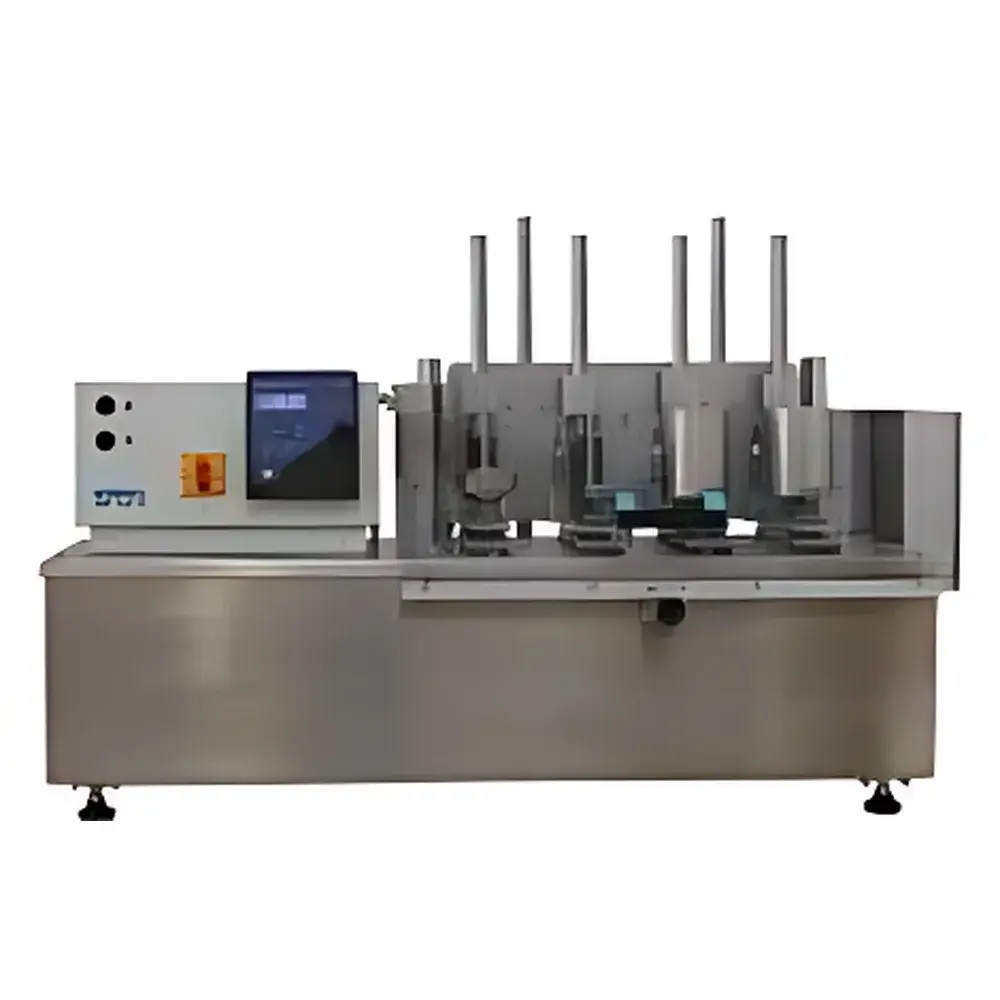
Kegel HDT Vicat 4U Heat Deflection Temperature and Vicat Softening Point Tester
| Brand | Kegel |
|---|---|
| Origin | Germany |
| Model | HDT Vicat 4U |
| Temperature Range | 5°C above ambient to 285°C |
| Temperature Stability | ±0.2°C to ±0.3°C (100–250°C) |
| Heating Rates | 50°C/h ±5°C/h and 120°C/h ±10°C/h |
| Temperature Sensor | Calibrated Pt100 per test station |
| Displacement Resolution | 0.01 mm (LVDT) |
| Test Stations | Up to 4 |
| Cooling Method | Water-cooled |
| Power Supply | 230 V, 50 Hz, ~3 kW |
| Dimensions (W×H×D) | 1020 × 690 × 520 mm |
| Weight | ~75 kg |
| Software | k-BASE for Windows |
| Compliance | ISO 75-1/2, ISO 306, ASTM D648, D1525, E77, E608, E644, E1137, DIN 43760, 53460, 53461/87, UNI 5641, 5462, BSI 2782, AFNOR NT T51-005/T51.021, UNE 53075/53118 |
Overview
The Kegel HDT Vicat 4U is a semi-automated, microprocessor-controlled thermal analysis instrument engineered for precise determination of the Heat Deflection Temperature (HDT) and Vicat Softening Point (VSP) of thermoplastic polymers, thermosets, and composite materials. It operates on standardized thermal-mechanical deformation principles: for HDT testing, a specified load is applied to a rectangular test specimen immersed in a heated silicone oil bath, and the temperature at which the specimen deflects by 0.34 mm is recorded; for Vicat testing, a needle with defined cross-sectional area penetrates the sample under constant load as temperature rises, and the temperature at which penetration reaches 1 mm is reported as the Vicat softening point. The system’s architecture integrates real-time thermal compensation based on sample-specific thermal diffusivity, ensuring measurement fidelity across diverse polymer morphologies and thicknesses. Designed for laboratory environments requiring regulatory traceability and inter-laboratory reproducibility, the instrument meets the physical and procedural requirements of major international standards without modification.
Key Features
- Four independent, parallel test stations—enabling simultaneous HDT or Vicat measurements on up to four specimens, significantly improving throughput in quality control and R&D workflows.
- Individual Pt100 temperature sensors calibrated per station, providing traceable, high-accuracy thermal monitoring directly at the specimen interface—not at the bath bulk.
- High-resolution LVDT displacement transducers (0.01 mm resolution) mounted directly on each loading rod, eliminating mechanical hysteresis and thermal drift artifacts common in lever-arm systems.
- PID-based microprocessor temperature control with dynamic thermal compensation algorithms that adjust heating profiles in real time based on measured thermal lag of each specimen geometry.
- Integrated water-cooling circuit enabling rapid thermal recovery—from 230°C to 40°C in approximately 40 minutes—minimizing downtime between test cycles.
- Optional specimen lift mechanism for automated post-test handling, reducing operator intervention and enhancing repeatability in high-volume testing scenarios.
- USB interface compliant with USB 2.0 specifications for direct connection to Windows-based host PCs; no proprietary interface cards or drivers required.
Sample Compatibility & Compliance
The HDT Vicat 4U accommodates standard test specimens conforming to ISO 75 and ASTM D648 geometries—including 80 × 10 × 4 mm (HDT) and 10 × 10 × 3–4 mm (Vicat) bars—as well as thicker or reinforced composites when used with appropriate support fixtures. Silicone oil baths are selected based on required upper temperature limits (e.g., high-stability methylphenyl silicone oils for operation up to 285°C). The instrument complies fully with ISO 75-1:2013, ISO 75-2:2013, ISO 306:2013, ASTM D648-22, ASTM D1525-21, and additional national standards including DIN 53460, UNI 5462, and AFNOR NT T51.021. All temperature and displacement subsystems are factory-calibrated with NIST-traceable references, and calibration certificates are provided. For GLP/GMP-regulated environments, k-BASE software supports audit trail logging, user access levels, and electronic signature functionality aligned with FDA 21 CFR Part 11 requirements.
Software & Data Management
Control, data acquisition, and reporting are managed exclusively through k-BASE—a dedicated Windows application developed by Kegel for thermal mechanical testing. k-BASE provides real-time graphical visualization of temperature vs. time and displacement vs. time curves for all active stations. Users define test protocols—including load selection (e.g., 10 N or 50 N for Vicat, 0.455 MPa or 1.82 MPa for HDT), heating rate (50 or 120 °C/h), and pass/fail criteria—via intuitive parameter templates. Raw data (timestamped temperature, displacement, and load values at 1 Hz sampling) are stored in encrypted binary format with metadata embedding (operator ID, sample ID, standard reference, calibration status). Export options include CSV, PDF reports with embedded graphs, and XML for LIMS integration. The software maintains full revision history, automatic backup scheduling, and configurable report headers compliant with ISO/IEC 17025 documentation requirements.
Applications
This instrument serves critical functions across polymer formulation development, incoming raw material verification, production lot release, and failure analysis. In R&D labs, it supports comparative studies of heat resistance across copolymer ratios, plasticizer content, or flame-retardant additives. In manufacturing QA/QC, it verifies conformance of injection-molded components—such as automotive interior trim, electrical enclosures, or medical device housings—to contractual thermal performance thresholds. Regulatory submissions for ISO 10993 biocompatibility or UL recognition often require documented HDT/VSP data; the Kegel HDT Vicat 4U delivers metrologically sound results accepted by notified bodies. Its robust design and stable thermal field also make it suitable for long-term stability studies under elevated temperature exposure protocols.
FAQ
What standards does the HDT Vicat 4U natively support?
It is configured and validated for ISO 75-1/2, ISO 306, ASTM D648, D1525, E77, E608, E644, E1137, DIN 43760, DIN 53460/53461, UNI 5641/5462, BSI 2782, AFNOR NT T51-005/T51.021, and UNE 53075/53118.
Is the instrument suitable for GLP-compliant laboratories?
Yes—when used with k-BASE software configured for audit trail, electronic signatures, and role-based access control, it satisfies core elements of GLP and FDA 21 CFR Part 11 for electronic records.
Can test parameters be modified after a run has started?
No—once initiated, heating rate, load, and endpoint criteria are locked to ensure result integrity; protocol changes require stopping and reinitializing the test.
What maintenance is required for long-term accuracy?
Annual recalibration of Pt100 sensors and LVDT transducers is recommended; silicone oil should be replaced every 12–18 months depending on usage frequency and maximum operating temperature.
Is inert gas purging necessary for all tests?
While optional, nitrogen or argon purging is strongly advised for tests above 200°C to prevent oxidative degradation of sensitive thermoplastics and ensure measurement repeatability.





