
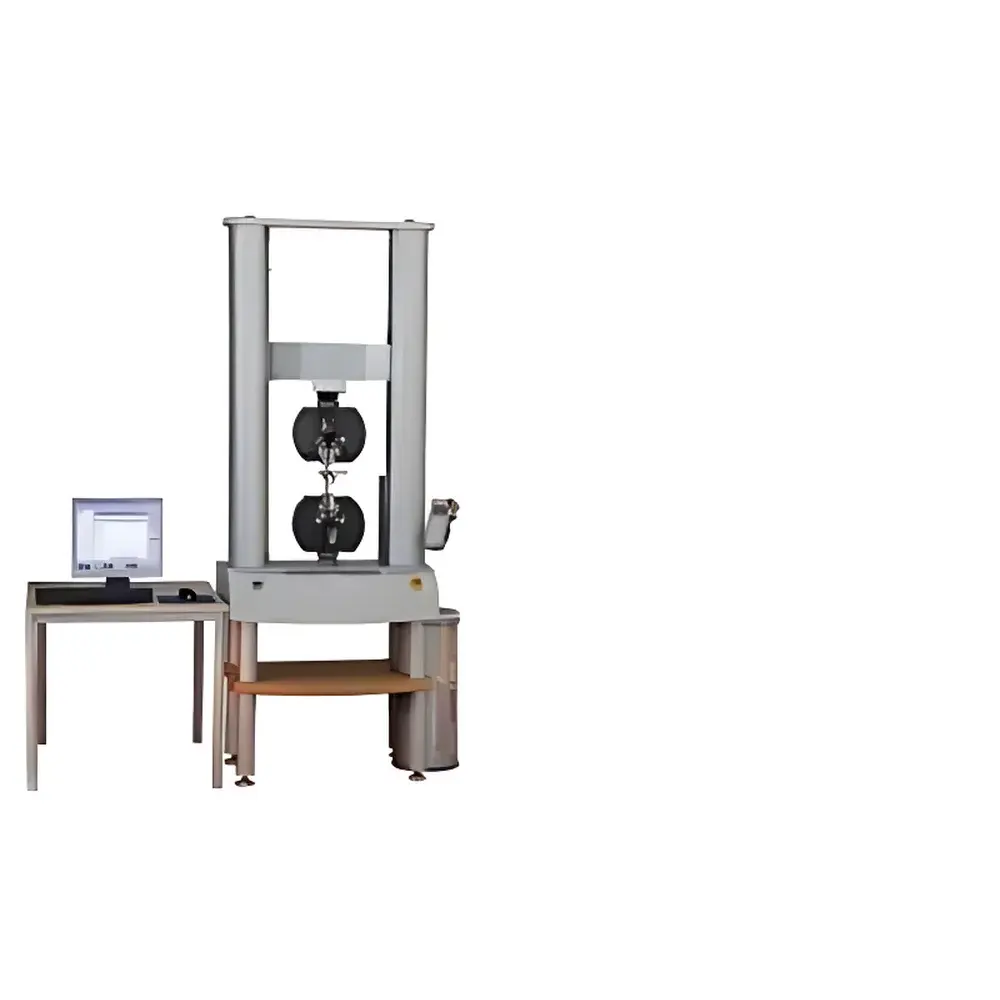
Kegge proTens Advanced Universal Testing Machine
| Brand | Kegge |
|---|---|
| Origin | Germany |
| Model | proTens |
| Maximum Load Capacity | 250 kN |
| Drive System | Dual-arm screw-driven with solid-state servo and electric control |
| Load Resolution | 120,000 counts |
| Load Accuracy | Class 1 per DIN EN ISO 7500 (0.4–100% of full scale) |
| Test Speed Range | 0.01–2000 mm/min |
| Motor Power Options | 300 W or 900 W |
| Software Interface | Human-centered, compliant with GLP/GMP data integrity requirements |
| Safety Features | Adjustable overload shutdown, quick-release sensor & grip system, precision crosshead guidance |
| Sample Compatibility | Metals, plastics, elastomers, foams, paper, wood, textiles, wires, and finished components |
| Test Modes | Tension, compression, bending, shear, peel |
Overview
The Kegge proTens Advanced Universal Testing Machine is a high-precision electromechanical testing system engineered for static mechanical characterization of materials and components under controlled uniaxial loading conditions. Based on the fundamental principles of Hooke’s law and stress–strain continuum mechanics, the proTens employs dual-arm screw-driven actuation coupled with solid-state servo control to deliver repeatable force application and displacement tracking across its full 250 kN load range. Its microprocessor-based architecture integrates real-time load cell signal conditioning with 120,000-count resolution analog-to-digital conversion—enabling traceable, high-fidelity data acquisition in accordance with ISO/IEC 17025 laboratory accreditation requirements. Designed for operational robustness in industrial QA/QC environments and research-grade reproducibility in R&D laboratories, the proTens meets the mechanical and metrological demands of standardized test methods including ASTM E8/E9/E21, ISO 6892-1, ISO 178, ISO 14129, and EN 10002-1.
Key Features
- Dual-arm precision screw drive system with preloaded ball screws and integrated backlash compensation for zero-hysteresis motion control
- Modular motor configuration: selectable 300 W (standard) or 900 W (high-torque) brushless servo motors enabling both high-speed positioning and low-velocity creep testing
- Crosshead guidance with hardened linear rails and self-aligning bearing supports ensures axial alignment within ±0.02 mm over full stroke
- Quick-release load train interface allows tool-free sensor and grip exchange—reducing setup time by up to 65% compared to conventional bolted configurations
- Programmable overload cutoff with adjustable threshold and deceleration ramp prevents specimen overloading and preserves calibration integrity
- Class 1 load measurement accuracy (DIN EN ISO 7500-1) verified across 0.4–100% of full scale; optional Class 0.5 upgrade available for critical regulatory applications
Sample Compatibility & Compliance
The proTens accommodates a broad spectrum of specimen geometries and material classes—including metallic alloys (e.g., aluminum 6061-T6, stainless steel 316), thermoplastics (PP, ABS, PC), elastomeric compounds (NR, SBR, silicone), cellular foams (PU, PE), fiber-reinforced composites, paperboard stacks, timber specimens (ASTM D143), textile laminates (ISO 13934-1), and wire harness assemblies. All mechanical interfaces comply with ISO 26203-2 for extensometer mounting and ASTM E4 for verification of force-measuring systems. The machine’s structural frame and safety enclosure meet CE Machinery Directive 2006/42/EC requirements, and its electrical subsystems conform to IEC 61000-6-2/6-4 immunity and emission standards.
Software & Data Management
The proTens operates with Kegge TestSuite™ v5.x—a validated Windows-based software platform supporting 21 CFR Part 11-compliant user access control, electronic signatures, and full audit trail logging. Test method templates are preconfigured for ISO 527, ASTM D638, ISO 178, and EN ISO 1133, with customizable parameter scripting for non-standard protocols. Raw data export includes ASCII (.txt), CSV, and XML formats; all measurement metadata (time stamps, environmental conditions, operator ID, calibration certificates) is embedded in binary .kts files. Data integrity safeguards include write-once storage mode, checksum validation, and automatic backup to network-attached storage (NAS) via configurable SMB protocol.
Applications
The proTens serves as a primary mechanical testing platform in accredited quality assurance labs performing incoming raw material verification (e.g., tensile yield strength of extruded profiles), production line in-process checks (e.g., peel adhesion of laminated packaging films), and advanced materials development (e.g., cyclic fatigue behavior of biomedical polymers). It is routinely deployed in automotive Tier-1 supplier labs for bracket deformation analysis (ISO 12109), aerospace composites qualification (SAE AMS 2750E), medical device component validation (ISO 14243-1), and packaging performance certification (ISTA 3A). Its wide speed range (0.01–2000 mm/min) supports both quasi-static modulus determination and high-rate impact simulation using programmable ramp-and-hold profiles.
FAQ
What standards does the proTens comply with for load cell calibration?
The proTens conforms to DIN EN ISO 7500-1 Class 1 accuracy requirements across 0.4–100% of full scale; optional Class 0.5 calibration is available with NIST-traceable certificate.
Can the system be integrated into an existing LIMS or MES environment?
Yes—via OPC UA server interface or RESTful API, enabling bidirectional data exchange with LabVantage, Thermo Fisher SampleManager, and Siemens Opcenter Execution.
Is third-party extensometer support available?
The proTens features ISO 26203-2-compliant mounting interfaces and supports digital LVDT, video, and laser extensometers from ZwickRoell, MTS, and Instron.
What maintenance intervals are recommended for long-term metrological stability?
Annual verification per ISO/IEC 17025 Annex A.3 is advised; biannual lubrication of screw drives and quarterly load cell zero-checks are included in the preventive maintenance schedule.
Does the system support multi-step test sequences with conditional branching?
Yes—TestSuite™ supports nested loops, pass/fail decision logic, and dynamic parameter adjustment based on real-time strain or load thresholds.



