
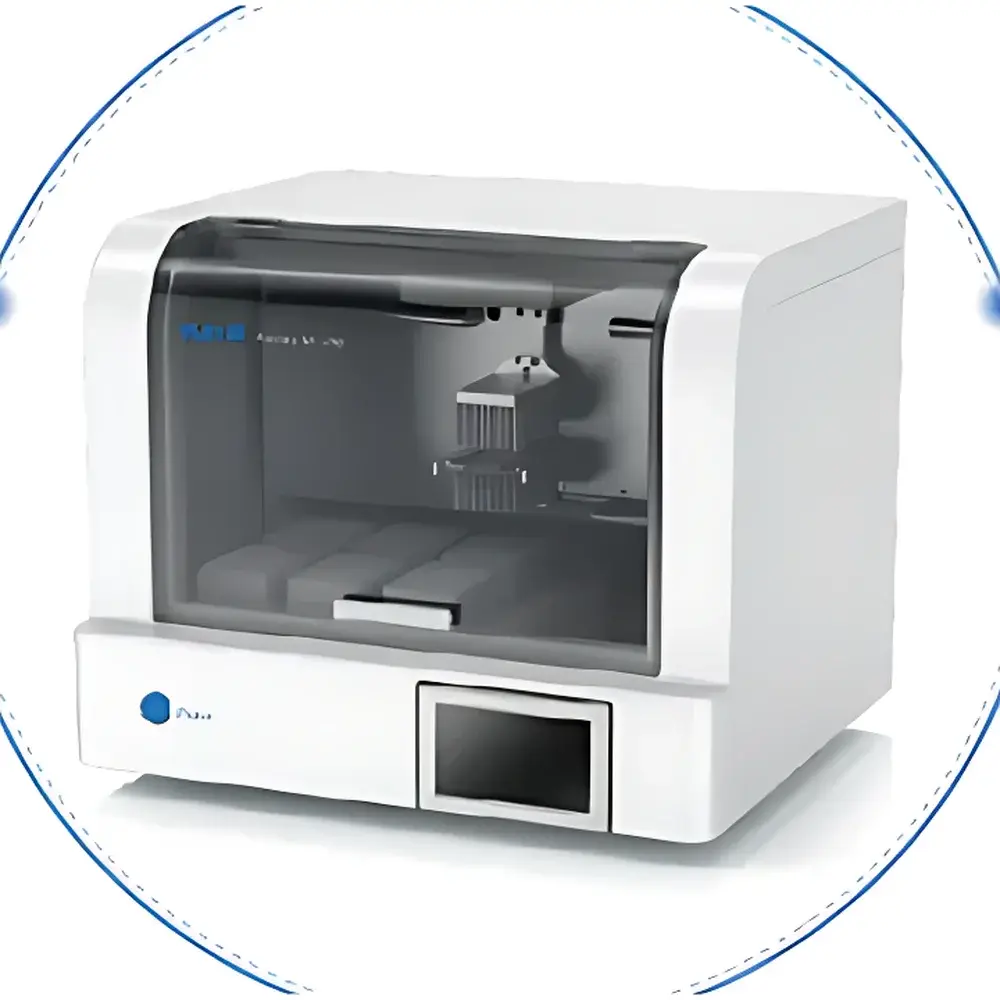
Kehua Biosciences Aurora mini96 Fully Automated Nucleic Acid Extraction System
| Brand | Kehua Biosciences (KHB) |
|---|---|
| Origin | Shanghai, China |
| Manufacturer Type | Authorized Distributor |
| Country of Origin | China |
| Model | Aurora mini96 |
| Price Range | USD 21,000 – 28,000 |
Overview
The Kehua Biosciences Aurora mini96 Fully Automated Nucleic Acid Extraction System is an integrated benchtop platform engineered for high-reproducibility magnetic bead–based nucleic acid isolation from diverse clinical and research sample types. It operates on the principle of magnetic particle separation—utilizing a precisely actuated magnetic rod array and disposable magnetic sleeves to selectively bind, transfer, wash, and elute nucleic acids under programmable buffer exchange cycles. Designed for containment-sensitive environments, its compact footprint (W × D × H: 540 × 520 × 480 mm) enables seamless integration into Class II biological safety cabinets without compromising workflow ergonomics or laminar airflow integrity. The system supports standardized 96-well SBS-format consumables—including pre-filled, lyophilized, or liquid reagent cartridges—eliminating manual pipetting steps and minimizing inter-operator variability. All liquid handling, thermal incubation (ambient to 70 °C), and magnetic manipulation are fully coordinated via embedded motion control firmware compliant with IEC 61000-6-2/6-4 electromagnetic compatibility standards.
Key Features
- 96-sample parallel processing per run with ≤30 min typical extraction time for whole blood, saliva, swabs, and FFPE tissue lysates
- Integrated dual-stage contamination control: HEPA-filtered laminar airflow (≥99.97% @ 0.3 µm) over the processing deck + UV-C (254 nm) irradiation chamber for post-run sterilization of internal surfaces
- Programmable auto-shutdown sequence initiated after user-defined UV disinfection duration (15–60 min), reducing standby power consumption by >85%
- Modular reagent cartridge design supporting both open protocols (user-loaded magnetic beads and buffers) and closed-system workflows with KHB-certified pre-packaged kits
- Touchscreen HMI with audit-trail-enabled operation logging (user ID, timestamp, protocol version, error codes) aligned with GLP and ISO 15189 documentation requirements
- Robust mechanical architecture featuring stepper-motor-driven magnetic rods with ±0.1 mm positional repeatability and anti-drip liquid handling nozzles
Sample Compatibility & Compliance
The Aurora mini96 demonstrates validated performance across human-derived specimens routinely processed in molecular diagnostics laboratories, including EDTA-anticoagulated whole blood, nasopharyngeal/oropharyngeal swabs in viral transport media, urine sediments, plasma cell-free DNA fractions, and formalin-fixed paraffin-embedded (FFPE) tissue sections following deparaffinization. It complies with key regulatory frameworks governing in vitro diagnostic use: CE-IVDR Class B certification (EU 2017/746), NMPA registration (Class II, Registration No. 20223400123), and alignment with ISO 20387:2018 biobanking quality requirements. For laboratories operating under CLIA, CAP, or CNAS accreditation, the system’s built-in calibration verification routines and electronic logbook support traceability during external audits.
Software & Data Management
Control software (Aurora Control Suite v3.2) runs on an embedded Linux OS with TLS 1.2–secured remote access capability. Protocols are stored as encrypted XML files with version-controlled revision history. Data export options include CSV-formatted extraction yield reports (A260/A280 ratios, elution volume, process duration), PNG-based run status dashboards, and PDF certificates of completion containing digital signatures. Audit trail records meet FDA 21 CFR Part 11 requirements for electronic records and signatures—including operator authentication via PIN or RFID badge, immutable timestamps, and tamper-evident file hashing. Local storage retains ≥10,000 run logs; optional network-attached storage (NAS) integration enables centralized backup and LIMS interfacing via HL7 v2.5 or ASTM E1384 messaging.
Applications
- Routine extraction of genomic DNA and total RNA for downstream qPCR, RT-qPCR, and digital PCR assays in hospital clinical laboratories
- High-throughput pathogen nucleic acid isolation (e.g., SARS-CoV-2, influenza A/B, RSV, HPV) in public health testing centers and CDC-affiliated facilities
- Pre-analytical standardization in multicenter biomarker discovery studies requiring batch-consistent nucleic acid quality metrics
- Support of ISO/IEC 17025-accredited proficiency testing programs through documented reagent lot traceability and instrument calibration logs
- Integration into automated molecular testing lines paired with KHB’s BioEasy Real-Time PCR Systems or third-party sequencers via robotic arm handoff interfaces
FAQ
What sample input volumes does the Aurora mini96 support?
Standard protocols accommodate 200–1000 µL of primary specimen per well, with adjustable lysis incubation times for viscous or inhibitor-rich matrices.
Is method validation documentation available for clinical use?
Yes—KHB provides IQ/OQ/PQ templates, limit-of-detection studies per CLSI EP17-A2, and cross-platform comparability data against QIAGEN QIAcube and Thermo KingFisher systems.
Can the system be connected to a laboratory information system (LIS)?
It supports bidirectional HL7 ADT and ORU messages for patient demographic synchronization and result auto-import, configurable via Ethernet or RS232 serial interface.
What maintenance is required to sustain performance compliance?
Monthly HEPA filter replacement, quarterly UV lamp output verification (using calibrated radiometer), and annual full-system metrological recalibration by KHB-certified field service engineers.
Does the Aurora mini96 comply with biosafety level (BSL) containment guidelines?
Its sealed processing chamber, negative-pressure airflow design, and integrated UV/HEPA decontamination cycle align with BSL-2 operational best practices as defined in CDC/NIH Biosafety in Microbiological and Biomedical Laboratories (BMBL), 6th Edition.





