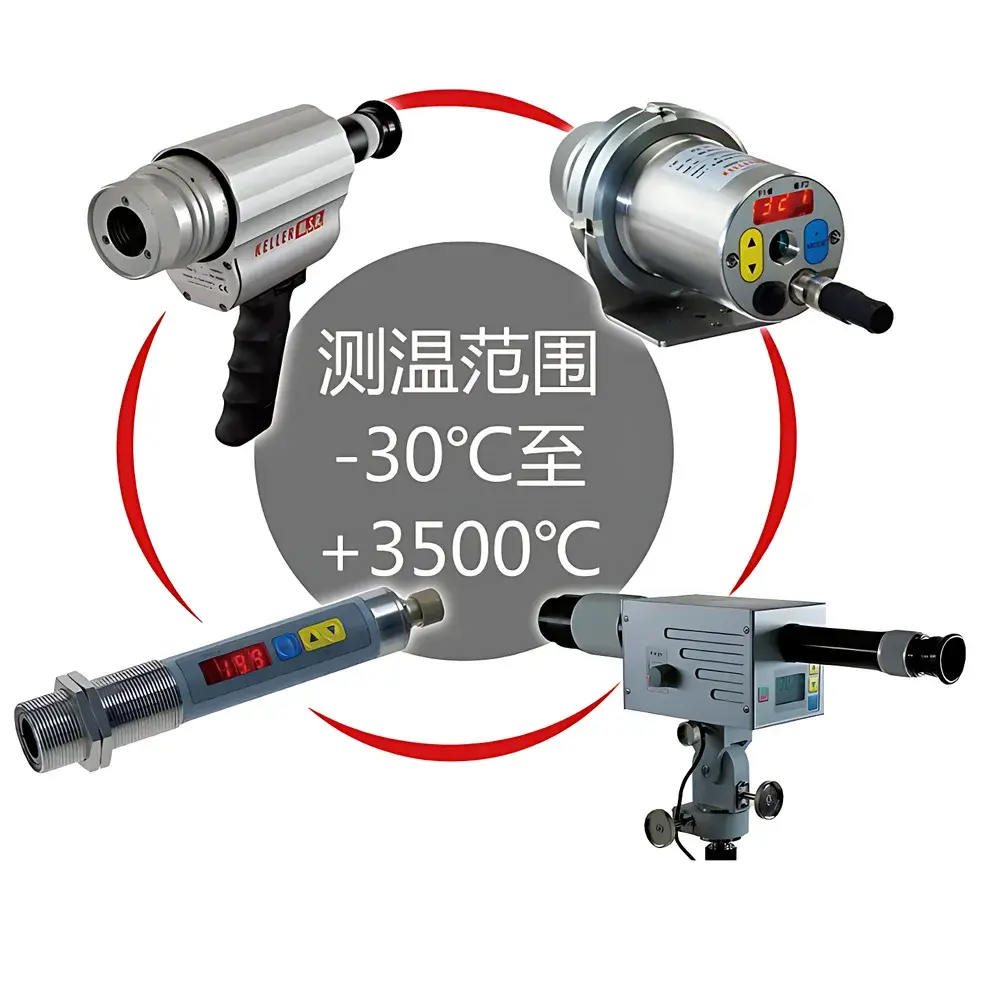
KELLER HCW Series Portable & Online Infrared Thermometers
| Brand | KELLER |
|---|---|
| Origin | Germany |
| Model | HCW Series |
| Measurement Principle | Two-Color (Ratio) and Single-Wavelength Pyrometry |
| Temperature Range | –30 °C to 3500 °C (model-dependent, segmented calibration) |
| Optical Resolution (Distance-to-Spot Ratio) | Up to 300:1 |
| Spectral Response | 0.8–1.1 µm (short-wave), 1.6 µm, 2.2 µm, or 8–14 µm (depending on model) |
| Output Signals | 4–20 mA, 0–10 V, thermocouple emulation, RS232/RS422/RS485 |
| Environmental Rating | IP65 (standard), optional IP67/IP69K housings |
| Housing Material | Anodized aluminum or AISI 316 stainless steel |
| Compliance | CE, RoHS, EMC Directive 2014/30/EU, IEC 61326-1 (industrial environments) |
Overview
The KELLER HCW Series infrared thermometers are precision-engineered non-contact temperature measurement instruments developed and manufactured in Germany. Leveraging decades of pyrometric expertise, the HCW platform implements both single-wavelength (monochromatic) and two-color (ratio) detection principles—enabling robust thermal monitoring across diverse industrial processes where emissivity variation, partial obscuration (e.g., steam, dust, or smoke), or target motion preclude reliable single-band measurements. These devices operate across a broad spectral range—including short-wave (0.8–1.1 µm), medium-wave (1.6 µm, 2.2 µm), and long-wave (8–14 µm) bands—selected per application to optimize signal-to-noise ratio, minimize atmospheric absorption, and mitigate interference from ambient radiation. Designed for continuous duty in demanding environments—from metallurgical furnaces and cement kilns to semiconductor crystal growth chambers—the HCW series delivers traceable accuracy, high repeatability (< ±0.5% of reading + 1 °C typical), and long-term stability under thermal cycling and mechanical stress.
Key Features
- Non-contact measurement ideal for live electrical components, rotating machinery, corrosive surfaces, or hazardous zones where physical probe access is impractical or unsafe
- Wide operational temperature span: –30 °C to 3500 °C, achieved through model-specific optical and detector configurations with NIST-traceable calibration certificates available
- Flexible deployment options: handheld (PT series), fixed-mount online units (PA, PX, PR, PK, PKF, PKL), and optical高温计 (PV11) for visual alignment and high-temperature reference applications
- High-speed response time: <10 ms typical, enabling real-time process feedback control in fast-moving production lines (e.g., hot-rolling mills, glass tempering)
- Dual-mode capability: Selectable single-color or two-color operation—critical for measuring low-emissivity metals (e.g., molten aluminum, copper), oxidized surfaces, or targets partially obscured by furnace viewports
- Industrial-grade mechanical construction: Sealed anodized aluminum or corrosion-resistant stainless steel housings rated IP65 as standard; optional water-cooled jackets, air-purge collars, and blast shields for extreme ambient conditions (up to 200 °C ambient without cooling)
- Multi-protocol digital interfaces: RS232, RS422, RS485 Modbus RTU support; analog outputs (4–20 mA, 0–10 V) configurable for loop-powered integration with PLCs, DCS, and SCADA systems
Sample Compatibility & Compliance
The HCW series accommodates a wide range of target materials and geometries—including bare and oxidized metals, ceramics, graphite, molten glass, refractory linings, and composite materials—without requiring surface preparation or emissivity correction in two-color mode. Units comply with EU directives for electromagnetic compatibility (2014/30/EU) and low-voltage safety (2014/35/EU), and meet IEC 61326-1 requirements for industrial measurement equipment. Optional factory calibration includes ISO/IEC 17025-accredited reports traceable to PTB (Physikalisch-Technische Bundesanstalt). For regulated industries, models support configurable audit trails and user-access levels compatible with GLP/GMP documentation workflows.
Software & Data Management
KELLER’s CellaView visualization and configuration software provides intuitive setup, real-time thermal trend analysis, alarm threshold definition, and data logging (CSV export). The software supports firmware updates, spectral response curve adjustment, and emissivity mapping for multi-zone applications. All communication protocols implement error-checking and timeout recovery to ensure data integrity in noisy plant-floor networks. For enterprise integration, OPC UA server modules are available upon request—enabling seamless connectivity with MES and historian platforms while maintaining full compliance with FDA 21 CFR Part 11 electronic record requirements when deployed with appropriate validation packages.
Applications
- Metal processing: Continuous casting, rolling mill exit temperature monitoring, annealing/tempering furnace profiling, induction heating control
- Energy & power generation: Boiler tube surface temperature, turbine blade monitoring, combustion chamber flame front analysis
- Building materials: Asphalt mixing plant control, concrete curing temperature verification, tunnel kiln profile mapping
- Electronics manufacturing: Solder reflow profiling, wafer temperature uniformity during epitaxial growth, LED substrate thermal management
- Automotive: Brake disc thermal fatigue assessment, exhaust manifold temperature validation, battery cell surface monitoring during formation cycling
- Food & pharma: Sterilization tunnel validation, oven belt temperature uniformity, freeze-dryer shelf surface mapping
FAQ
What is the difference between single-color and two-color infrared thermometry?
Single-color pyrometers measure radiance at one wavelength and require accurate emissivity input; two-color devices compute the ratio of radiance at two wavelengths, reducing sensitivity to emissivity changes, partial occlusion, and viewing path obstructions.
Can HCW thermometers be used through quartz or sapphire windows?
Yes—provided the window material transmits within the instrument’s configured spectral band and is kept clean and thermally stable; transmission loss corrections can be applied via software calibration offset.
Is air purge required for installation in dusty environments?
Air purge is recommended for fixed installations in high-dust or high-humidity areas to prevent lens contamination; KELLER offers integrated purge collars with flow monitoring for critical applications.
Do HCW models support custom analog output scaling?
Yes—users may configure linear or segmented analog output ranges (e.g., 4–20 mA = 500–1800 °C) via CellaView or front-panel keypad, with zero/span adjustment and fault-signal options (e.g., 3.6 mA = sensor fault).
Are NIST-traceable calibration certificates included with shipment?
Standard units ship with factory calibration certificates; ISO/IEC 17025-accredited certificates with uncertainty budgets are available as optional add-ons at time of order.