
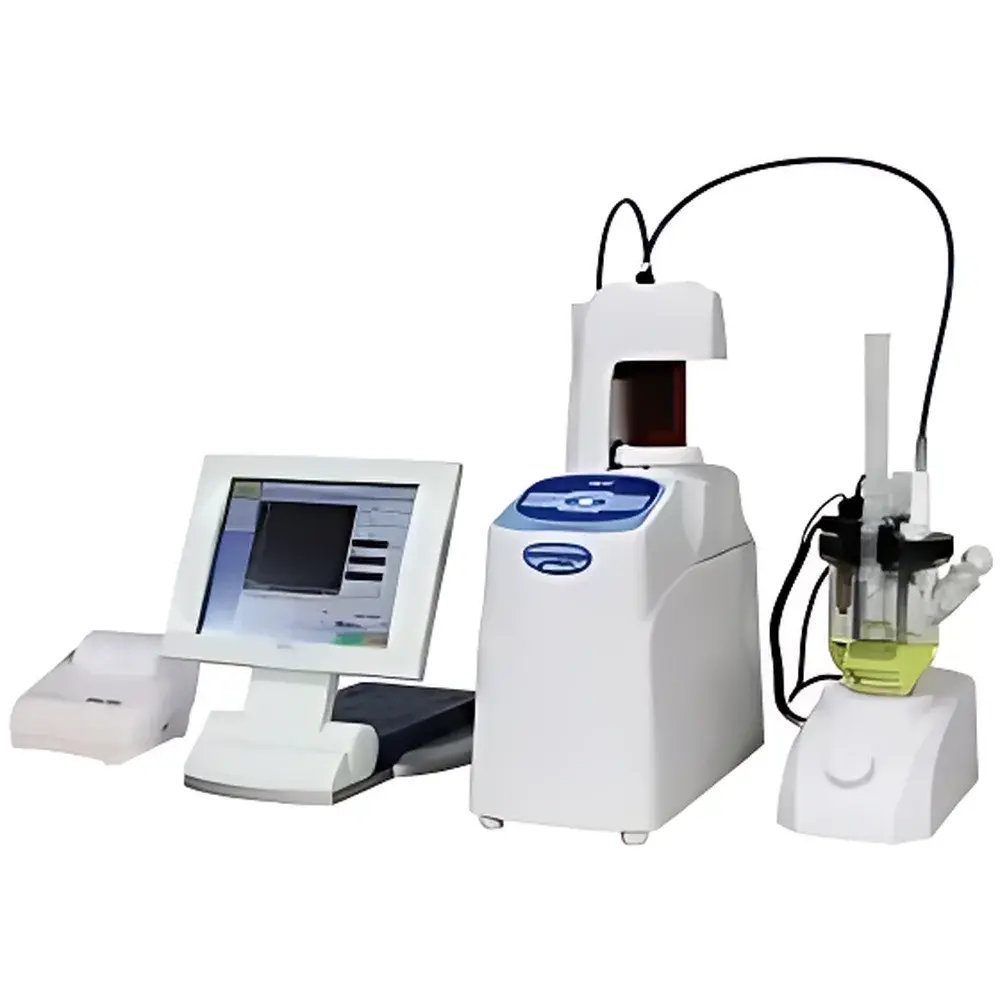
KEM Kyoto Electronics MKH-700 Hybrid Coulometric-Volumetric Karl Fischer Moisture Titrator
| Brand | KEM Kyoto Electronics |
|---|---|
| Origin | Japan |
| Model | MKH-700 |
| Coulometric Range | 10 µg – 300 mg H₂O |
| Volumetric Range | 100 µg – 500 mg H₂O (dependent on KF reagent titer) |
| Hybrid Range | 10 µg – 500 mg H₂O |
| Coulometric Precision | RSD < 0.3% at 1 mg water |
| Volumetric Precision | RSD < 0.3% at 10 mg water |
| Coulometric Resolution | 0.1 µg |
| Burette Capacity | 10 mL, Repeatability ±0.005 mL |
| Electrolytic Titer Calibration Range | 1–5 mg/mL, RSD < 1% |
| Interfaces | RS-232C, SS-BUS, LAN |
| Power | AC 100–240 V, 50/60 Hz, 80 W |
| Dimensions | 141 × 296 × 383 mm (W×D×H) |
| Weight | ~4.5 kg |
Overview
The KEM Kyoto Electronics MKH-700 Hybrid Coulometric-Volumetric Karl Fischer Moisture Titrator represents a foundational advancement in quantitative moisture analysis for laboratories requiring trace- to macro-level water determination across diverse sample matrices. Engineered around KEM’s proprietary Hybrid Titration Method, the MKH-700 dynamically integrates coulometric and volumetric Karl Fischer (KF) principles within a single sealed titration cell—eliminating manual method switching while preserving metrological integrity. Unlike conventional single-mode instruments, the MKH-700 continuously monitors real-time water concentration in the electrolyte and automatically selects or concurrently applies coulometric generation (for low-water samples, ≤100 µg) and volumetric delivery (for high-water content, ≥100 µg), ensuring optimal response time, stoichiometric accuracy, and minimal reagent consumption. The system operates strictly in accordance with ASTM E203, ISO 760, and USP , supporting both iodometric redox chemistry (I₂ + SO₂ + H₂O → 2HI + SO₃) and electrochemical regeneration of iodine at the anode. Its architecture is purpose-built for regulated environments where reproducibility, audit readiness, and method flexibility are non-negotiable.
Key Features
- Hybrid Titration Algorithm: Real-time adaptive control logic switches between or combines coulometric and volumetric KF modes based on measured water load—enabling seamless analysis from 10 µg to 500 mg H₂O without recalibration or hardware reconfiguration.
- Electrolytic Titer Calibration System: Fully automated, single-button calibration of volumetric KF reagent titer (1–5 mg/mL) via controlled electrolysis; eliminates dependence on certified water standards or operator-introduced pipetting errors.
- Unified Dual-Mode Titration Cell: Integrated cell design accommodates both coulometric iodine generation and volumetric reagent dispensing using shared electrodes and solvent reservoir—enhancing sealing reliability, reducing carryover risk, and simplifying maintenance.
- Modular Anode Diaphragm: Removable, user-replaceable diaphragm on the generator electrode enables routine cleaning and prevents salt deposition-induced drift—critical for long-term stability in high-salinity or viscous samples.
- Triple-Mode Operational Flexibility: Select volumetric, coulometric, or hybrid mode per test sequence—all executed within identical cell geometry and environmental conditions for cross-method comparability.
- Digital Data Integrity Architecture: Native USB port supports encrypted export of methods, raw titration curves, endpoint logs, and audit trails to external USB storage—compliant with ALCOA+ data governance expectations.
Sample Compatibility & Compliance
The MKH-700 demonstrates broad compatibility with pharmaceutical actives, excipients, polymers, petrochemicals, lithium battery electrolytes, and food-grade oils—provided samples dissolve fully in KF-compatible solvents (e.g., methanol, chloroform, or specialized anhydrous media). Its sealed cell design minimizes atmospheric moisture ingress during analysis, and optional sample changers (e.g., KEM AS-5000) extend unattended operation. From a regulatory standpoint, the instrument supports 21 CFR Part 11-compliant workflows when paired with KEM’s dedicated LabX®-compatible software (via RS-232C or LAN), enabling electronic signatures, role-based access control, and immutable audit trails. All calibration and validation records—including electrolytic titer verification, volumetric burette linearity checks, and system suitability tests—conform to ICH Q2(R2) guidelines and GLP/GMP documentation requirements.
Software & Data Management
While the MKH-700 operates autonomously via its front-panel interface, it interfaces seamlessly with KEM’s PC-based KEM-Link software (Windows OS) for advanced method development, statistical reporting, and compliance archiving. Data export formats include CSV, PDF, and XML—structured to align with LIMS ingestion protocols. Each measurement stores full metadata: timestamp, operator ID, solvent batch, reagent titer, cell temperature, drift correction values, and raw current/time profiles. The built-in memory retains up to 200 test results locally, and USB export ensures offline backup without network dependency—essential for facilities with air-gapped IT infrastructure.
Applications
- Pharmaceutical QC: Residual moisture quantification in lyophilized proteins, APIs, and tablet granulations per USP and Ph. Eur. 2.5.12.
- Battery Materials: Water content in LiPF₆ electrolytes and cathode precursors where sub-10 ppm levels directly impact SEI formation and cycle life.
- Polymer Manufacturing: Moisture monitoring in polyamide, polycarbonate, and PET resin prior to extrusion—preventing hydrolytic degradation.
- Fuel Analysis: Detection of trace water in aviation turbine fuels (ASTM D6304) and biodiesel blends (EN 14971).
- Food & Beverage: Quantification of bound water in powdered dairy, coffee extracts, and hygroscopic spices under AOAC 992.17.
FAQ
Does the MKH-700 require certified water standards for routine calibration?
No. Its integrated electrolytic titer calibration system performs traceable, operator-independent verification of volumetric reagent concentration without external standards.
Can the same titration cell be used for both coulometric and volumetric analysis?
Yes. The unified cell design eliminates cross-contamination risk and ensures consistent electrode geometry and solvent volume across all three operational modes.
Is the MKH-700 compliant with 21 CFR Part 11 for electronic records?
When configured with KEM-Link software and appropriate administrative controls (e.g., password policies, audit trail activation), the system meets core technical requirements for Part 11 compliance.
What maintenance intervals are recommended for the generator electrode diaphragm?
KEM recommends visual inspection after every 50 analyses or weekly—whichever occurs first—and replacement if discoloration, swelling, or increased background drift (>10 µg/min) is observed.
How does the Hybrid Method improve measurement uncertainty compared to standalone volumetric systems?
By applying coulometric quantification at low water levels—where mass-based volumetric delivery introduces proportionally higher relative error—the Hybrid Method reduces overall RSD by up to 40% in the 10–100 µg range.






