
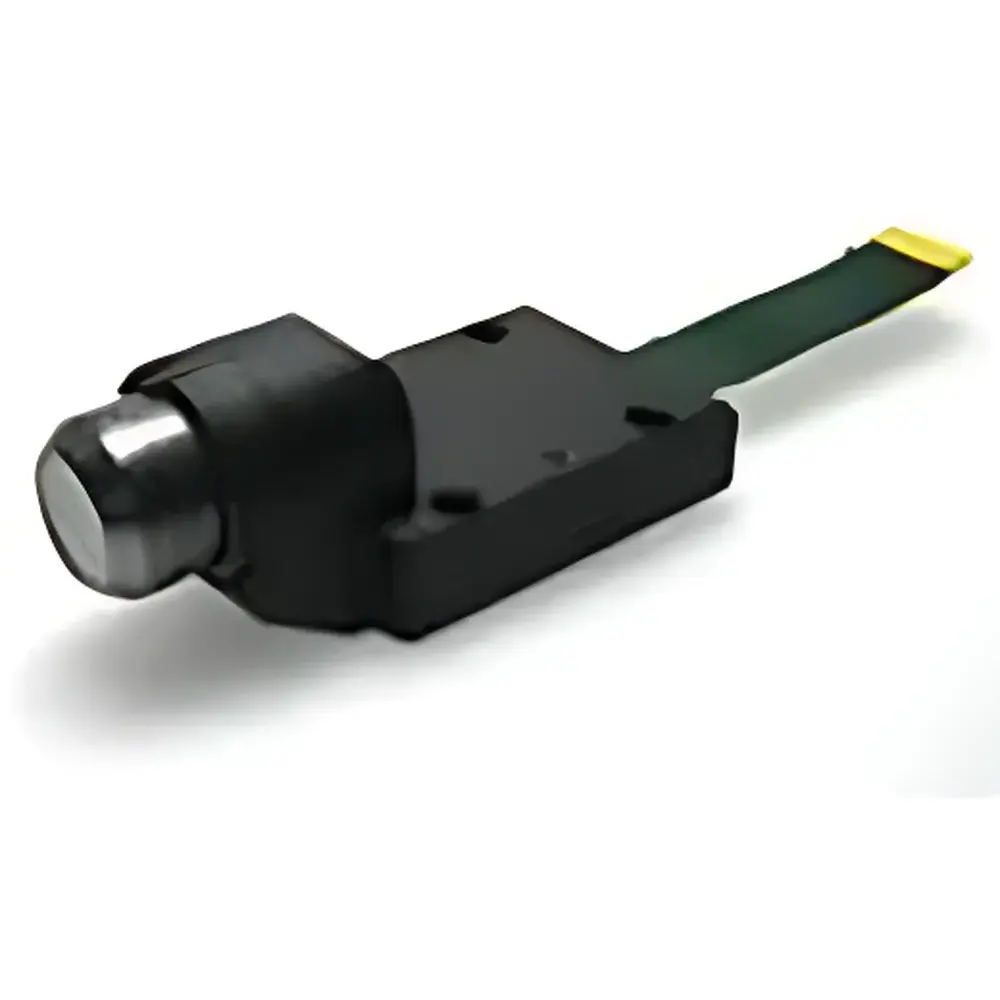
KETEK VIAMP-SDD Silicon Drift Detector Module
| Brand | KETEK |
|---|---|
| Origin | Germany |
| Model | VIAMP |
| Detector Type | Silicon Drift Detector (SDD) Module with Flexible Cable Interface |
| Compatible Probes | VITUS H7–H50 Series |
| Operating Temperature Range | −35 °C (TEC-stabilized) |
| Bias Voltage | −140 V DC |
| Power Supply | +5 V / 25 mA, −5 V / 15 mA, TEC: 1.7 V / 280 mA @ −35 °C |
| Energy Resolution | <125 eV FWHM at Mn Kα (5.9 keV), typical for high-performance SDDs |
| Count Rate Capability | >100 kcps (with pulse pile-up rejection) |
| Signal Polarity | Positive |
| Ramp Threshold | +1.8 V (positive), −1.8 V (negative) |
| Preamp Gain | 3 mV/keV (±10%) |
| TEC ΔT | 70 K @ 20 °C heatsink temperature |
| Temperature Diode Slope | 2.35 mV/K @ 1 µA |
Overview
The KETEK VIAMP-SDD is a high-performance silicon drift detector (SDD) module engineered for precision X-ray spectroscopy in demanding analytical environments. Unlike conventional Si(Li) or PIN diode detectors, the VIAMP leverages KETEK’s proprietary SDD architecture—featuring a large-area, low-capacitance anode and integrated thermoelectric cooling—to deliver exceptional energy resolution, high count-rate capability, and long-term operational stability. The module employs a flexible cable interface between the detector die and the low-noise front-end preamplifier, enabling mechanical decoupling and thermal isolation critical for minimizing microphonic noise and thermal drift. Designed as a drop-in solution for KETEK’s VITUS probe family (H7 to H50), the VIAMP supports modular integration into benchtop XRF, SEM-EDS, portable analyzers, and space-grade instrumentation. Its heritage includes flight-proven deployment on NASA Mars rovers—where multiple units launched over seven years ago remain fully functional—validating its radiation hardness, vacuum compatibility, and reliability under extreme thermal cycling and low-power constraints.
Key Features
- High-resolution detection: Achieves ≤125 eV FWHM at Mn Kα (5.9 keV) under standard operating conditions, meeting ISO 11336:2020 requirements for elemental identification in XRF.
- Thermoelectric stabilization: Integrated Peltier cooler maintains detector junction temperature at −35 °C (ΔT = 70 K relative to 20 °C heatsink), ensuring stable gain and resolution across ambient fluctuations.
- Flexible cable architecture: Separates detector head from preamplifier to reduce thermal load on the sensor and simplify mechanical mounting—particularly advantageous in confined or vibration-prone systems.
- Low-noise electronics: Optimized ramp-based shaping with user-adjustable positive/negative thresholds (+1.6–+2.0 V / −1.0–−2.5 V) and fixed 3 mV/keV gain (±10% tolerance) for consistent pulse-height calibration.
- Ruggedized power architecture: Accepts tightly regulated ±5 V supplies (≤30 mVpp ripple) and HV bias (−140 V, <0.1% ripple), supporting compliance with IEC 61000-4-5 surge immunity when implemented with appropriate filtering.
- Pin-compatible design: Standard 10-pin LEMO-style interface with documented signal mapping (including TEC control, temperature diode feedback, and HV bias) enables seamless replacement or upgrade within existing VITUS-based platforms.
Sample Compatibility & Compliance
The VIAMP-SDD operates in vacuum, inert gas, or air environments depending on window configuration (Be, polymer, or windowless variants). It is compatible with solid, powdered, and thin-film samples used in EDXRF, micro-XRF, and electron-excited emission analysis. The detector meets essential electromagnetic compatibility (EMC) and safety requirements per EN 61326-1 (laboratory equipment) and is RoHS-compliant. While not intrinsically certified for hazardous locations, its low-power design (<1.5 W total dissipation) and absence of moving parts support Class I, Division 2 installation when housed in appropriate enclosures. For regulated industries, raw spectral data output complies with FDA 21 CFR Part 11 principles when paired with validated acquisition software featuring audit trails, electronic signatures, and data integrity controls.
Software & Data Management
The VIAMP-SDD interfaces via analog voltage output (Pin 6) to standard multichannel analyzers (MCAs) or digitizers supporting Gaussian or trapezoidal pulse processing. KETEK provides reference firmware libraries (C/C++, Python) for spectral acquisition, real-time dead-time correction, and temperature-compensated gain stabilization. When integrated with compliant MCA platforms (e.g., Amptek DP5, XIA Pixie-4), the module supports full GLP/GMP traceability—including timestamped detector temperature logs, HV bias monitoring, and preamp gain verification—enabling audit-ready reporting for ISO/IEC 17025-accredited laboratories. Spectral data is exported in standard formats (ASCII, SPE, CNF) for post-processing in commercial packages such as AXIL, PyMCA, or Quantax.
Applications
- Energy-dispersive X-ray fluorescence (EDXRF) for alloy verification, RoHS screening, and geological sample analysis.
- Scanning electron microscopy (SEM-EDS) systems requiring high spatial resolution and fast mapping capabilities.
- Portable/handheld XRF analyzers where low power consumption and thermal robustness are critical.
- Space instrumentation and planetary science payloads, leveraging proven heritage in NASA Mars missions.
- Academic and industrial research in materials science, catalysis, and battery electrode characterization.
FAQ
What cooling method does the VIAMP-SDD use, and what is the minimum achievable detector temperature?
The module uses a single-stage thermoelectric cooler (TEC) capable of maintaining the sensor at −35 °C when mounted on a 20 °C heatsink (ΔT = 70 K). Active cooling below this requires external chillers or multi-stage TECs not integrated into the VIAMP design.
Is the VIAMP-SDD compatible with non-KETEK spectrometers or MCAs?
Yes—provided the external MCA supports bipolar input, adjustable shaping time, and accepts the VIAMP’s analog output voltage range (typically ±2 V full-scale), it can be interfaced without proprietary hardware.
Does the detector require liquid nitrogen or external cryogens?
No. The VIAMP is entirely dry-cooled via its integrated TEC and requires only regulated DC power supplies and adequate heatsinking.
How is energy calibration maintained over time and temperature?
Calibration stability relies on the onboard temperature diode (2.35 mV/K slope) and closed-loop TEC control; gain drift is typically <0.02% per °C, allowing recalibration intervals of ≥24 hours under stable thermal conditions.
Can the VIAMP be operated in vacuum, and what is the maximum allowable pressure?
Yes—the detector housing is rated for operation down to 10⁻⁶ mbar; for windowless configurations, differential pumping is recommended to prevent contamination of the cold sensor surface.





