
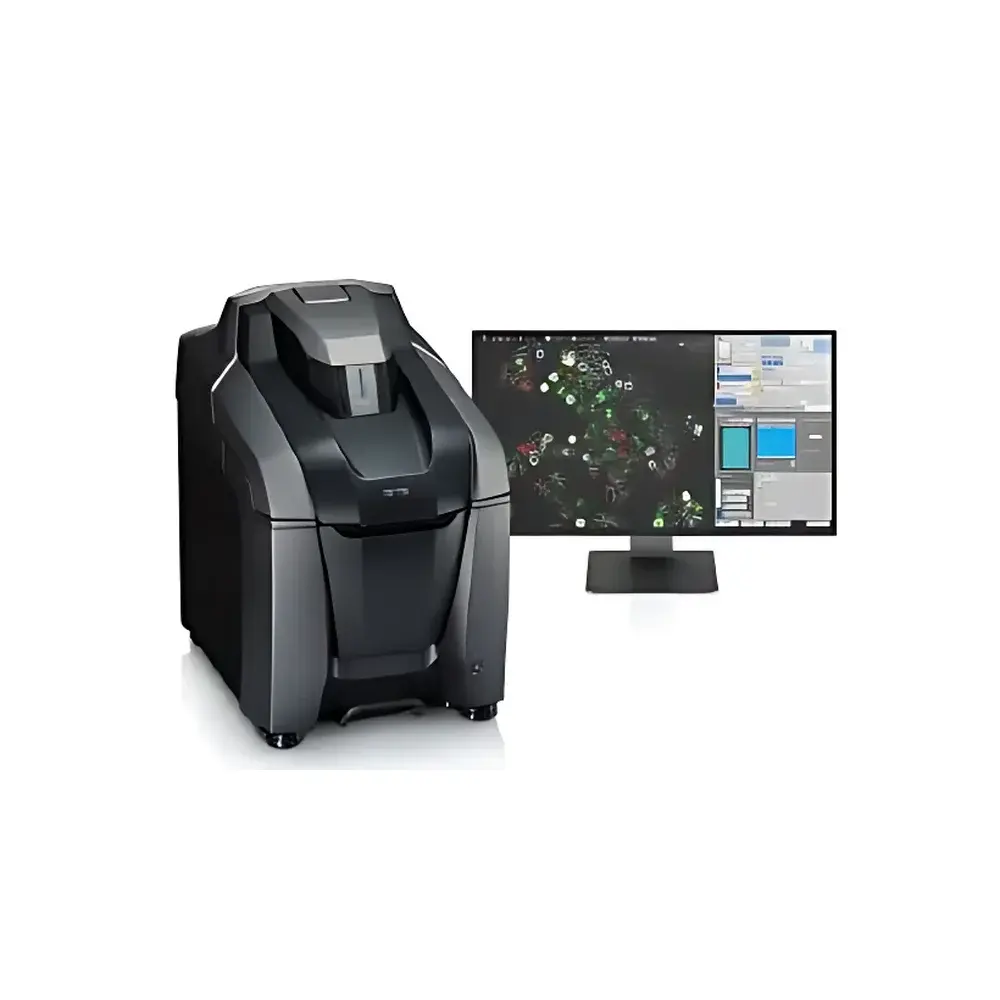
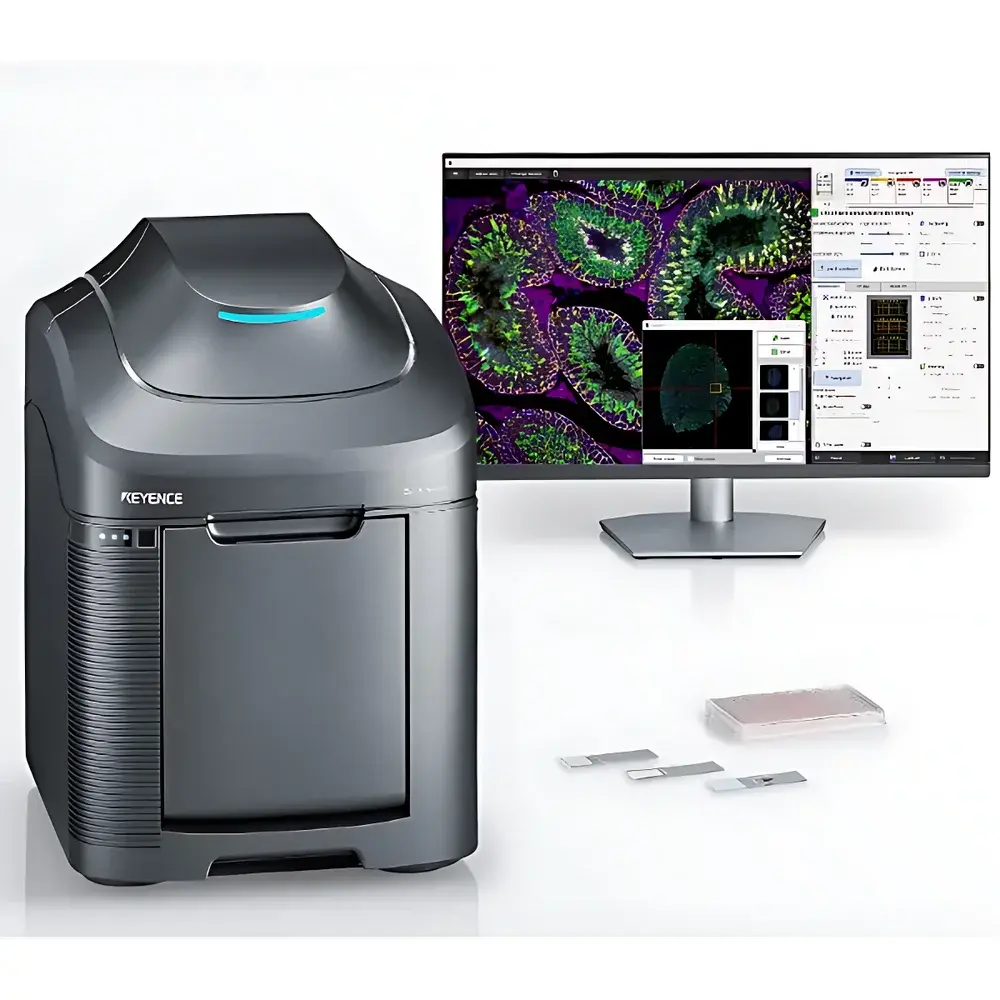
KEYENCE BZ-X1000 Series All-in-One Fluorescence Microscope System
| Brand | KEYENCE |
|---|---|
| Origin | Japan |
| Manufacturer Type | Original Equipment Manufacturer (OEM) |
| Product Origin | Imported |
| Model | BZ-X1000 Series |
| Instrument Type | Inverted Fluorescence Microscope |
| Excitation Source | High-Power LED (24 W / 48 W) |
| Classification | Research-Grade Fluorescence Microscope |
| Objective Lenses | Plan Apochromat 2×, 4×, 10×, 20×, 40×, 60× Oil, 100× Oil |
| Fluorescence Module | 11-Channel Widefield & Optical Sectioning Capability |
| Control Interface | PC-Based Software Control |
| Camera | 2/3″ 10-Megapixel Monochrome CMOS Sensor (Switchable to Color Mode) |
| Focus Mechanism | Motorized Z-Axis with High-Speed Autofocus |
| Stage | Motorized XYZ Precision Stage |
| Fluorescence Filter Sets | Customizable Interference Filter Cubes |
| DIC Compatibility | Not Equipped |
| Condenser | Not Applicable (Integrated Illumination Design) |
Overview
The KEYENCE BZ-X1000 Series is an all-in-one fluorescence microscope system engineered for precision life science research in academic, pharmaceutical, and clinical laboratory environments. Built upon a fully integrated optical and computational architecture, it employs widefield epifluorescence illumination combined with high-fidelity optical sectioning—achieved through sequential image acquisition and computational deconvolution—to deliver quantitative, multi-dimensional imaging without confocal scanning hardware. Its inverted configuration supports live-cell observation in standard culture vessels, including multi-well plates, chamber slides, and Petri dishes. The system eliminates dependency on darkroom operation, features a compact footprint (A3-sized), and integrates motorized optics, stage, and filter control into a single software-controlled platform—enabling reproducible, operator-independent acquisition protocols aligned with GLP-compliant workflows.
Key Features
- High-Resolution Imaging Engine: Equipped with a 2/3″ 10-megapixel monochrome CMOS sensor optimized for photon-limited fluorescence detection; color mode is software-switchable for comparative brightfield or phase contrast documentation.
- Multi-Channel Fluorescence Flexibility: Supports up to 11 independently configurable fluorescence channels via motorized filter turret and dual-filter wheel architecture—enabling rapid spectral switching and multi-label co-localization studies.
- Automated Workflow Architecture: Includes intelligent auto-focus algorithms, specimen recognition-based navigation mapping, and condition-replay functionality to ensure inter-operator consistency and reduce protocol variability.
- Optical Sectioning & 3D Reconstruction: Generates z-stacks using precise motorized focus control, followed by computational reconstruction of optically sectioned volumes—supporting quantitative surface rendering, volume measurement, and colocalization analysis.
- Time-Lapse & Multi-Modality Acquisition: Synchronizes brightfield, phase contrast, and multiple fluorescence channels at user-defined intervals—ideal for longitudinal assays such as calcium imaging, cell migration tracking, and mitotic progression analysis.
- Scalable Platform Design: Modular hardware interface allows integration of optional near-infrared (NIR) excitation modules and advanced environmental control units for long-term live-cell experiments.
Sample Compatibility & Compliance
The BZ-X1000 accommodates a broad range of biological specimens—from fixed tissue sections and cytospin preparations to adherent and suspension cultures in 6–384-well microplates. Its motorized XYZ stage enables automated tiling across large-area samples (e.g., whole-slide imaging of stained histology sections) and high-throughput screening of compound libraries. The system complies with ISO 13485 design controls for medical device-related research applications and supports audit-trail-enabled data capture per FDA 21 CFR Part 11 requirements when deployed with validated software configurations. All optical components meet JIS B 7151 standards for microscope performance verification.
Software & Data Management
Acquisition, processing, and quantification are unified within KEYENCE’s proprietary BZ-X Analyzer software—designed for intuitive yet rigorous scientific analysis. It provides built-in tools for cell counting, intensity profiling, object segmentation, and time-series normalization. Image metadata—including exposure parameters, objective magnification, filter set IDs, and stage coordinates—is embedded directly into TIFF and OME-TIFF files, ensuring FAIR (Findable, Accessible, Interoperable, Reusable) data principles. Export options include CSV for statistical packages (e.g., GraphPad Prism, R), HDF5 for deep learning pipelines, and PDF reports compliant with internal lab SOPs. Software updates follow IEC 62304 Class B medical software lifecycle standards.
Applications
- Tissue Morphometry: Automated stitching and quantification of immunofluorescently labeled tissue arrays for biomarker expression profiling.
- Single-Cell Analysis: Subcellular localization quantification, nuclear/cytoplasmic ratio calculation, and dynamic organelle tracking over time.
- Drug Discovery Screening: High-content analysis of phenotypic responses in multi-well formats—including proliferation, apoptosis, and translocation assays.
- Developmental Biology: Long-term timelapse imaging of embryoid bodies or organoids under controlled environmental conditions.
- Neuroscience: Dendritic spine density mapping, synaptic puncta co-localization, and activity-dependent fluorescent reporter dynamics.
FAQ
Is the BZ-X1000 compatible with third-party antibodies and fluorophores?
Yes—the system supports standard fluorophores (e.g., DAPI, FITC, TRITC, Cy5) and is compatible with any commercially available antibody conjugates, provided emission spectra fall within the transmission range of installed filter sets.
Can acquired images be exported in formats suitable for publication or machine learning training?
All raw and processed images export in lossless TIFF and open-standard OME-TIFF formats; metadata-rich HDF5 export is available for AI/ML pipeline integration.
Does the system support regulatory-compliant data integrity practices?
When configured with electronic signature and audit trail modules, the BZ-X Analyzer software meets FDA 21 CFR Part 11 and EU Annex 11 requirements for regulated environments.
What level of technical support and service coverage is available internationally?
KEYENCE provides global field service engineering, remote diagnostics, and application-specific training—backed by regional calibration laboratories certified to ISO/IEC 17025.
How does the BZ-X1000 differ from confocal or spinning-disk systems in terms of resolution and phototoxicity?
While not a point-scanning system, its optical sectioning algorithm achieves effective axial resolution comparable to widefield deconvolution systems—offering reduced photobleaching and higher acquisition speed than laser-scanning platforms, particularly for sensitive live specimens.





