KEYENCE GL-S Series Safety Light Curtain
| Brand | KEYENCE |
|---|---|
| Origin | Japan |
| Manufacturer Type | Manufacturer |
| Origin Category | Imported |
| Model | GL-S |
| Pricing | Upon Request |
Overview
The KEYENCE GL-S Series Safety Light Curtain is an IEC 61496-1/-2 and ISO 13857 compliant electro-sensitive protective equipment (ESPE) engineered for reliable presence detection in industrial automation environments. Utilizing infrared LED emitter/receiver arrays with synchronized pulsed scanning, the GL-S series detects intrusion into defined hazardous zones by monitoring beam interruption across its sensing field. Designed for integration into machine safeguarding systems requiring Category 4 / SIL 3 performance per EN ISO 13849-1 and IEC 62061, the series supports safety-rated stop signaling to PLCs or safety controllers via dual-channel OSSD outputs. Its modular architecture enables rapid deployment in both new installations and retrofits, with built-in diagnostics supporting continuous self-monitoring of optical alignment, emitter output stability, and internal circuit integrity.
Key Features
- Three Configurable Wiring Architectures: Selectable between Single-Cable System (reducing inter-unit wiring to just 4 conductors), Optical Synchronization System (enabling independent power supply for emitter and receiver units while eliminating electrical noise coupling), and Wired Synchronization System (supporting advanced safety functions including muting, blanking, EDM monitoring, and self-checking logic).
- Minimal Mounting Effort: Pre-installed direct-mount brackets allow secure attachment to standard aluminum framing with only two M4 screws—eliminating bracket assembly and alignment calibration steps during installation.
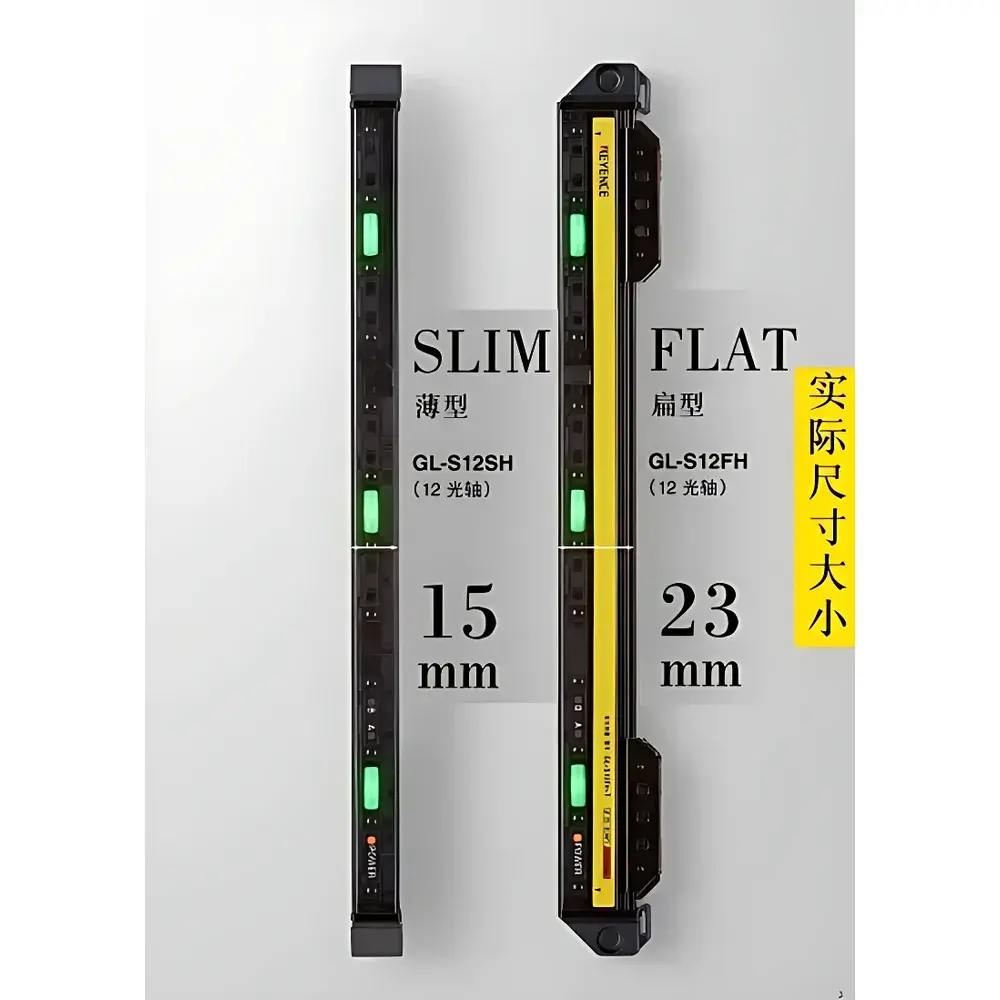
- Two Form Factors for Spatial Flexibility: GL-SS (Slim Type) features a 15 mm front projection depth and triple-directional status indication (front + dual side views), optimized for flush mounting in narrow access corridors or aperture-front applications. GL-SF (Flat Type) offers a 15 mm profile thickness with dual-axis visibility, ideal for recessed or U-shaped mounting configurations where frontal clearance is constrained but lateral observation remains critical.
- Multi-Color Status Indication: Programmable external input-triggered LEDs display green (normal operation), red (safety stop active), or orange (warning/fault condition), serving both functional diagnostics and operator guidance without requiring auxiliary signaling hardware.
- Rapid Fulfillment & Integration Support: Standard configurations are available for same-day shipping on orders placed before 16:00 JST; comprehensive CAD models, EPLAN macros, and safety validation documentation (including PL calculation reports and SIL verification summaries) are provided for seamless system design compliance.
Sample Compatibility & Compliance
The GL-S Series is certified to meet global functional safety standards required for machinery safety integration in regulated manufacturing sectors. It carries TÜV Rheinland certification for Performance Level e (PL e) and Safety Integrity Level 3 (SIL 3) per EN ISO 13849-1 and IEC 62061 respectively. All models comply with electromagnetic compatibility requirements under EN 61326-3-1 and environmental robustness specifications per EN 60529 (IP65 front panel rating). The device supports integration into safety networks conforming to PROFIsafe, CIP Safety, and openSAFETY protocols when used with compatible safety controllers. No user-configurable parameters affect safety integrity—configuration is limited to non-safety-related status signaling and synchronization mode selection, preserving certified architecture validity.
Software & Data Management
Configuration and diagnostic data are managed exclusively through KEYENCE’s proprietary FT Series Configuration Tool (v3.2+), which runs on Windows-based engineering workstations. The tool provides real-time beam status mapping, alignment verification graphs, response time logging, and fault history export in CSV format. Audit trails—including parameter changes, firmware updates, and diagnostic event timestamps—are retained onboard for GLP/GMP-aligned traceability. While no cloud connectivity or remote monitoring capability is embedded, all configuration files adhere to IEC 62443-3-3 guidelines for secure offline storage and version-controlled deployment. Firmware updates require physical USB interface connection and digital signature validation to ensure runtime integrity.
Applications
- Robotic cell perimeter guarding with dynamic zone muting during part transfer cycles
- Packaging line entry/exit points requiring high-speed response (<20 ms total system stopping time)
- Press brake light curtains with integrated blanking for tool change sequences
- Assembly station hand-insertion zones with multi-zone height discrimination (via optional height-select modules)
- Automated guided vehicle (AGV) docking stations requiring fail-safe approach detection
- Pharmaceutical filling line access control meeting FDA 21 CFR Part 11 electronic record requirements via linked safety PLC audit logs
FAQ
What safety standards does the GL-S Series comply with?
It meets EN ISO 13849-1 (PL e), IEC 62061 (SIL 3), IEC 61496-1/-2 (Type 4), and UL 508 (Class 2 power limited circuit classification).
Can the GL-S be integrated into existing safety PLC architectures?
Yes—OSSD outputs are compatible with major safety controllers from Siemens, Rockwell Automation, Schneider Electric, and Mitsubishi Electric when configured per manufacturer-specific wiring diagrams.
Is alignment verification required after initial installation?
No manual alignment tools are needed—the system performs automatic optical axis calibration during power-up and continuously monitors beam integrity during operation.
Does the GL-S support muting or blanking functions?
Muting is supported only via the Wired Synchronization System configuration; blanking requires external safety relay or controller-level implementation.
What is the maximum sensing height available for GL-S models?
Standard catalog models offer up to 1800 mm detection height; custom configurations beyond this range are available upon engineering review and additional certification testing.