
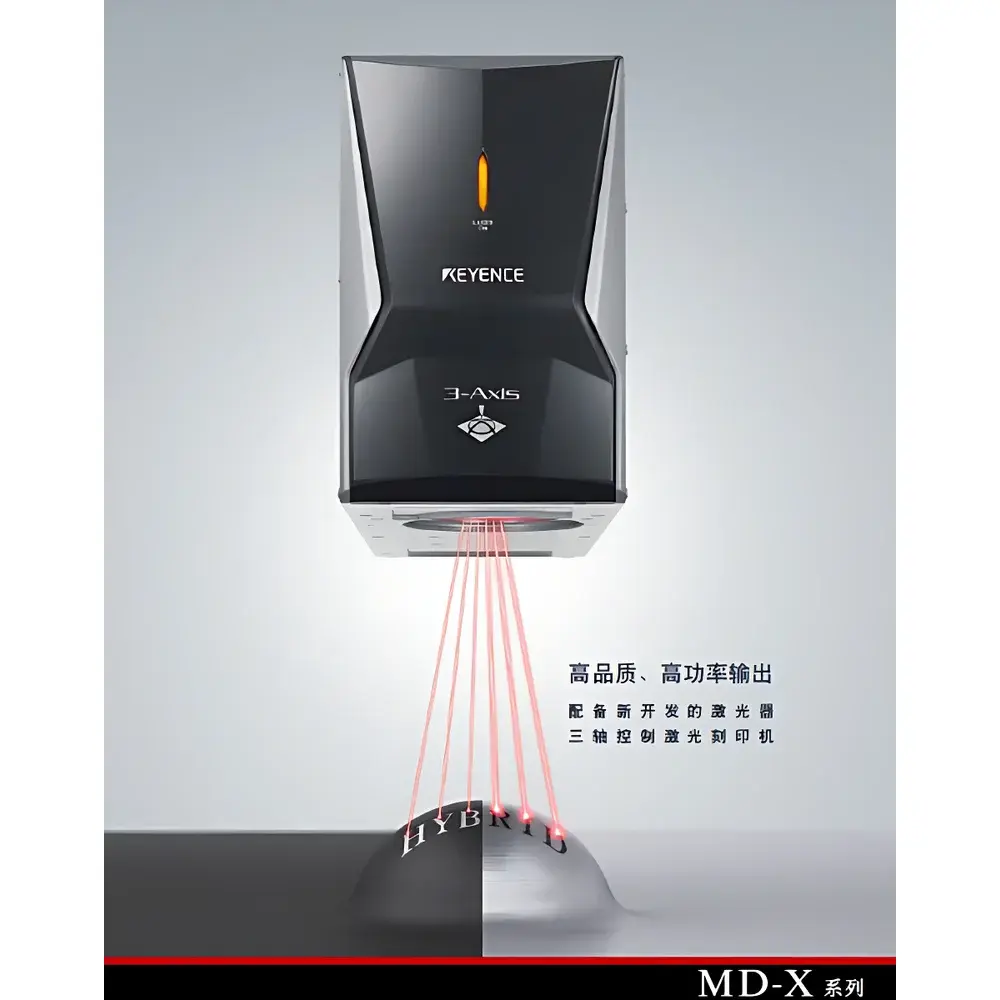
KEYENCE MD-X1000/1500 Series 3-Axis Hybrid Laser Marking System
| Brand | KEYENCE |
|---|---|
| Origin | Japan |
| Manufacturer Type | Manufacturer |
| Origin Category | Imported |
| Model | MD-X1000/1500 Series |
| Peak Power | 200 kW |
| Average Output Power | 25 W |
| Laser Architecture | Hybrid YVO₄–Fiber Oscillator |
| Scanning Axes | X, Y, Z (simultaneous 3-axis galvanometric control) |
| Focus Adjustment | Motorized Z-axis with auto-focus via integrated camera |
| Integrated Vision | High-resolution monochrome CMOS camera with depth-sensing capability |
| QR Code Reading | Built-in ISO/IEC 15415-compliant decoder with grade-based print quality assessment |
| Compliance | CE, FDA 21 CFR Part 11 (audit trail & electronic signature ready), ISO 9001-aligned manufacturing |
Overview
The KEYENCE MD-X1000/1500 Series is a precision-engineered 3-axis hybrid laser marking system designed for high-reliability permanent identification in demanding industrial environments. Unlike conventional single-architecture laser markers, the MD-X integrates a proprietary hybrid laser source that synergistically combines the high beam quality and short pulse characteristics of a diode-pumped vanadate (YVO₄) oscillator with the thermal stability, wall-plug efficiency, and long operational lifetime of a fiber-amplified stage. This architecture delivers both high peak power (up to 200 kW) and sustained average output (25 W), enabling crisp, high-contrast marking on highly reflective metals (e.g., stainless steel, aluminum, titanium), engineered plastics, anodized surfaces, and coated substrates—without compromising mark permanence or process repeatability. The system operates at a fundamental wavelength of 1064 nm, optimized for absorption across broad material classes while minimizing thermal distortion in thin or heat-sensitive components.
Key Features
- True 3-axis dynamic focusing: Independent X/Y galvanometric scanners coupled with a motorized Z-axis lens driver enable real-time focal plane adjustment across complex 3D contours—eliminating manual repositioning and supporting consistent mark depth on curved, sloped, or stepped surfaces.
- Integrated vision-guided auto-focus: A calibrated monochrome CMOS camera continuously monitors working distance and surface topology; closed-loop feedback adjusts Z-position within ±5 µm accuracy, compensating for part height variation, conveyor belt drift, or fixture wear.
- Dual-function imaging module: Simultaneously performs pre-mark verification (feature recognition, positional alignment), post-mark inspection (edge sharpness, contrast uniformity), and ISO/IEC 15415-compliant 2D symbol grading—including Data Matrix and QR code readability scoring per industry-defined Luminance Uniformity, Modulation, and Decodability metrics.
- Hybrid laser source with >100,000-hour diode lifetime: Combines YVO₄’s superior M² <1.3 beam parameter product with fiber amplification’s robust thermal management—reducing maintenance intervals and eliminating water-cooling requirements typical of high-power DPSS systems.
- Real-time thermoelectric power monitoring: An embedded Peltier-based photodiode sensor provides continuous, traceable measurement of instantaneous laser output—critical for process validation under ISO 13485 or IATF 16949 quality management frameworks.
Sample Compatibility & Compliance
The MD-X series supports direct part marking (DPM) on materials ranging from hardened tool steels (HRC 60+) and medical-grade cobalt-chrome alloys to polyimide flex circuits and glass-filled PBT. Its pulse-to-pulse energy stability (<±1.5% RMS over 8 hours) ensures compliance with aerospace standards such as SAE AS9132 and automotive requirements per AIAG B-17. All firmware and configuration logs adhere to FDA 21 CFR Part 11 Annex 11 principles, including role-based access control, electronic signatures, and immutable audit trails. CE marking confirms conformity with EMC Directive 2014/30/EU and Machinery Directive 2006/42/EC.
Software & Data Management
KEYENCE’s MD-View software provides intuitive graphical programming with drag-and-drop symbol libraries (including GS1 DataMatrix, UDI-compliant formats), parametric font scaling, and geometric distortion correction for cylindrical marking. Process recipes are stored with full metadata—laser parameters, camera settings, calibration timestamps—and exportable in CSV/XML for integration with MES or QMS platforms (e.g., Siemens Opcenter, ETQ Reliance). Version-controlled firmware updates include cryptographic signature verification to maintain integrity during deployment.
Applications
- Aerospace component traceability: Permanent UID marking on turbine blades, landing gear fittings, and composite fasteners meeting MIL-STD-130 requirements.
- Medical device serialization: UDI-compliant Data Matrix codes on surgical instruments, implantable housings, and diagnostic cartridges—validated per ISO/IEC 15415 and ASTM F2963.
- Electronics miniaturization: Sub-50 µm feature marking on PCBs, semiconductor packages, and MEMS sensors without substrate ablation or delamination.
- Automotive powertrain: High-speed VIN and QR marking on engine blocks, transmission cases, and EV battery modules—even on oily or slightly oxidized surfaces.
- Tooling & mold identification: Deep engraving on hardened H13 and S7 steels with repeatable depth control down to ±2 µm across 300 × 300 mm fields.
FAQ
Does the MD-X support marking on moving parts on high-speed conveyors?
Yes—the system synchronizes laser firing and scanning motion with encoder signals up to 1 MHz, enabling stable marking at line speeds exceeding 120 m/min with positional jitter <±15 µm.
Can the built-in camera verify marks on highly reflective or curved surfaces?
Yes—the camera uses structured illumination and adaptive exposure control to acquire high-SNR images on polished metals and convex geometries; depth-sensing algorithms reconstruct local surface normals for accurate focus compensation.
Is remote diagnostics and firmware update supported?
Yes—via secure TLS 1.2 Ethernet connection; KEYENCE’s cloud-enabled Remote Service Portal allows authorized technicians to perform health checks, log analysis, and zero-touch updates without onsite intervention.
How is laser power calibration maintained over time?
The integrated thermoelectric power monitor provides NIST-traceable reference points; optional annual calibration service includes beam profiler validation and pulse shape characterization per ISO 11554.
What safety certifications does the MD-X hold for Class 1 enclosure integration?
The MD-X1500 model is certified to IEC 60825-1:2014 Ed.3 for Class 1 operation when installed in a fully interlocked enclosure meeting EN 60204-1 requirements; laser hazard analysis documentation is provided per ANSI Z136.1-2022.







