
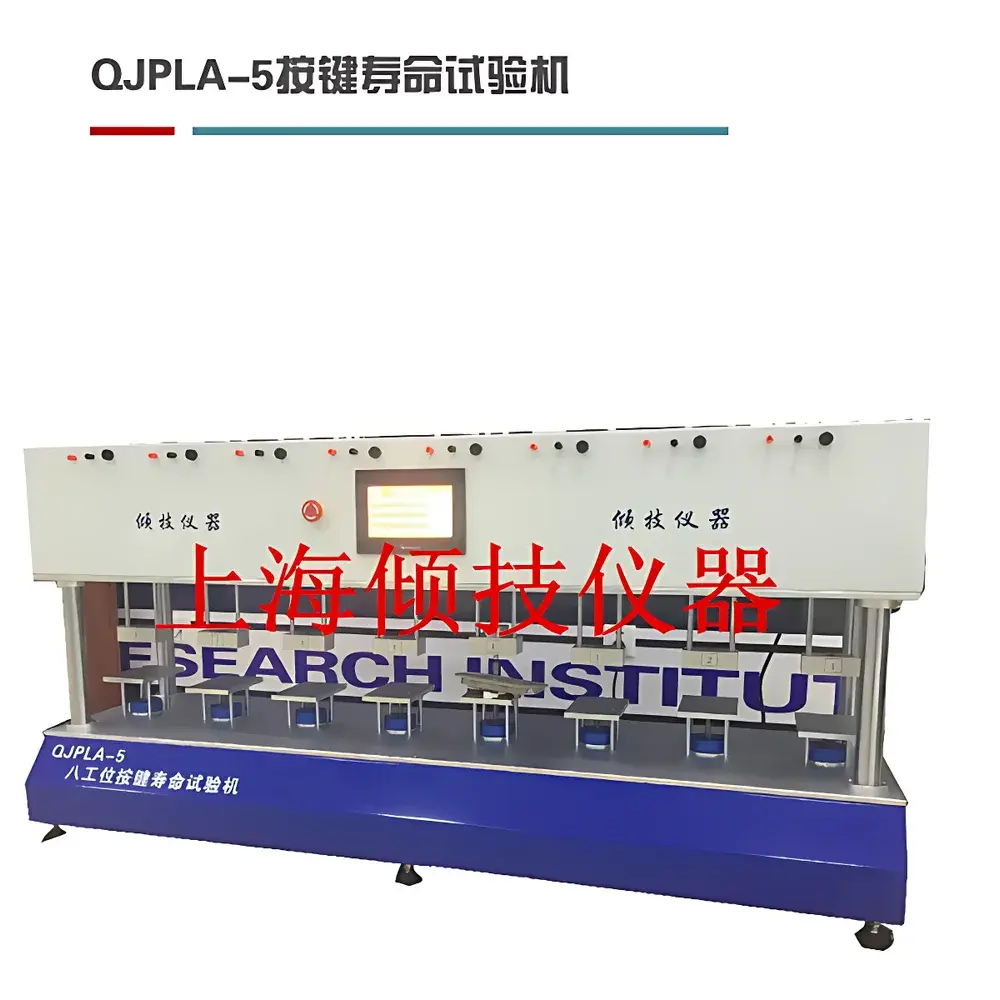
Keyence QJPLA-5 Eight-Station Keypad Lifecycle Tester
| Origin | Shanghai, China |
|---|---|
| Manufacturer Type | Authorized Distributor |
| Product Origin | Domestic (PRC) |
| Model | QJPLA-5 |
| Instrument Category | Electromechanical Universal Testing Machine |
| Test Speed | 1–360 cycles/min (adjustable) |
| Actuation Force Options | 50 g, 100 g, 200 g, 300 g standard weights |
| Vertical Stroke Range | 0–50 mm (adjustable), with fixed 10 mm nominal compression travel |
| Test Platform Dimensions | 80 × 80 mm |
| Electrical Continuity Monitoring | Real-time contact resistance detection |
| Motion Mechanism | Linear bearing-guided vertical actuation for repeatable axial alignment |
| Cycle Counter Resolution | 8-digit programmable counter (0–99,999,999 cycles) with auto-halt |
| Probe Mounting Height Adjustment | 0–150 mm vertical range |
| Power Supply | 220 V AC, 50 Hz |
| Warranty | 12-month comprehensive coverage |
Overview
The Keyence QJPLA-5 Eight-Station Keypad Lifecycle Tester is an electromechanical universal testing system engineered for quantitative mechanical endurance evaluation of tactile input components—including membrane switches, rubber dome keypads, mechanical pushbuttons, and capacitive button overlays. It operates on a controlled displacement-driven actuation principle: a vertically reciprocating probe applies calibrated compressive force to the test specimen at user-defined frequency and stroke depth, while continuously monitoring electrical continuity across the contact interface. This enables precise correlation between mechanical actuation count and functional failure—defined as loss of conductive path integrity under load. Designed for laboratory-based quality assurance, incoming inspection, and design validation workflows, the QJPLA-5 supports deterministic fatigue analysis in accordance with internal reliability protocols and industry-aligned test methodologies such as IEC 60659 (switching devices) and ISO/IEC 17025-compliant calibration traceability frameworks.
Key Features
- Eight independent test stations: Enables parallel evaluation of identical or heterogeneous keypad samples, improving throughput and statistical robustness without cross-station interference.
- Programmable actuation parameters: Test speed adjustable from 1 to 360 cycles per minute; vertical stroke precisely tunable from 0 to 50 mm; force application via standardized stainless-steel weights (50 g, 100 g, 200 g, 300 g) ensuring NIST-traceable load consistency.
- Real-time electrical continuity monitoring: Integrated low-voltage (<5 V DC), high-impedance circuit detects open-circuit events during compression—triggering immediate test termination and logging the exact cycle count at failure.
- Linear bearing-guided motion architecture: Ensures orthogonal, friction-minimized probe travel with sub-0.02 mm repeatability in vertical alignment—critical for eliminating skew-induced premature wear or false failure modes.
- 8-digit programmable cycle counter: Supports test termination at up to 99,999,999 cycles; retains non-volatile memory of final count, elapsed time, and stop condition (e.g., “open circuit”, “manual abort”, “counter limit reached”).
- Modular probe mounting system: Vertical adjustment range of 0–150 mm accommodates diverse housing heights and switch stack configurations; quick-lock clamping ensures positional stability across extended test durations.
Sample Compatibility & Compliance
The QJPLA-5 accommodates flat or low-profile tactile actuators with active surface dimensions ≤80 × 80 mm and total height ≤150 mm. Its open-platform design permits integration with custom fixtures for curved, angled, or multi-layer assemblies—provided mechanical stability and probe access are maintained. The system complies with CE safety directives (2014/30/EU EMC, 2014/35/EU LVD) and meets EN 61000-6-2/6-4 immunity/emission requirements. While not certified to UL or CSA standards out-of-box, its architecture supports third-party certification readiness when installed in controlled environments meeting ISO 17025 laboratory accreditation criteria. All electrical continuity measurements adhere to ASTM D257 guidelines for surface resistivity verification protocols.
Software & Data Management
The QJPLA-5 operates via embedded firmware with local LCD interface—no PC dependency required for basic operation. Optional RS-232 or USB-to-serial interface enables connection to host systems running custom LabVIEW, Python (PySerial), or MATLAB scripts for automated data logging, histogram generation, and Weibull distribution fitting. Exported CSV files include timestamp, cycle number, status flag, and real-time continuity state (pass/fail per cycle). Audit trails are retained in device memory for GLP/GMP-aligned environments; full traceability supports FDA 21 CFR Part 11 compliance when paired with validated electronic record systems and role-based user authentication.
Applications
- Accelerated life testing of automotive HVAC control panels under thermal cycling preconditioning
- Reliability qualification of medical device front-panel interfaces per IEC 62366 usability engineering requirements
- Comparative durability benchmarking of silicone vs. polyester dome membranes in industrial HMI applications
- Failure mode analysis of backlight-integrated keypads subjected to humidity exposure prior to lifecycle testing
- Supplier qualification audits requiring documented MTTF (mean time to failure) and B10 life metrics
FAQ
Is the QJPLA-5 compatible with non-standard switch geometries, such as concave or angled actuators?
Yes—custom jigs and angled probe adapters can be fabricated using the 0–150 mm vertical adjustment range and modular mounting plate; dimensional constraints must ensure unobstructed linear probe travel and stable sample fixation.
Can the continuity detection threshold be adjusted for high-resistance or coated-contact switches?
The default threshold is set at >10 kΩ for open-circuit detection; threshold reconfiguration requires firmware-level modification and is available under Keyence’s Engineering Support Program upon submission of switch characterization data.
Does the system provide calibration certificates for applied force or stroke accuracy?
Factory calibration reports for weight mass (±0.1% tolerance) and stroke encoder linearity (±0.05 mm full-scale) are supplied with each unit; ISO/IEC 17025-accredited third-party calibration services are available through authorized regional partners.
What maintenance intervals are recommended to sustain long-term repeatability?
Linear bearings require lubrication every 500,000 cycles or annually—whichever occurs first; probe tips should be inspected for deformation after 10,000 cycles when testing abrasive surfaces; all maintenance logs are stored in the device’s internal service history register.



