
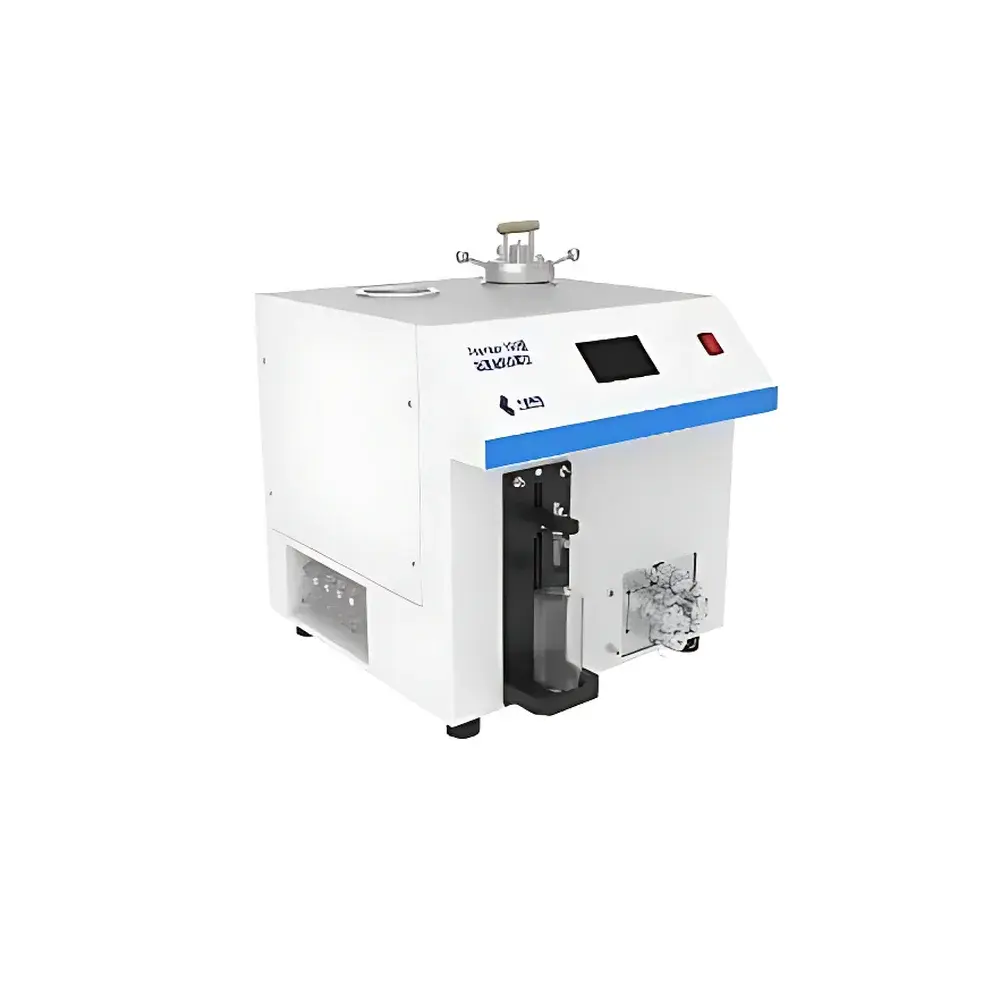
KEZHE Aseeker-100 Accelerated Solvent Extractor
| Brand | KEZHE SHANGHAI |
|---|---|
| Origin | Shanghai, China |
| Manufacturer Type | Original Equipment Manufacturer (OEM) |
| Country of Origin | China |
| Model | Aseeker-100 |
| Instrument Category | Solid-Liquid Extraction System |
| Temperature Range | Ambient to 200 °C (±1 °C) |
| Pressure Range | 0–20 MPa (±0.3 MPa) |
| Extraction Cell Volumes | 11 mL / 22 mL / 33 mL |
| Collection Vial Capacities | 40 mL / 60 mL |
| Solvent Flow Rate | 0.1–50 mL/min |
| Extraction Time | 20–30 min |
| Solvent Consumption | 10 mL per 10 g sample |
| Gas Supply Requirement | Nitrogen, 0.4–1 MPa |
| Power Input | 100–240 VAC ±10 %, 50–60 Hz |
| Max. Power Consumption | 600 W |
| Dimensions (W×D×H) | 450 mm × 500 mm × 530 mm |
| Weight | 30 kg |
| Sample Contact Materials | PEEK, PTFE, 316L stainless steel, ceramic |
| Safety Features | Mechanical overpressure protection, electronic overtemperature cutoff, leak detection with automatic shutdown, liquid-level sensing with overflow prevention, integrated post-extraction filtration |
Overview
The KEZHE Aseeker-100 Accelerated Solvent Extractor is an engineered solid-liquid extraction platform designed for high-efficiency analyte recovery from complex solid matrices under elevated temperature and pressure conditions. It operates on the principle of accelerated solvent extraction (ASE®), leveraging thermodynamically enhanced solubility and mass transfer kinetics to achieve rapid, reproducible extractions—typically completing a full cycle in 20–30 minutes. By maintaining precise control over temperature (ambient to 200 °C, ±1 °C) and pressure (up to 20 MPa, ±0.3 MPa), the system enables optimized dissolution of target compounds—including persistent organic pollutants, pesticides, lipids, pharmaceutical residues, and natural product metabolites—while minimizing thermal degradation. Its single-channel architecture delivers laboratory-grade performance without the complexity or footprint of multi-vessel systems, making it suitable for mid-throughput QC labs, environmental testing facilities, and academic research groups requiring method development flexibility and regulatory traceability.
Key Features
- Single-channel extraction module with compact footprint (450 × 500 × 530 mm) and low operational weight (30 kg), ideal for space-constrained laboratories.
- Ring-type heating furnace ensures uniform thermal distribution across the extraction cell, reducing axial temperature gradients and improving extraction consistency.
- Dual-needle fluid delivery system (inner/outer needle configuration) prevents collection vial over-pressurization and eliminates solvent spray during nitrogen purge—critical for operator safety and sample integrity.
- Integrated liquid-level detection continuously monitors collection vial fill status and triggers automatic process suspension upon reaching capacity, preventing overflow and cross-contamination.
- Real-time leak detection circuitry initiates immediate shutdown upon solvent leakage, supported by redundant mechanical overpressure relief and electronic overtemperature cutoff (200 °C limit).
- Post-extraction inline filtration unit automatically separates particulates from the extract prior to collection, eliminating manual filtration steps and reducing analyst handling error.
- High-resolution capacitive touchscreen interface with intuitive workflow navigation, parameter logging, and user-accessible method templates compliant with GLP documentation requirements.
- Chemically inert wetted path constructed entirely from PEEK, PTFE, 316L stainless steel, and ceramic—resistant to aggressive solvents (e.g., dichloromethane, acetone, acetonitrile, methanol, hexane) and compatible with acidic or basic matrices.
Sample Compatibility & Compliance
The Aseeker-100 supports diverse solid sample types including soil, sediment, sludge, plant tissue, animal feed, foodstuffs, polymer composites, and pharmaceutical tablets. Extraction cells are available in three standardized volumes (11 mL, 22 mL, 33 mL), accommodating sample masses from 0.5 g to 30 g depending on matrix density and porosity. The system meets foundational design criteria aligned with ASTM D7698 (Standard Practice for Extraction of Organic Compounds from Solid Matrices Using Pressurized Fluids), EPA Method 3545A (Pressurized Fluid Extraction), and ISO 14507 (Soil Quality — Extraction of Compounds Using Pressurized Hot Water or Organic Solvents). All operational parameters—including temperature ramp profiles, pressure hold durations, flush volumes, and purge cycles—are fully programmable and auditable. Data logs include timestamps, user IDs, method names, and instrument status flags—supporting 21 CFR Part 11-compliant electronic record retention when paired with validated LIMS integration.
Software & Data Management
The embedded firmware provides non-volatile storage for ≥1,000 method protocols, each supporting up to 10-step sequences with independent setpoints for heating rate, static extraction time, rinse volume, and nitrogen purge duration. Exportable CSV reports contain raw sensor outputs (temperature, pressure, flow rate), event markers (start/stop/leak/fill), and calibration verification records. Optional USB data export enables offline analysis in third-party statistical packages (e.g., JMP, Minitab) or chromatography data systems (CDS). Audit trails are retained for ≥18 months and include operator login history, parameter modification timestamps, and system error codes—fully traceable for internal quality audits or external accreditation reviews (e.g., ISO/IEC 17025).
Applications
- Environmental monitoring: PAHs, PCBs, organochlorine pesticides, dioxins/furans from soils and sediments.
- Food safety: Mycotoxins (aflatoxin B1, ochratoxin A), veterinary drug residues, plasticizer migration (phthalates, bisphenol A).
- Pharmaceutical QA/QC: Active pharmaceutical ingredient (API) content uniformity in tablets, excipient-solvent interactions, residual solvent profiling per ICH Q3C.
- Natural products research: Terpenoids, alkaloids, polyphenols, and glycosides from botanical extracts.
- Polymer analysis: Additive leaching (antioxidants, UV stabilizers, flame retardants) and monomer quantification.
FAQ
What solvents are compatible with the Aseeker-100?
Commonly used solvents include hexane, acetone, methanol, acetonitrile, dichloromethane, ethyl acetate, and mixtures thereof. Solvent selection must consider compatibility with PEEK, PTFE, and 316L stainless steel at operating temperatures up to 200 °C.
Does the system support gradient solvent programming?
No—the Aseeker-100 uses discrete solvent selection from four preloaded reservoirs; gradient elution is not implemented. Sequential extractions with different solvents require manual method reconfiguration between runs.
Is remote monitoring or network connectivity available?
The base configuration includes local touchscreen control only. Ethernet or Wi-Fi modules are not standard but may be added via OEM customization for centralized lab instrument management platforms.
How often does the system require calibration verification?
Temperature and pressure sensors should be verified quarterly using NIST-traceable references. Flow calibration is recommended semiannually or after pump maintenance.
Can the Aseeker-100 be integrated into automated sample preparation workflows?
Yes—RS-232 and digital I/O ports enable synchronization with robotic autosamplers or fraction collectors, provided external logic controllers handle interlock signaling and sequence coordination.



