
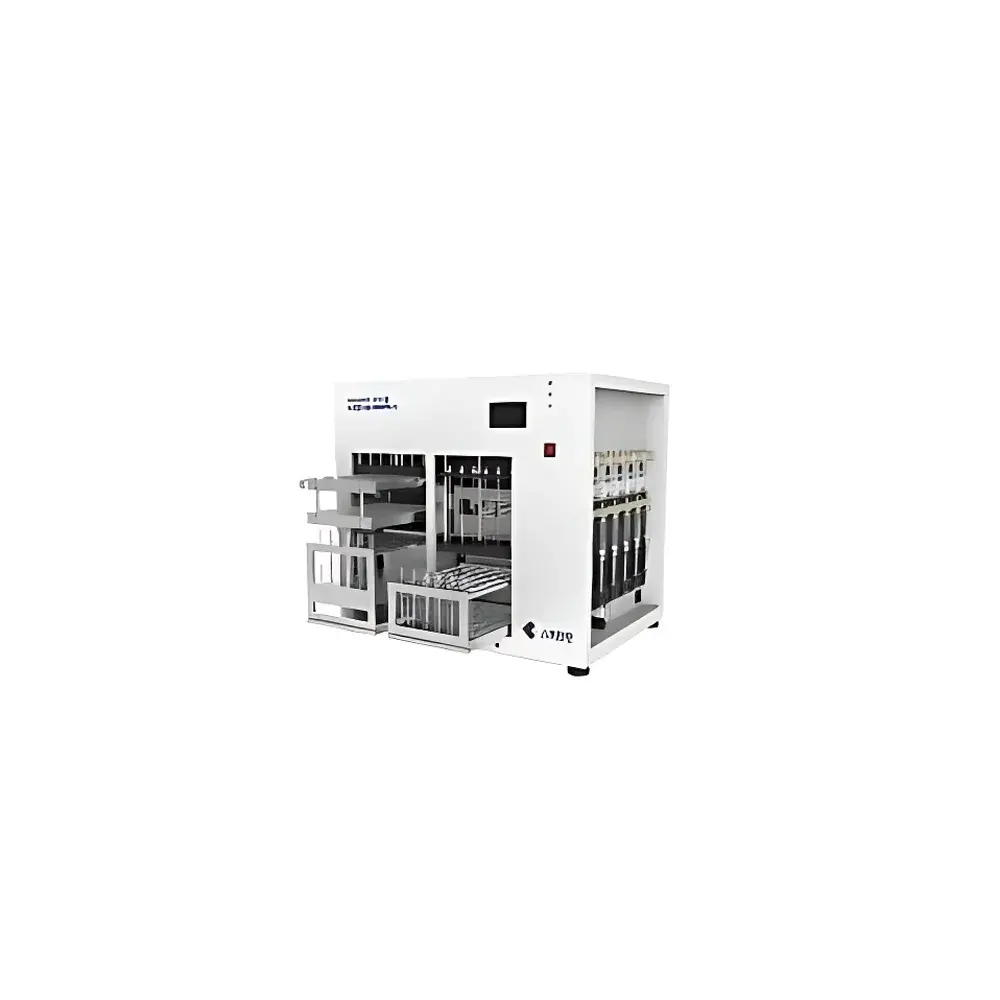
KEZHE GOODSPE-8600 High-Throughput Automated Solid Phase Extraction System
| Brand | KEZHE Shanghai |
|---|---|
| Origin | Shanghai, China |
| Manufacturer Type | Original Equipment Manufacturer (OEM) |
| Country of Origin | China |
| Model | GOODSPE-8600 |
| Automation Level | Fully Automated |
| Number of Channels | 6 (configurable from 2 to 10) |
| SPE Format Compatibility | Cartridge & Disk (Column-Membrane Universal) |
| Flow Rate Range | 0.1–100 mL/min per channel |
| Solvent Selection | 8 independent solvent channels with multi-position valve switching |
| Sample Capacity | Up to 72 samples per batch |
| Sample Loading Volume | 1–80 mL (standard) |
| Elution Fraction Volumes | 20 mL or 80 mL (customizable) |
| Wetting/Soak Function | Yes |
| Sequential Column Stacking (Tandem SPE) | Yes |
| Solvent Contact Materials | PTFE (Teflon®), Borosilicate Glass |
| Waste Management | 3 independent waste lines (organic, aqueous, acidic) |
| Positioning Accuracy | ±0.1 mm |
| Liquid Handling Accuracy | ≥99% |
| Power Supply | 100–240 VAC, 50/60 Hz |
| Software Interface | Windows-based GUI with real-time status monitoring, method error detection, audit-trail-enabled logging, and Wi-Fi connectivity |
Overview
The KEZHE GOODSPE-8600 is a high-throughput, fully automated solid phase extraction (SPE) system engineered for reproducible, unattended sample preparation in regulated and high-volume analytical laboratories. It operates on the principle of selective adsorption and elution of analytes from complex liquid matrices—such as environmental water, food extracts, biological fluids, and pharmaceutical formulations—onto functionalized sorbent phases (e.g., C18, silica, ion-exchange, or mixed-mode cartridges and disks). Unlike manual or semi-automated platforms, the GOODSPE-8600 integrates precise fluidic control, spatially resolved robotic handling, and intelligent process sequencing to execute all critical SPE steps—including column conditioning, sample loading, washing, nitrogen-assisted drying, and gradient or stepwise elution—in a single, programmable workflow. Its architecture supports both conventional cartridge-based and membrane disk-based formats, enabling method flexibility across trace organic analysis workflows destined for GC, HPLC, LC-MS/MS, or GC-MS instrumentation.
Key Features
- Fully automated, walk-away operation: executes column activation, sample loading, wash, dry, and elution without manual intervention.
- Modular 6-channel core platform (expandable to 2–10 channels), each equipped with a high-precision 10 mL syringe pump delivering flow rates from 0.1 to 100 mL/min with ≤1% CV repeatability.
- Universal SPE format support: accommodates 1 mL, 3 mL, 6 mL, and 12 mL cartridges from multiple vendors, plus disk-based membranes—enabling method transfer and application scalability.
- Dual-arm robotic architecture: three independent motorized arms handle sample racks, collection tubes, and SPE columns simultaneously; coordinated motion ensures zero cross-contamination and collision-free operation.
- Nitrogen-assisted drying with external gas source and dedicated three-way valve: maintains stable flow during drying, eliminates pressure fluctuations, and achieves consistent residual solvent removal prior to elution.
- Eight-solvent reservoir system with high-integrity multi-port valve switching: enables sequential or combinatorial solvent delivery for complex cleanup protocols (e.g., multi-step washing or pH-controlled elution).
- Large-volume processing capability: optional deep-well sample racks support direct extraction of ≥1 L aqueous samples—ideal for EPA Method 525.3, ISO 17993, or EN 16699 applications.
- Integrated waste management: three segregated waste lines (organic, aqueous, acidic) prevent solvent incompatibility and corrosion; deep-well exhaust troughs are physically isolated from sample and collection zones.
- Onboard needle wash station with dual rinse ports (aqueous + organic): prevents carryover between samples and extends consumable lifetime.
- Compact footprint (<900 mm W × 700 mm D × 750 mm H): designed for under-hood installation in standard fume hoods; solvent bottle tray integrated into upper chassis.
Sample Compatibility & Compliance
The GOODSPE-8600 is validated for use with aqueous, alcoholic, and mildly acidic or basic matrices typical of environmental, food safety, and clinical toxicology labs. All wetted surfaces contacting solvents or samples consist exclusively of chemically inert materials—PTFE (Teflon®) tubing, borosilicate glass manifolds, and ceramic-coated stainless steel fittings where structural integrity demands it—ensuring compatibility with aggressive solvents (e.g., dichloromethane, acetonitrile, 1% formic acid) and eliminating metal leaching risks in trace-level analyses. The system complies with key regulatory expectations for data integrity: its software implements full 21 CFR Part 11-compliant audit trails, electronic signatures, method version control, and tamper-evident log files. It supports GLP/GMP-aligned workflows through user-role permissions, instrument calibration logs, and hardware-initiated error flagging with timestamped event records.
Software & Data Management
The GOODSPE-8600 is controlled via KEZHE’s proprietary Windows-based SPEControl™ software, accessible over secure Wi-Fi—eliminating cable clutter and enabling remote operation from office workstations or adjacent lab rooms. The graphical interface provides real-time visualization of arm positions, pump status, solvent selection, and elapsed time per step. Method development includes drag-and-drop protocol building, soak/dwell time definition, tandem column configuration, and fraction-collection mapping. Critical safeguards include intelligent syntax validation during method editing, automatic conflict detection (e.g., incompatible solvent sequences), and pre-run hardware self-checks. All operational data—including method parameters, run logs, alarm history, and maintenance events—is stored in encrypted SQLite databases with daily auto-backup options. Export formats include CSV, PDF reports, and XML for LIMS integration.
Applications
The GOODSPE-8600 serves as a foundational front-end solution for quantitative trace analysis across regulated sectors:
- Environmental testing: EPA Methods 508.1, 525.2, 525.3, 8081B, 8270D, and ISO 17993 for pesticides, PAHs, PCBs, dioxins/furans, brominated flame retardants, and endocrine disruptors in drinking water, wastewater, and soil extracts.
- Food & beverage safety: Multi-residue analysis per EU SANTE/11312/2021, AOAC 2007.01, and GB 23200 series for organophosphates, neonicotinoids, mycotoxins, veterinary drug residues (e.g., sulfonamides, quinolones), and plasticizers (e.g., phthalates, bisphenol A).
- Pharmaceutical QC: Extraction of active pharmaceutical ingredients (APIs) and leachables from parenteral solutions, oral suspensions, and packaging materials per USP , , and ICH Q5C guidelines.
- Clinical & forensic toxicology: Isolation of drugs of abuse (e.g., opioids, benzodiazepines, amphetamines), metabolites, and novel psychoactive substances from urine, plasma, and hair digests prior to LC-MS/MS analysis.
- Research applications: Coupling with offline GPC (gel permeation chromatography) or ASE (accelerated solvent extraction) systems for comprehensive sample clean-up in natural product isolation, polymer additive screening, and biomarker discovery.
FAQ
Does the GOODSPE-8600 support method validation per ISO/IEC 17025 requirements?
Yes—the system provides full traceability of instrument parameters, operator actions, and environmental conditions during runs, supporting documented IQ/OQ/PQ protocols.
Can it handle viscous or particulate-laden samples?
Pre-filtration is recommended; the system accepts clarified supernatants or centrifuged extracts but does not include inline filtration. Optional in-line 0.45 µm syringe filters can be integrated at the inlet manifold.
Is remote troubleshooting supported?
KEZHE offers secure remote desktop access (with customer consent) for firmware updates, diagnostic logging, and configuration review—fully compliant with GDPR and HIPAA data-handling policies.
What maintenance intervals are recommended?
Syringe pump calibration every 6 months; PTFE tubing replacement every 12 months or after 500 runs; nitrogen filter cartridge replacement quarterly; full optical encoder alignment annually.
Are third-party SPE cartridges compatible?
All standard 1/3/6/12 mL polypropylene or glass cartridges from Waters, Agilent, Thermo Fisher, and Phenomenex are mechanically and hydraulically compatible; no adapters required.



