
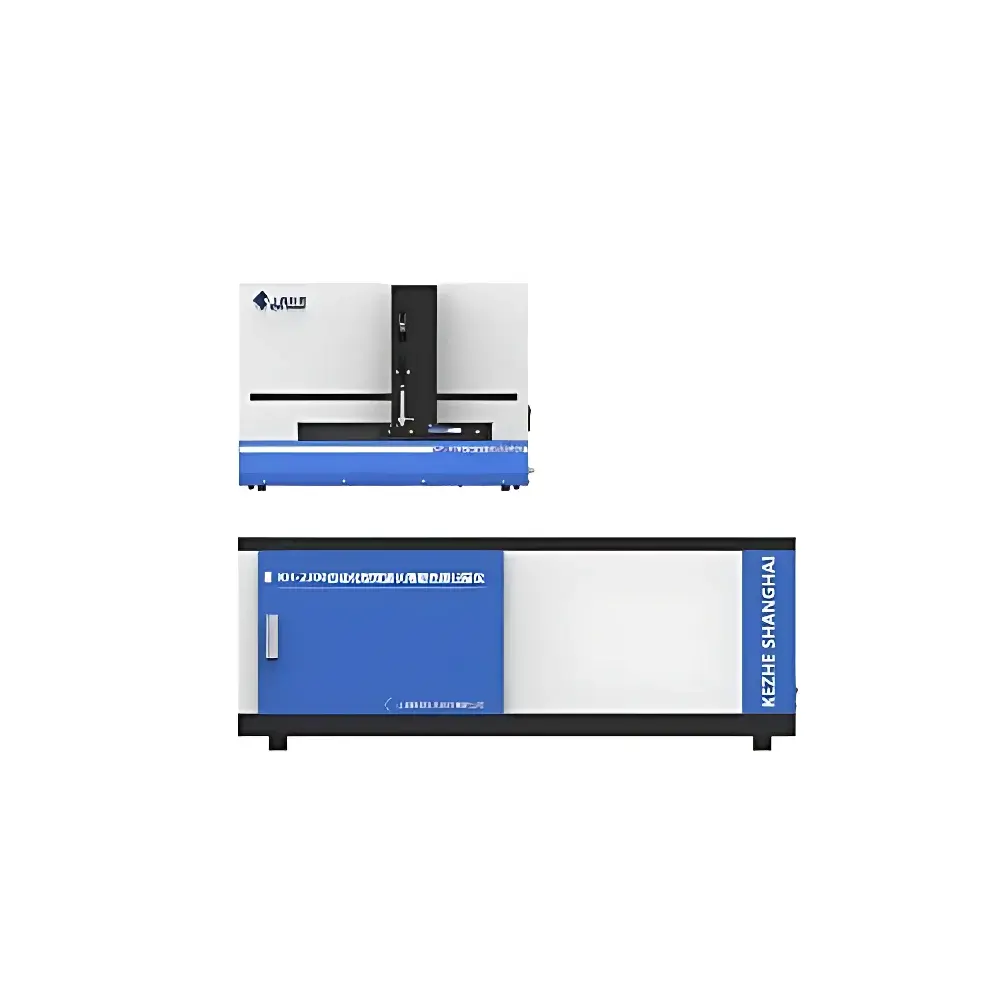
KEZHE SHANGHAI KH-2300 Automated Dual-Wavelength Thin-Layer Chromatography Scanner
| Brand | KEZHE SHANGHAI |
|---|---|
| Origin | Shanghai, China |
| Manufacturer Type | Direct Manufacturer |
| Model | KH-2300 |
| Instrument Type | TLC Scanner |
| Operation Mode | Fully Automatic |
| Measurement Modes | Reflectance, Fluorescence (optional), Absorbance |
| Wavelength Range | 190–700 nm (automatically programmable) |
| Light Source | Deuterium Lamp + Tungsten Halogen Lamp |
| Monochromator | Holographic Grating |
| Spectral Bandwidth | 5 nm |
| Wavelength Accuracy | ≤ ±1 nm |
| Wavelength Repeatability | RSD ≤ 2.0% |
| Minimum Spatial Resolution | 25 µm |
| Imaging Wavelengths | 254 nm, 365 nm, White Light |
| Sample Stage Capacity | Up to 20 × 30 cm TLC plates of arbitrary thickness |
| Scanning Speed | 0–50 mm/s |
| Auto-sampler Capacity | 96 × 2 mL vials |
| Minimum Spot Volume | 10 nL |
| Spotting Modes | Circular, Band, Square |
| Band Length Range | 5–195 mm |
| Heating Base Temperature Range | 30–60 °C (±1 °C) |
| Optional Accessories | TS-II Dual-Nozzle Electrospray Nebulizer, TD-II Automated TLC Plate Coater, TK-10 Electronic Development Chamber |
Overview
The KEZHE SHANGHAI KH-2300 is a fully integrated, dual-wavelength automated thin-layer chromatography (TLC) scanning system engineered for high-throughput, regulatory-compliant quantitative analysis in pharmaceutical quality control laboratories. It combines a precision optical scanner with an integrated SP-30E-class automatic TLC spotter—enabling synchronized, position-matched spotting and scanning without manual plate repositioning. The instrument operates on the principle of reflectance densitometry: incident light at user-selectable wavelengths (190–700 nm) is directed onto developed TLC plates; reflected or fluorescent emission intensities are captured via a high-stability photomultiplier tube (PMT) detector, enabling quantification based on Beer–Lambert law (absorbance) or linear fluorescence response. Its dual-lamp source (deuterium + tungsten halogen) ensures continuous spectral coverage from deep UV to visible range, critical for detecting diverse phytochemicals, alkaloids, flavonoids, and synthetic APIs per Chinese Pharmacopoeia (ChP) monographs.
Key Features
- Fully automated workflow: Integrated auto-spotter and scanner share identical coordinate referencing—eliminating positional drift between spotting and scanning, ensuring measurement traceability.
- Dual-wavelength scanning capability: Simultaneous or sequential acquisition at 254 nm and 365 nm, plus white-light imaging for plate documentation—supports both UV-absorbing and native-fluorescent analytes without plate repositioning.
- Regulatory-ready hardware architecture: Complies with JJG 868–2019 “Verification Regulation for TLC Scanners” (PRC National Metrological Verification Regulation); certified under ISO 9001:2000 Quality Management System.
- Thermally controlled spotting stage: Heated base (30–60 °C, ±1 °C) accelerates solvent evaporation post-spotting, minimizing diffusion artifacts and improving spot integrity for reproducible quantitation.
- Multi-mode spotting: Supports circular, band, and square deposition patterns; band spotting (5–195 mm) recommended for improved resolution in multi-component herbal extracts.
- Automated needle washing and degassing: Reduces carryover and bubble-induced volume error during sequential sample loading across 96 vials.
- Pre-loaded ChP method library: Embedded analytical protocols for TLC-based assays from ChP 2000, 2005, 2010, 2015, and 2020 editions—including validation parameters, calibration ranges, and acceptance criteria.
Sample Compatibility & Compliance
The KH-2300 accommodates standard silica gel, aluminum oxide, cellulose, and RP-18 TLC plates up to 20 × 30 cm, regardless of backing rigidity or thickness. Its open-stage design permits direct integration with optional accessories—including TS-II dual-nozzle electrospray nebulizers for low-volume, high-resolution band application, and TD-II automated plate coaters for uniform layer preparation. From a compliance standpoint, the system supports audit-trail-enabled operation when paired with validated TStar-2100 software (Windows 7/10), fulfilling core requirements of GLP and GMP environments. While not inherently 21 CFR Part 11 compliant out-of-the-box, its software architecture allows configuration for electronic signature, user access control, and immutable data logging—enabling qualification for FDA-inspected facilities upon site-specific validation.
Software & Data Management
TStar-2100 professional workstation provides unified control over spotting, scanning, and data evaluation. Spotting software manages X/Y/Z-axis motion, needle calibration, temperature setpoints, and wash cycles; scanning software delivers real-time chromatogram visualization, peak detection (with baseline correction algorithms), integration (tangent skim, valley-to-valley), and calibration curve generation (linear, quadratic, or cubic regression). Quantitative outputs include peak area/height, Rf values, correlation coefficients (r²), limit of detection (LOD), and final concentration reports. All raw scan data (.tsd), method files (.tmd), and report templates (.rtf/.pdf) are stored in structured directories with timestamped metadata—facilitating retrospective review and data reprocessing per ICH Q5A and USP .
Applications
The KH-2300 is optimized for routine QC of traditional Chinese medicine (TCM) preparations, including decoction pieces, granules, tablets, and injections. Typical use cases include: quantification of marker compounds (e.g., paeoniflorin in *Paeonia lactiflora*, berberine in *Coptis chinensis*); identity testing of multi-herb formulations via fingerprint profiling; stability-indicating assays for degradation product monitoring; and batch release testing aligned with ChP general chapters 0502 (TLC Identification) and 0512 (TLC Quantitation). Its automation and method portability also support contract research organizations (CROs) performing method transfer studies between labs, as well as academic labs conducting natural product isolation screening.
FAQ
Does the KH-2300 support fluorescence detection?
Yes—fluorescence scanning is available as a factory-configured option, utilizing the same optical path and PMT detector with appropriate excitation/emission filters.
Can the system be validated for GMP use?
Yes—the hardware meets JJG 868–2019 metrological requirements, and TStar-2100 software can be qualified for 21 CFR Part 11 compliance through documented IQ/OQ/PQ protocols.
What is the smallest detectable spot volume?
The auto-spotter achieves minimum dispensing volumes of 10 nL using calibrated 25 µL syringes; actual detection limit depends on analyte extinction coefficient and plate sensitivity.
Is method transfer possible between KH-2300 units?
Yes—method files (.tmd), calibration curves, and plate layout definitions are portable across instruments running identical TStar-2100 firmware versions.
Does the system support external data export for LIMS integration?
Yes—scan results and quantitative reports can be exported in CSV, TXT, or PDF formats; custom XML schema mapping is supported via API extension modules.
Related Products




