
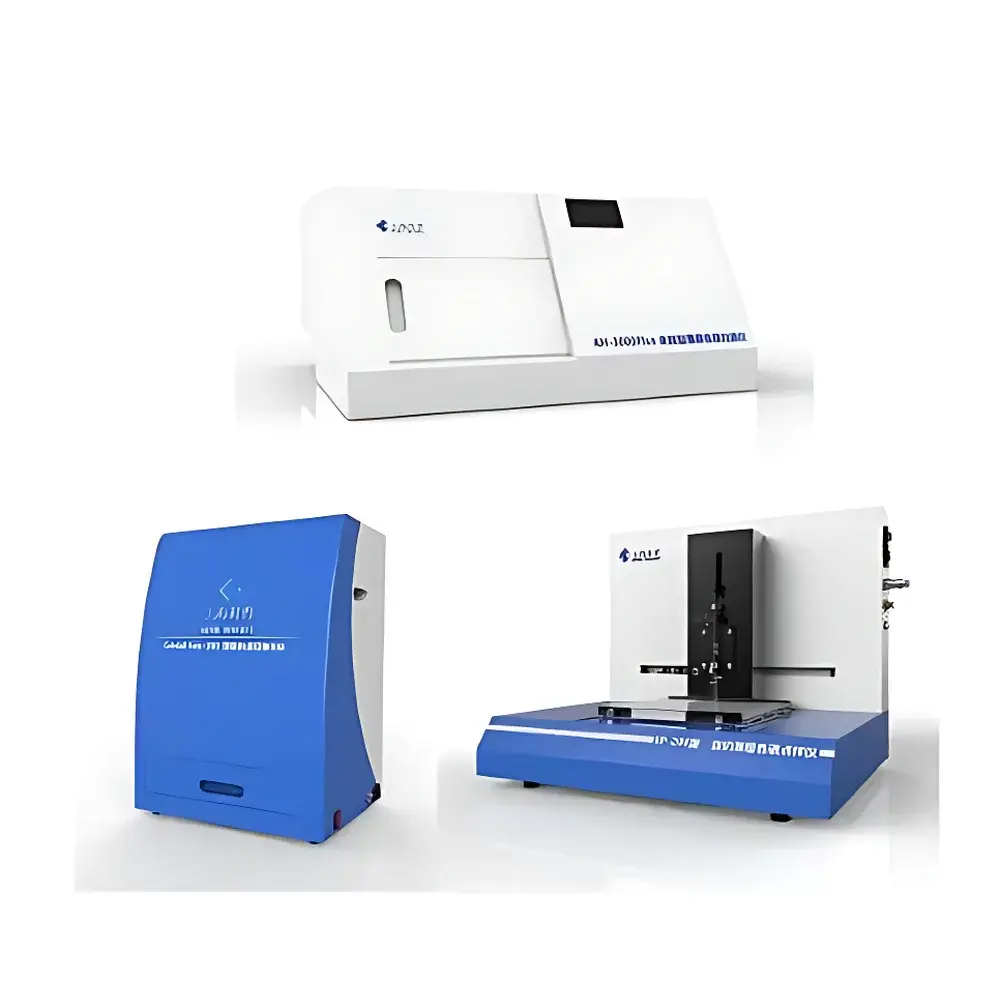
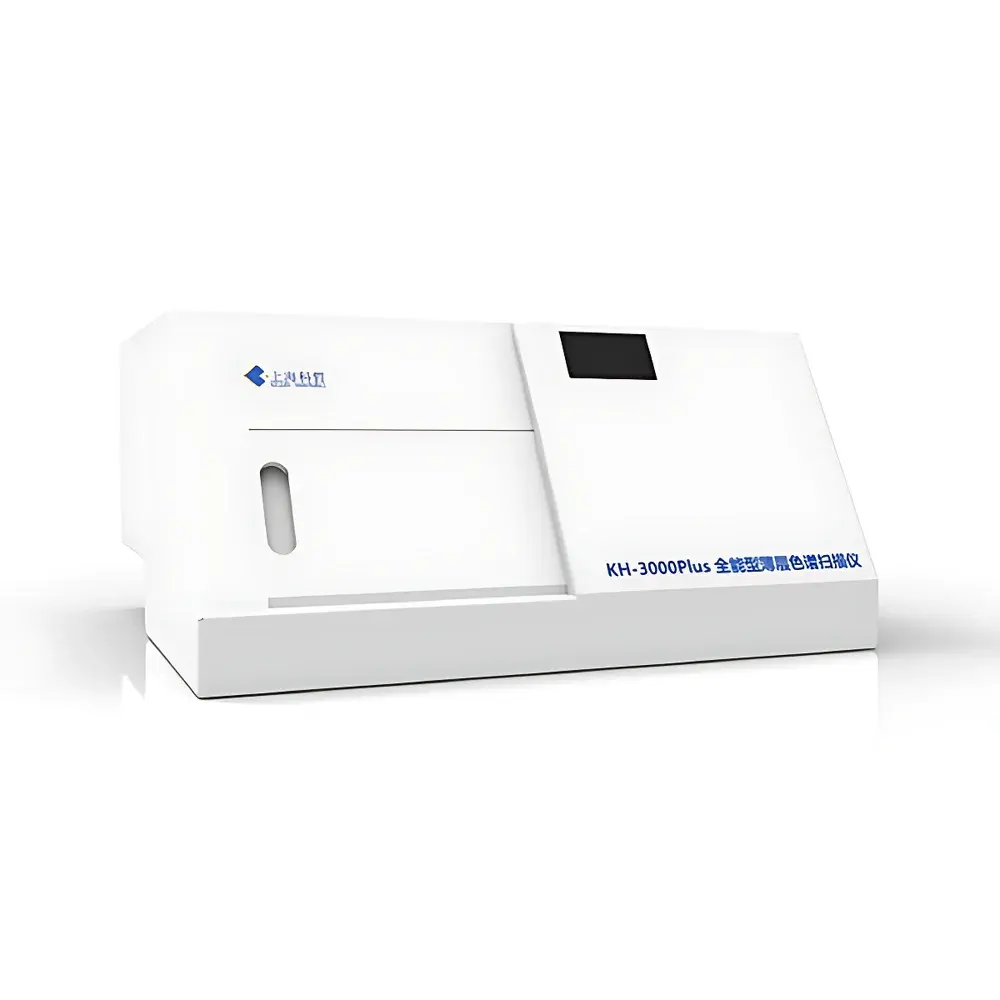
KEZHE SHANGHAI KH-3000Plus Universal Thin-Layer Chromatography Scanner
| Brand | KEZHE SHANGHAI |
|---|---|
| Origin | Shanghai, China |
| Manufacturer Type | Original Equipment Manufacturer (OEM) |
| Instrument Type | TLC Densitometer |
| Measurement Modes | Reflectance Absorption, Reflectance Fluorescence, Transmission Absorption, Transmission Fluorescence, Chemiluminescence |
| Wavelength Range | 190–900 nm (continuously adjustable) |
| Light Sources | Tungsten-halogen lamp, Deuterium lamp, Mercury lamp (auto-switching) |
| Monochromator | Holographic grating (1200 lines/mm) with nitrogen purge capability |
| Spectral Bandwidth | 5 nm / 10 nm / 20 nm (user-selectable |
| Wavelength Accuracy | ±0.5 nm |
| Wavelength Repeatability | <0.1 nm |
| Minimum Spatial Resolution | 10–25 µm |
| Imaging Wavelengths | 254 nm, 365 nm, White Light (fully automated control) |
| Sample Stage Capacity | Accommodates 200 mm × 200 mm TLC plates (customizable up to 300 mm × 200 mm) |
| Scan Speed | 0–120 mm/s |
Overview
The KEZHE SHANGHAI KH-3000Plus Universal Thin-Layer Chromatography (TLC) Scanner is an integrated analytical platform engineered for high-precision densitometric quantification and digital image analysis of chromatographic separations on planar stationary phases. Based on dual-detection architecture—combining photomultiplier tube (PMT)-based scanning densitometry with high-fidelity CCD imaging—it enables simultaneous acquisition of quantitative spectral data and spatially resolved visual documentation. The instrument operates across a broad UV-Vis spectral range (190–900 nm), supporting reflectance and transmission modes in absorption and fluorescence detection geometries—including chemiluminescence—making it suitable for pharmaceutical QC, herbal fingerprinting, forensic toxicology, and regulatory compliance workflows. Its optical design incorporates auto-switching light sources (tungsten-halogen, deuterium, mercury), a high-efficiency holographic grating monochromator with nitrogen purge option to suppress ozone-induced absorption artifacts, and continuously variable slit geometry for adaptive spot sizing and signal-to-noise optimization. Designed to meet stringent requirements of national arbitration laboratories and GMP/GLP-regulated environments, the KH-3000Plus complies with Chinese Pharmacopoeia (2005–2020 editions), USP , and ISO/IEC 17025 traceability frameworks.
Key Features
- Dual-detector architecture: Synchronized PMT-based densitometry and high-resolution CCD imaging for concurrent quantitative and qualitative analysis
- Automated 8-position fluorescence filter wheel with customizable bandpass filters (e.g., K320, K360, K400, K450, K510, K550)
- Continuously variable slit system (0–8 mm length × 0–4 mm width), computer-controlled for optimal spot resolution and dynamic range adaptation
- 24-bit A/D conversion with 8-channel parallel acquisition, 20 µs sampling interval, and 30,000 data points per second throughput
- Linear scanning mode with positional accuracy <0.2% and repeatability <0.5% RSD across full travel (up to 120 mm/s)
- Integrated Goodsee-20E TLC imaging station with automatic illumination correction, geometric distortion compensation, and Rf-guided peak annotation
- Tstar-3000Plus workstation software compliant with FDA 21 CFR Part 11 (electronic signatures, audit trails, user access controls), GLP/GMP documentation standards, and Chinese Pharmacopoeia method libraries
- Full peripheral interoperability: native control of SP-20E automatic band applicator, TK-20E automated development chamber, TS-20E quantitative derivatization sprayer, and TBS-5 method development system
Sample Compatibility & Compliance
The KH-3000Plus accommodates standard silica gel, alumina, cellulose, and reversed-phase TLC plates up to 200 mm × 200 mm (extendable to 300 mm × 200 mm upon request), supporting both manual and automated band application protocols. Its non-contact dispensing mechanism ensures minimal plate surface disturbance and high reproducibility ( 0.999 over 3 orders of magnitude), LOD/LOQ determination, precision (intra-day and inter-day RSD <2%), and robustness testing under wavelength, slit width, and scan speed variations. Data integrity safeguards include timestamped audit logs, electronic signature workflows, and immutable raw data archiving in vendor-neutral formats (e.g., TIFF, CSV, XML).
Software & Data Management
Tstar-3000Plus is a modular, Windows 7/10-native application integrating three core functional suites: (1) Densitometric Analysis Module—with single/dual-wavelength scanning, spectral scanning, multi-point calibration (linear, quadratic), peak integration (baseline subtraction, valley-to-valley, tangent skim), and Rf-dependent response correction; (2) Image Analysis Module (Goodsee-20E)—featuring auto-Rf calculation, background-subtracted densitometry, similarity indexing (correlation coefficient, cosine similarity), and comparative overlay of multiple lanes or plates; (3) Workflow Orchestration Module—enabling sequence-driven automation of sample application → development → derivatization → imaging → scanning → reporting. All modules generate ALCOA+ compliant reports (Attributable, Legible, Contemporaneous, Original, Accurate), exportable to PDF/A-1b, Excel, or LIMS-compatible XML. Raw spectral and image datasets are stored in hierarchical folder structures with SHA-256 checksum verification and optional AES-256 encryption.
Applications
The KH-3000Plus serves as a primary analytical tool in regulated quality control laboratories for herbal medicine standardization (e.g., TCM fingerprinting per Chinese Pharmacopoeia Vol. I), residual solvent screening in APIs, pesticide residue analysis in food matrices, and stability-indicating assay development. Its chemiluminescence capability supports detection of peroxide-sensitive compounds and enzymatic reactions (e.g., horseradish peroxidase-coupled immunoassays on TLC membranes). In forensic applications, it enables rapid identification of controlled substances via dual-wavelength ratio analysis and spectral library matching. Academic users leverage its open API for custom algorithm integration—such as machine learning–based spot classification or multivariate curve resolution (MCR) for co-eluting components. The system’s ability to generate pharmacopoeial-compliant reports—including Rf, peak area %, relative standard deviation, and annotated chromatograms—streamlines submissions to NMPA, FDA, EMA, and WHO prequalification dossiers.
FAQ
Does the KH-3000Plus support 21 CFR Part 11 compliance out of the box?
Yes—Tstar-3000Plus includes configurable electronic signature workflows, role-based access control, and tamper-evident audit trails meeting FDA 21 CFR Part 11 Subpart B requirements.
Can the instrument perform quantitative analysis without prior calibration standards?
No—quantitative densitometry requires reference standard curves generated from known concentrations; however, the software supports internal standard normalization and relative quantitation using peak area ratios.
Is nitrogen purge mandatory for UV measurements below 220 nm?
Nitrogen purging is recommended for measurements at 190–210 nm to eliminate atmospheric oxygen absorption; the monochromator housing includes dedicated inlet/outlet ports for continuous purge gas flow.
What is the maximum plate thickness supported by the scanning stage?
The Z-axis travel accommodates plates up to 3.2 mm thick, including glass-backed silica gel layers and flexible polyester-supported membranes.
How does the trajectory tracking function improve scanning accuracy?
By capturing real-time CCD images during scanning, the system detects lane curvature or plate warping and dynamically adjusts the scan path vector—reducing positional error to <5 µm RMS across 200 mm travel.
Related Products






