
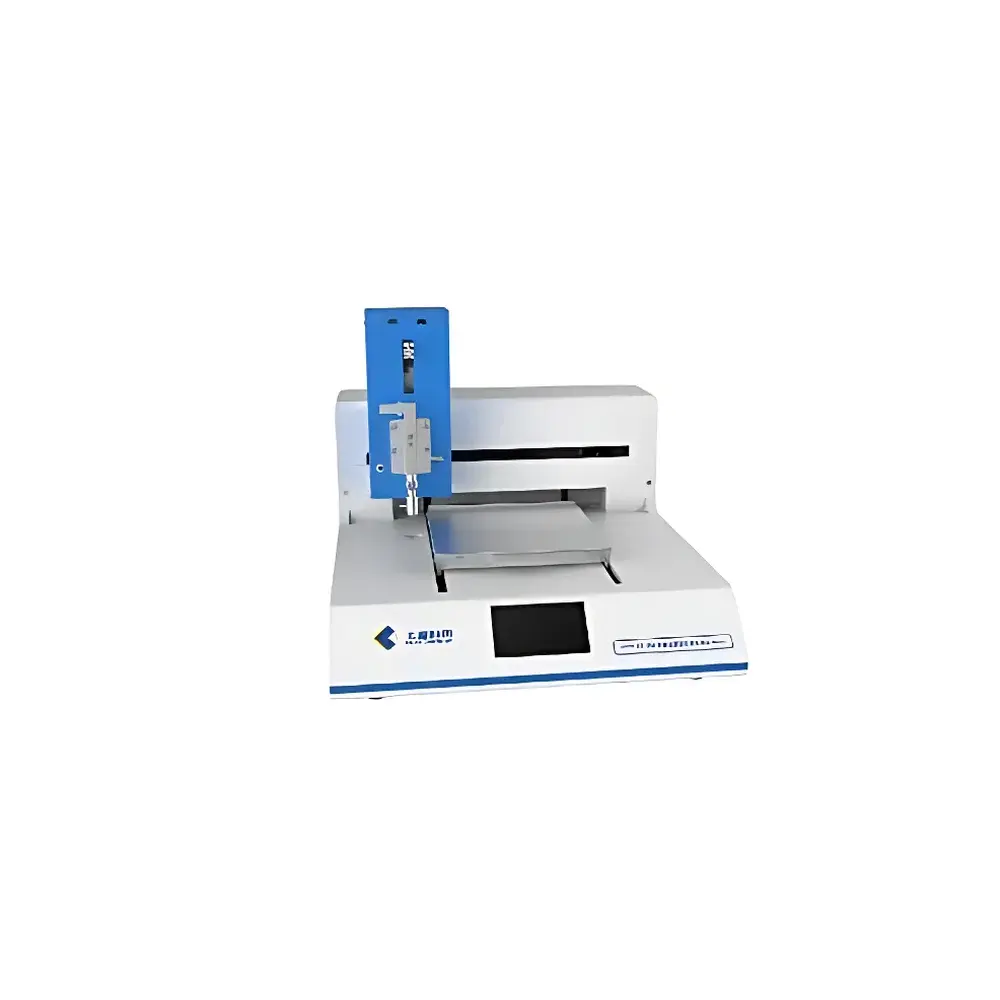
KEZHE SHANGHAI SP-20E Automated Thin-Layer Chromatography (TLC) Sample Spotter
| Brand | KEZHE SHANGHAI |
|---|---|
| Origin | Shanghai, China |
| Manufacturer Type | Direct Manufacturer |
| Model | SP-20E |
| Instrument Type | Automated TLC Sample Spotter |
| Detection Modes | Reflectance Absorption, Reflectance Fluorescence, Transmission Absorption, Transmission Fluorescence |
| Wavelength Range | 190–800 nm |
| Light Sources | Xenon Lamp, Tungsten-Halogen Lamp, High-Pressure Mercury Lamp |
| Monochromator | Holographic Grating (1200 lines/mm) with Nitrogen Purge Capability |
| Spectral Bandwidth | 5 nm |
| Wavelength Accuracy | < 1 nm |
| Wavelength Repeatability | < 0.2 nm |
| Minimum Spatial Resolution | 25 µm |
| Imaging Wavelengths | 254 nm, 365 nm, White Light |
| Sample Stage Capacity | Up to 200 mm × 200 mm TLC Plates |
| Maximum Scanning Speed | 100 mm/s |
| Spotting Mode | Contactless Linear Band Deposition |
| Spotting Length | 5–195 mm (customizable) |
| Spotting Volume | 1–20 µL (customizable up to higher volumes) |
| Flow Rate Options | 0.5, 1, 2, 5, 10 µL/min |
| Power Supply | 220 V, 50 Hz, 90 W |
| Software Platform | Windows 7/10 Compatible Dedicated TLC Spotting Workstation |
Overview
The KEZHE SHANGHAI SP-20E Automated Thin-Layer Chromatography (TLC) Sample Spotter is an engineered solution for high-precision, reproducible, and fully programmable sample deposition onto planar chromatographic plates. Designed specifically for laboratories performing quantitative or semi-quantitative TLC analysis—particularly those integrating with subsequent densitometric scanning—the SP-20E implements non-contact linear band spotting using precision syringe-driven dispensing and closed-loop stepper motor positioning. Unlike conventional manual or contact-based capillary spotting, this system eliminates plate surface damage, solvent spreading, and sample carryover, ensuring consistent spot geometry critical for accurate calibration curves and peak integration in reflectance or transmission mode detection. Its optical architecture supports multi-wavelength excitation and imaging (254 nm, 365 nm, white light), enabling compatibility with both UV-absorbing and fluorescent analytes across pharmaceutical, natural product, forensic, and quality control applications.
Key Features
- Non-contact linear band spotting with sub-25 µm spatial resolution ensures narrow, uniform deposition profiles—maximizing chromatographic resolution and minimizing zone broadening during development.
- Programmable flow rates (0.5–10 µL/min) and volumetric precision (1–20 µL per band, scalable) support method optimization for diverse matrix viscosities and analyte concentrations.
- Motorized XYZ stage with ±1 µm positional repeatability enables precise alignment of bands relative to origin lines, plate edges, and scanner reference markers.
- Dual optical detection capability: integrated reflectance and transmission modes support both absorption and fluorescence quantification without hardware reconfiguration.
- Holographic grating monochromator (1200 lines/mm) with nitrogen purge option minimizes ozone generation and maintains spectral stability during extended UV operation (190–400 nm).
- Real-time graphical interface displays current position, flow status, and spotting progress; methods—including multi-segment gradients, pause intervals, and repeat cycles—are stored indefinitely and recallable via password-protected user profiles.
Sample Compatibility & Compliance
The SP-20E accommodates standard silica gel, alumina, cellulose, and reversed-phase TLC plates up to 200 mm × 200 mm—including pre-coated, glass-backed, and flexible polyester substrates. Its open-platform design allows integration with common plate development tanks and visualization systems. From a regulatory standpoint, the instrument supports audit-ready workflows aligned with GLP and GMP principles: all spotting parameters (volume, speed, coordinates, timestamp) are logged automatically within the workstation software. While not certified as 21 CFR Part 11 compliant out-of-the-box, the software architecture permits configuration of electronic signatures, change controls, and secure data export—facilitating validation under ISO/IEC 17025, USP , and ICH Q2(R2) guidelines for analytical method verification.
Software & Data Management
The dedicated TLC Spotting Workstation software runs natively on Windows 7 and 10 platforms and provides a modular interface for method creation, plate mapping, and real-time monitoring. Users define spotting sequences using drag-and-drop plate templates, assign individual parameters per lane (e.g., different volumes, speeds, or dwell times), and simulate deposition paths prior to execution. All raw method files (.spf) and execution logs (.log) are stored in encrypted SQLite databases with optional network backup. Export formats include CSV (for LIMS ingestion), PNG (annotated plate maps), and XML (for cross-platform instrument interoperability). Version-controlled firmware updates ensure long-term maintainability and backward compatibility with legacy methods.
Applications
- Pharmaceutical QC: Uniform band spotting of active pharmaceutical ingredients (APIs) and impurities for identity confirmation and assay validation per USP monographs.
- Natural product profiling: Simultaneous deposition of multiple herbal extracts onto single plates to enable comparative fingerprinting and marker compound tracking.
- Forensic toxicology: High-throughput screening of controlled substances in biological matrices with optimized band widths for enhanced separation of structurally similar alkaloids or cannabinoids.
- Academic research: Method development for chiral TLC, gradient elution analogues, and coupling with post-chromatographic derivatization protocols.
- Regulatory submission support: Generation of traceable, repeatable spotting records required for ANDA, NDA, or CMC documentation packages.
FAQ
What distinguishes band spotting from traditional circular spotting in TLC?
Band spotting deposits samples as narrow, continuous lines perpendicular to the solvent front—increasing loading capacity while preserving sharp migration boundaries. This geometry improves peak capacity and quantitation linearity, especially when coupled with slit-scanning densitometry.
Can the SP-20E be integrated with third-party TLC scanners?
Yes. Plate coordinate definitions and spotting metadata are exported in standardized formats compatible with CAMAG, Desaga, and other major densitometer software suites.
Is nitrogen purging mandatory for UV operation below 220 nm?
Nitrogen purge is recommended—not mandatory—for extended operation at 190–210 nm to suppress atmospheric ozone absorption and maintain photometric stability over time.
How is calibration verified for volumetric accuracy?
Calibration is performed using gravimetric measurement of dispensed solvent (e.g., methanol) on an analytical balance (0.01 mg resolution), traceable to NIST standards. A full calibration report template is included in the software.
Does the system support unattended overnight operation?
Yes. The instrument includes hardware interlocks, thermal monitoring, and auto-shutdown on error detection—enabling scheduled batch processing across multiple plates without operator intervention.





