
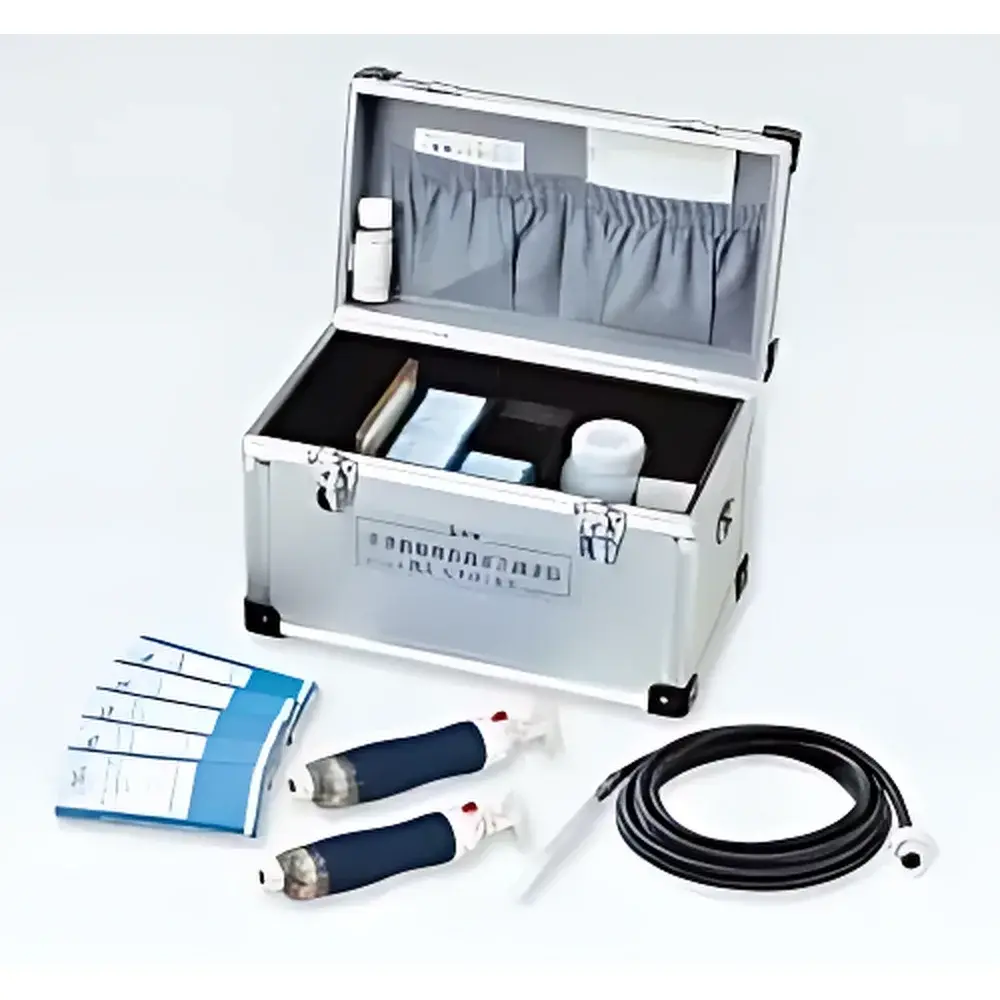
Kikuchi P-51 Emergency Toxic & Hazardous Gas Detection Kit
| Brand | Kikuchi |
|---|---|
| Origin | Japan |
| Model | P-50/P-51 |
| Configuration | AP-20 dual syringe pump, SH-5N 5-m remote sampling tube, collection box, B-191 tube cutter, qualitative chart for organic/inorganic gases, spent tube disposal container, instruction manual (Organic Kit 186B ×1, Inorganic Kit 131 ×1, CO/SO₂/CO₂/H₂S/NH₃/C₆H₆/Cl₂/HCl/gasoline/NOₓ ×1 each, 10 tubes per box) |
| Compliance | Meets China MEE on-site emergency monitoring requirements |
| Regulatory Context | Designed for field use under ISO 16000-23, ASTM D5402, and OSHA 29 CFR 1910.120 guidelines |
Overview
The Kikuchi P-51 Emergency Toxic & Hazardous Gas Detection Kit is a field-deployable, colorimetric gas analysis system engineered for rapid qualitative and semi-quantitative identification of airborne contaminants during industrial accidents, chemical spills, confined-space entries, or disaster response operations. It operates on the principle of length-of-stain (LOS) colorimetric detection: when air is drawn through a glass detection tube containing a chemically impregnated reagent, target analytes react to produce a visible color front whose length correlates with concentration. This method requires no power supply, calibration gases, or software—enabling immediate deployment in off-grid, high-risk environments where electronic sensors may fail or pose ignition hazards. The P-51 kit is optimized for compliance with China’s Ministry of Ecology and Environment (MEE) technical specifications for on-site emergency monitoring and aligns with international field-sampling best practices defined in ISO 16000-23 (indoor air—determination of formaldehyde and other carbonyls) and ASTM D5402 (standard practice for sampling and analysis of hazardous air pollutants using detector tubes). Its architecture prioritizes operator safety through 5-meter remote sampling capability, eliminating direct exposure to unknown plumes.
Key Features
- Remote sampling via SH-5N flexible hose (5 m length), enabling safe standoff distance from leak sources or contaminated zones
- Dual AP-20 hand-pump samplers with calibrated stroke volume (100 mL/stroke) for reproducible draw volumes across repeated measurements
- Comprehensive qualitative screening: one inorganic tube (Model 131) detects >12 common inorganic gases (e.g., H₂S, Cl₂, NH₃, SO₂, HCl); one organic tube (Model 186B) screens >40 volatile organic compounds (VOCs)
- Semi-quantitative analysis using over 300 certified Kikuchi detection tubes—including saturated/unsaturated hydrocarbons (propane, butane, acetylene), aromatics (benzene, toluene, xylene), oxygenates (acetone, formaldehyde, acetaldehyde), alcohols, carboxylic acids, esters, and amines
- Integrated accessories: B-191 precision tube cutter for consistent breakage, dedicated spent-tube disposal container for regulated waste handling, and laminated qualitative reference chart for rapid interpretation
- Optional DS-110 night-vision magnifier for low-light conditions and enhanced stain-length reading accuracy
Sample Compatibility & Compliance
The P-51 kit supports direct ambient air sampling without pre-concentration or thermal desorption. Tubes are validated for use at standard temperature and pressure (20–25°C, 760 mmHg) and exhibit minimal interference from humidity (≤80% RH) or moderate particulate loading. Each tube batch undergoes lot-specific certification per JIS K 0117 (Japanese Industrial Standard for detector tubes) and carries traceable calibration data against NIST-traceable reference standards. The system meets functional equivalency requirements under OSHA 29 CFR 1910.120 (HAZWOPER) for initial hazard assessment and supports documentation necessary for GLP-aligned incident reporting. All included tubes comply with GHS labeling requirements and carry UN transport classification information where applicable.
Software & Data Management
The P-51 is a hardware-only, analog detection platform with no embedded electronics or digital interfaces. Data recording is performed manually using standardized field logs aligned with EPA Form 1010-1 (Emergency Response Field Log) or ISO 17025-compliant observation sheets. Users record tube lot number, sampling duration, stroke count, observed stain length, and environmental conditions (temperature, barometric pressure) to enable traceable concentration calculation using supplied nomograms or Kikuchi’s published calibration curves. For laboratories requiring audit-ready records, the kit integrates seamlessly with LIMS platforms via scanned log entries or structured CSV import templates provided in the instruction manual (English version included).
Applications
- First-responder triage during chemical release incidents (e.g., chlorine tanker rupture, ammonia refrigeration failure)
- Confined-space entry verification prior to worker deployment (e.g., sewer lines, storage tanks, silos)
- Post-fire scene assessment for residual cyanide, hydrogen sulfide, or incomplete combustion products
- Industrial hygiene surveys in petrochemical, pharmaceutical, and coating manufacturing facilities
- Environmental remediation site screening for VOC migration in soil vapor or groundwater headspace
- Border control and customs inspection for illicit chemical shipments
FAQ
How is detection limit determined for each tube?
Each tube’s lower detection limit (LDL) and upper range are defined by its reagent chemistry and internal diameter, published in Kikuchi’s Technical Data Sheets (TDS) per JIS K 0117 Annex B. Typical LDLs range from 0.1 ppm (H₂S) to 50 ppm (methane), with ranges spanning up to three orders of magnitude.
Can tubes be reused after sampling?
No. Detection tubes are single-use, disposable devices. Reuse compromises accuracy due to irreversible reagent consumption and potential cross-contamination.
Is training required to interpret results accurately?
Yes. Proper stain-length measurement, correction for temperature/pressure deviations, and interference recognition require competency-based training per ISO/IEC 17025 Clause 6.2. Kikuchi-certified workshops are available upon request.
Are tubes compatible with other brands’ pumps?
Only AP-20 and equivalent constant-volume hand pumps meeting ISO 16000-23 Annex C flow-rate tolerances (±5% of nominal 100 mL/stroke) ensure valid results. Non-certified pumps introduce systematic bias.
What regulatory documentation accompanies each tube lot?
Each box includes a Certificate of Analysis (CoA) listing lot-specific calibration data, expiry date, storage conditions, and conformity statement to JIS K 0117 and MEE Guideline HJ 168-2020.







