
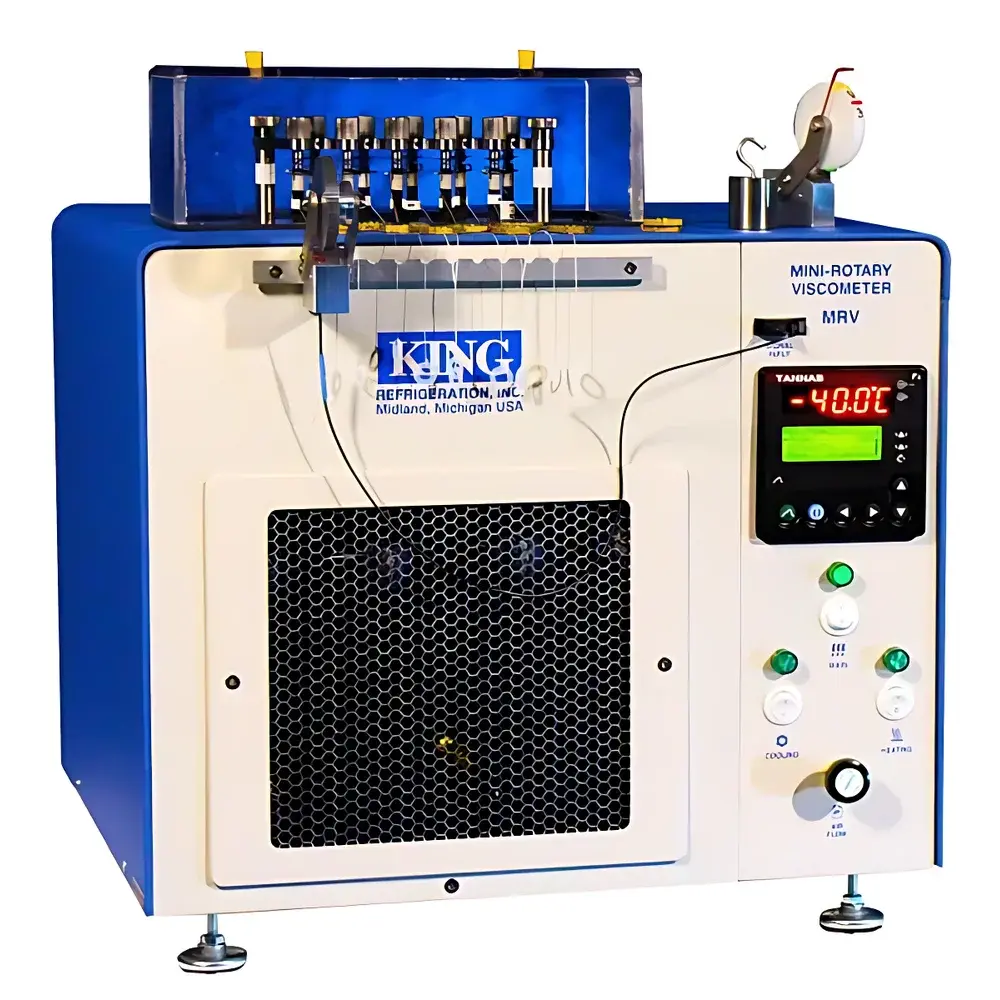
KING MRV TP-1 Cold Cranking Simulator (CCS) and Mini-Rotary Viscometer (MRV) for Lubricating Oil Low-Temperature Pumpability Testing
| Brand | Tannas & King |
|---|---|
| Origin | USA |
| Model | MRV TP-1 |
| Standards Compliance | ASTM D4684 (Method A), SH/T 0562 |
| Temperature Range (BLB702) | 30 °C to −70 °C |
| Cooling Power | 600 W at 0 °C, 100 W at −40 °C, 300 W at −70 °C |
| Heating Power | 600 W |
| Sample Capacity | 12-position bath |
| Bath Volume | 3.8 L |
| Dimensions (W×D×H) | 48 cm × 53 cm × 66 cm |
| Net Weight | ~68 kg |
| Transport Weight | 122–136 kg |
| Transport Dimensions | 81 cm × 76 cm × 104 cm |
| Electrical Supply | 220 VAC, 50/60 Hz, Single Phase |
| Safety Certifications | CE, High-Temp Cut-off, Low-Level Fluid Detection, Over-Pressure Breaker |
| Viewing Window | 41 cm × 23 cm |
Overview
The KING MRV TP-1 is a fully integrated Cold Cranking Simulator (CCS) and Mini-Rotary Viscometer (MRV) system engineered for precise low-temperature pumpability assessment of engine oils, gear oils, and other petroleum-based lubricants. It operates in strict accordance with ASTM D4684 (Method A) and SH/T 0562, delivering reproducible torque-based viscosity measurements under controlled shear and thermal conditions that simulate real-world cold-start and oil circulation scenarios. Unlike conventional MRV instruments requiring external cryogenic baths or complex pre-conditioning workflows, the MRV TP-1 employs an integrated solid-state “block” thermal unit capable of direct heating and cooling of the sample cell—achieving temperatures as low as −70 °C (BLB702 configuration) without auxiliary chillers or pre-heating steps. This architecture eliminates thermal lag, improves temperature stability (< ±0.1 °C over 15 min), and ensures high repeatability across sequential test runs.
Key Features
- Integrated solid-block thermal control system enabling rapid, stable temperature ramping from +30 °C to −70 °C without external refrigeration units or pre-conditioning cycles
- Removable test cell assembly designed for rapid installation, solvent-based cleaning, and minimal cross-contamination risk between samples
- Carbon-fiber rotor shaft offering high torsional rigidity and low thermal mass, ensuring accurate torque transmission during low-temperature viscosity measurement
- Dedicated dry-air delivery channel integrated into the stator housing, providing pre-cooled air directly to rotor–stator interfaces—eliminating reliance on insulated caps or secondary sealing mechanisms
- Large front-view window (41 cm × 23 cm) with anti-fog coating for real-time visual monitoring of sample behavior, crystallization onset, and rotor immersion integrity
- 12-position sample bath (3.8 L total volume) supporting unattended multi-sample testing with programmable sequence scheduling
- Comprehensive safety architecture including CE certification, high-temperature cut-off, low-bath-level detection with automatic power interruption, and pressure-relief circuit breaker
Sample Compatibility & Compliance
The MRV TP-1 is validated for use with SAE 0W through 25W multigrade engine oils, synthetic and mineral-based gear lubricants, hydraulic fluids, and specialty aviation oils meeting MIL-PRF-23699 or similar specifications. Its mechanical design and thermal response profile align with the physical constraints defined in ASTM D4684 Annex A1 (MRV instrumentation requirements) and SH/T 0562’s procedural tolerances for rotational speed, torque resolution, and temperature dwell stability. All firmware logic and calibration routines are traceable to NIST-certified reference standards, and the system supports audit-ready documentation for GLP and GMP environments. While not inherently 21 CFR Part 11 compliant, optional software modules provide electronic signature support, user access controls, and immutable audit trails for regulated laboratories.
Software & Data Management
Control and data acquisition are managed via the proprietary Tannas&King MRV Control Suite v4.x, running on Windows-based host PCs connected via USB 2.0 or Ethernet. The interface enables full parameter programming—including ramp rate, hold time, rotational speed (0.1–100 rpm), torque threshold limits, and pass/fail criteria per ASTM D4684 Table 1. Real-time torque vs. time curves, temperature deviation plots, and yield stress extrapolations are generated automatically. Raw data exports comply with ASTM E1382 and ISO/IEC 17025 reporting formats (.csv, .xlsx, .pdf). Instrument logs retain all environmental conditions, operator IDs, calibration timestamps, and maintenance events for full traceability. Remote diagnostics and firmware updates are supported via secure HTTPS channels with TLS 1.2 encryption.
Applications
- Determination of low-temperature pumpability failure point (MRV yield stress) in automotive engine oils per OEM specifications (e.g., GM dexos1™ Gen 3, Ford WSS-M2C945-A)
- Screening of additive package efficacy in cold-flow improvers and pour point depressants
- Quality assurance of batch-to-batch consistency in synthetic ester and polyalphaolefin (PAO)-based lubricants
- Development validation of low-viscosity, high-shear-stability formulations targeting CAFE and Euro 7 compliance
- Supporting research into wax crystallization kinetics and gel network formation in paraffinic base stocks
- Third-party certification testing for API licensing programs requiring ASTM D4684 verification
FAQ
What is the primary difference between the BLB701, BLB702, and BLB-DIN configurations?
The BLB701 supports a temperature range of +30 °C to −40 °C; the BLB702 extends to −70 °C using enhanced cryogenic compression staging; the BLB-DIN variant complies with DIN 51377 thermal ramp profiles and operates from +30 °C to −55 °C.
Can the MRV TP-1 perform both CCS and MRV tests on the same sample without manual intervention?
No—CCS and MRV are distinct test modes requiring different rotor geometries, shear rates, and thermal protocols. Switching requires hardware reconfiguration and recalibration per ASTM D5293 and D4684 respectively.
Is routine calibration required, and what standards are recommended?
Yes—annual calibration against NIST-traceable viscosity standards (e.g., Cannon Kinematic Viscosity Standards, certified at −30 °C and −40 °C) is recommended. Torque sensor verification should be performed quarterly using certified dead-weight kits.
Does the system support automated sample loading?
No—the MRV TP-1 is manually loaded. However, its 12-position bath allows sequential testing with programmable start times, reducing operator presence during extended overnight runs.
What maintenance intervals are specified for the refrigeration module?
Compressor oil and filter replacement every 2,000 operating hours; annual inspection of refrigerant charge integrity and heat exchanger fouling by authorized Tannas&King service engineers.



