
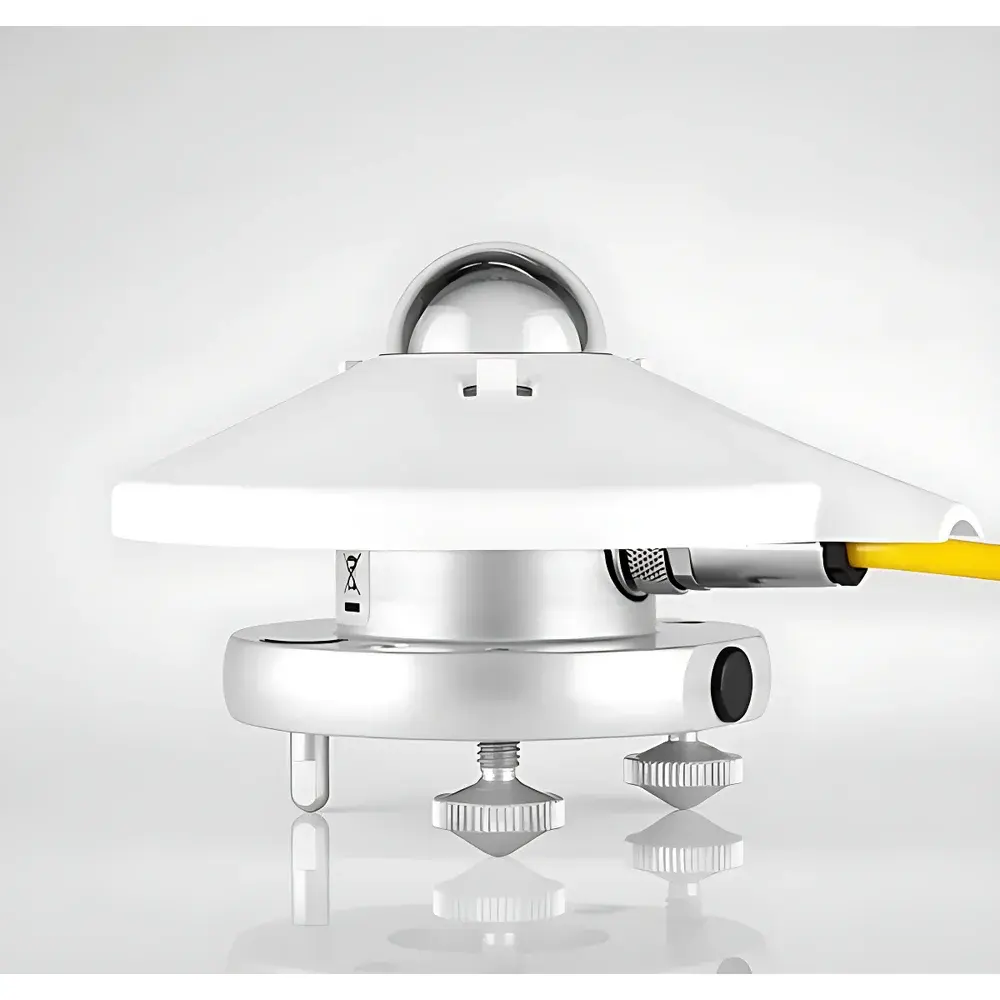
Kipp & Zonen CMP6 First-Class Pyranometer
| Brand | Kipp & Zonen |
|---|---|
| Origin | Netherlands |
| Model | CMP6 |
| ISO 9060 | 1990 Classification: First Class |
| Spectral Range (50% points) | 285–2800 nm |
| Thermal Offset (at 200 W/m²) | <12 W/m² |
| Temperature Response Drift | <4% (−10 °C to +40 °C) |
| Non-stability (annual) | <1% |
| Non-linearity (100–1000 W/m²) | <1% |
| Tilt Error (0–90°, 1000 W/m²) | <1% |
| Leveling Accuracy | <0.1° |
| Response Time (63%) | <6 s |
| Response Time (95%) | <18 s |
| Max. Irradiance | 2000 W/m² |
| Sensitivity | 5–20 µV/W/m² |
| Impedance | 20–200 Ω |
| Output Signal (0–1500 W/m²) | 0–30 mV |
| Spectral Selectivity (350–1500 nm) | <3% |
| Field of View | 180° |
| Operating Environment | −40 °C to +80 °C, 0–100% RH |
| Ingress Protection | IP67 |
Overview
The Kipp & Zonen CMP6 First-Class Pyranometer is a precision thermopile-based instrument engineered for continuous, high-accuracy measurement of global solar irradiance on horizontal or tilted surfaces. Designed and calibrated in accordance with ISO 9060:1990 (First Class specification), the CMP6 delivers metrologically traceable performance suitable for research-grade applications in hydrological monitoring networks, agricultural climate stations, and long-term environmental observation programs. Its sensing principle relies on a 64-junction thermopile detector mounted beneath a dual-glass hemispherical dome — a configuration that minimizes thermal offset errors and improves directional response compared to single-dome designs. The blackened thermopile surface features a highly stable, inorganic carbon coating with uniform spectral absorptance across the solar spectrum (285–2800 nm), ensuring minimal dependence on incident spectral distribution and robust resistance to UV degradation over decades of field deployment.
Key Features
- ISO 9060:1990 First Class classification — validated for scientific and regulatory-grade solar radiation monitoring
- Dual-glass dome construction enhances thermal mass stability and reduces convective heat loss, lowering thermal offset (<12 W/m² at 200 W/m² irradiance)
- 64-junction thermopile sensor with inorganic carbon absorber ensures long-term spectral neutrality and minimal aging-induced drift (<1% annual non-stability)
- High mechanical robustness: IP67-rated enclosure withstands extreme ambient conditions (−40 °C to +80 °C, 0–100% RH)
- Integrated leveling bubble with <0.1° accuracy enables rapid, repeatable instrument alignment without external tools
- Gilded connector contacts facilitate reliable signal transmission and simplify field recalibration or sensor exchange
- Low temperature dependence (<4% sensitivity variation from −10 °C to +40 °C) supports unheated outdoor operation across diverse climatic zones
Sample Compatibility & Compliance
The CMP6 is optimized for measuring broadband global horizontal irradiance (GHI) under natural sky conditions, including clear-sky, overcast, and rapidly varying cloud cover. It complies fully with the spectral, directional, and temporal response requirements defined in ISO 9060:1990 for First Class pyranometers. While not intrinsically compliant with IEC 61724-1:2021 (photovoltaic system monitoring) or ASTM G173-03 (reference spectra), its calibration traceability to the World Radiometric Reference (WRR) via Kipp & Zonen’s accredited laboratory ensures compatibility with international intercomparison campaigns and national meteorological networks. The instrument meets GLP-aligned documentation standards for calibration certificates (including uncertainty budgets and serial-number-traceable reference data), supporting audit readiness in regulated agricultural and hydrological monitoring frameworks.
Software & Data Management
The CMP6 outputs a passive analog voltage signal (0–30 mV over 0–1500 W/m²), compatible with industry-standard data loggers supporting millivolt input channels (e.g., Campbell Scientific CR series, Delta-T DL2e, Onset HOBO UX120). When integrated into automated weather stations, its low-impedance output (20–200 Ω) minimizes noise susceptibility over cable runs up to 100 m using shielded twisted-pair wiring. No proprietary software is required; raw mV readings are converted to W/m² using the factory-supplied sensitivity factor (µV/W/m²), typically ranging from 5 to 20 µV per unit irradiance. For networked deployments, the CMP6 supports time-synchronized sampling protocols and integrates seamlessly into SCADA systems adhering to Modbus RTU or SDI-12 interfaces when paired with appropriate signal-conditioning modules. Calibration history and correction coefficients can be maintained within metadata-aware database schemas compliant with ISO/IEC 17025 documentation practices.
Applications
- High-accuracy solar resource assessment for irrigation scheduling and evapotranspiration modeling in precision agriculture
- Long-term climate monitoring in national hydrological observation networks (e.g., FAO Penman-Monteith inputs)
- Greenhouse microclimate control systems requiring real-time GHI feedback for shading and supplemental lighting actuation
- Validation of satellite-derived solar irradiance products (e.g., CAMS, NASA POWER)
- Calibration transfer reference for secondary-class sensors in distributed agro-meteorological sensor arrays
- Field validation of building energy simulation models under variable sky conditions
FAQ
What does “First Class” mean in ISO 9060:1990?
First Class denotes a maximum permissible uncertainty envelope for spectral error, directional response, temperature dependence, and non-linearity — stricter than Second Class but less stringent than Secondary Standard. The CMP6 meets all First Class limits defined in the standard.
Is the CMP6 suitable for tilted-plane irradiance measurements?
Yes, though optimized for horizontal mounting. Its tilt error remains below 1% across 0–90° inclination at 1000 W/m², making it appropriate for fixed-tilt PV array monitoring when combined with appropriate mounting hardware.
Does the CMP6 require a ventilation unit or heater?
No. The dual-glass dome and thermally stabilized design minimize dew/frost formation and thermal offset without active heating — ideal for low-power remote installations.
How often should the CMP6 be recalibrated?
Kipp & Zonen recommends recalibration every two years for research applications and every three years for operational networks, depending on exposure conditions and data quality objectives.
Can the CMP6 be used indoors under artificial lighting?
Not recommended. Its spectral response is optimized for natural solar radiation (285–2800 nm); artificial sources (e.g., LEDs, fluorescents) fall outside its characterized range and may yield non-representative readings.







