
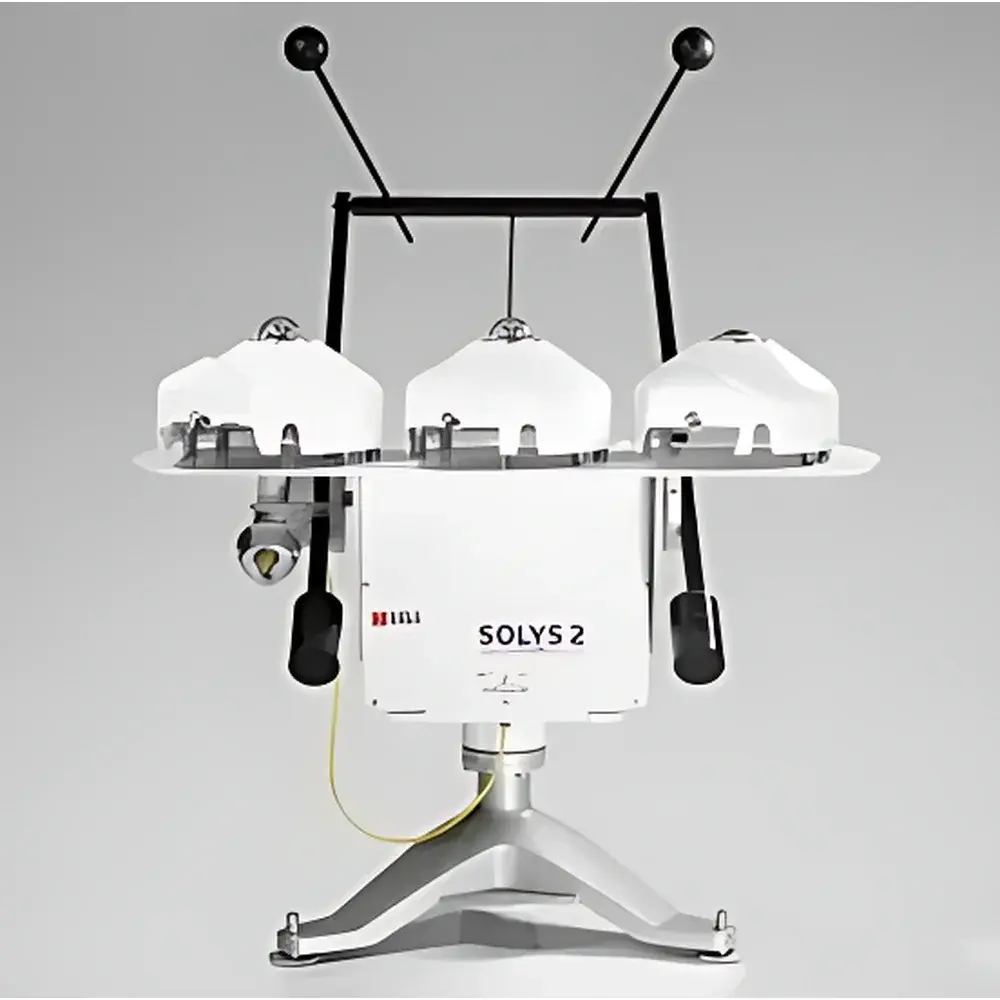
Kipp & Zonen SOLYS2 Solar Tracker
| Brand | Kipp & Zonen |
|---|---|
| Origin | Netherlands |
| Model | SOLYS2 Solar Tracker |
| Tracking Accuracy | < 0.1° (passive) / < 0.02° (active with optional sun sensor) |
| Payload Capacity | 20 kg |
| Power Supply | 18–30 VDC or 90–264 VAC (50/60 Hz) |
| Operating Temperature | −20 to +50 °C (DC) / −40 to +50 °C (AC) |
| Tracker Dimensions | 50 × 34 × 38 cm |
| Tracker Weight | 23 kg |
| Tripod Weight | 5 kg |
| Communication Interface | Ethernet / Web-based UI |
| Drive Mechanism | Inverted toothed belt |
| Power Consumption | 21 W (typical), 13 W (nighttime), 100 W (with heater, AC only) |
Overview
The Kipp & Zonen SOLYS2 Solar Tracker is a high-precision, field-deployable azimuth-elevation tracking system engineered for continuous, autonomous pointing of radiometric instruments toward the solar disk. It operates on the principle of predictive astronomical ephemeris calculation—leveraging an integrated GPS receiver to automatically acquire and update geographic coordinates (latitude, longitude, altitude) and Coordinated Universal Time (UTC), eliminating manual time-zone or daylight saving time configuration errors. Its dual-mode operation supports both passive (open-loop) tracking—based on real-time solar position algorithms—and active (closed-loop) tracking when paired with the optional auxiliary sun sensor, which provides real-time feedback correction for mechanical drift induced by thermal expansion, wind load, or foundation settling. Designed to meet the stringent pointing stability and repeatability requirements of the Baseline Surface Radiation Network (BSRN), the SOLYS2 serves as the mechanical backbone for direct normal irradiance (DNI), global horizontal irradiance (GHI), and spectral irradiance measurement systems in solar resource assessment, atmospheric science, photovoltaic performance monitoring, and climate research.
Key Features
- Integrated GPS module enabling automatic geolocation and UTC synchronization—no external computer or configuration software required during setup
- Built-in bubble level and adjustable leveling feet for rapid, tool-free instrument leveling directly on-site
- Robust cast-aluminum housing with textured surface finish and corrosion-resistant anodization for long-term outdoor exposure
- Modular top mounting plate accommodating up to three ventilated Kipp & Zonen pyrheliometers or pyranometers (e.g., CHP1, CMP22, SMP series)
- Dual power input compatibility: 18–30 VDC (standard for remote off-grid stations) and 90–264 VAC (50/60 Hz) with integrated heating element for sub-zero operation
- Inverted toothed belt drive system ensuring smooth, low-backlash motion with high positional reproducibility and minimal maintenance
- Web-based user interface accessible via Ethernet—enabling remote status monitoring, firmware updates, and diagnostic logging without proprietary software
- Open-source firmware architecture supporting customization and integration into third-party SCADA or data acquisition platforms
Sample Compatibility & Compliance
The SOLYS2 is mechanically and electrically compatible with all Kipp & Zonen thermopile-based solar radiometers requiring precise solar vector alignment—including the CHP1 Direct Normal Irradiance (DNI) sensor, the SMP series spectroradiometers, and the CMP22 secondary-standard pyranometer. Its payload capacity of 20 kg allows simultaneous mounting of multiple instruments with ventilation units and shading assemblies. The tracker conforms to BSRN operational guidelines for solar tracking accuracy (< 0.1° RMS error in passive mode) and supports ISO 9060:2018 Class A spectral response compliance when used with certified sensors. All electrical interfaces comply with IEC 61000-6-2 (immunity) and IEC 61000-6-4 (emissions) standards. For installations under GLP or GMP-regulated solar monitoring programs, audit-trail-capable firmware logs—including timestamped position commands, GPS lock status, and heater activation events—are retained internally and exportable via HTTP GET requests.
Software & Data Management
The SOLYS2 features an embedded Linux-based controller running open-source firmware (licensed under GPLv3), exposing a RESTful API and HTML5 web interface over standard Ethernet. No vendor-specific drivers or desktop applications are required. Configuration parameters—including site coordinates, instrument offsets, tracking mode selection, and heater activation thresholds—are set through intuitive web forms. Real-time telemetry (azimuth/elevation angles, GPS status, internal temperature, power supply voltage, and motor current) is streamed via JSON over HTTP and can be polled at user-defined intervals (default: 10 s). Firmware updates are performed via secure HTTPS upload. System logs—including startup sequences, GPS acquisition events, and error codes—are stored in non-volatile memory for up to 30 days and downloadable in CSV format. The tracker supports NTP client functionality when connected to a network with internet access, providing additional time synchronization redundancy beyond GPS.
Applications
- Solar energy resource assessment for utility-scale PV and CSP plant feasibility studies
- Long-term atmospheric radiation budget monitoring within BSRN, GCOS, and ACTRIS networks
- Calibration and intercomparison campaigns for reference radiometers and spectroradiometers
- Direct normal irradiance (DNI) validation for satellite-derived solar irradiance products (e.g., CAMS, NSRDB)
- Field testing of concentrating photovoltaic (CPV) and solar thermal collector optical efficiency
- Climate change research requiring multi-decadal, traceable solar irradiance time series
FAQ
Does the SOLYS2 require a PC for initial setup?
No. All configuration—including location, time, and tracking mode—is performed via its built-in web interface using any standard web browser connected via Ethernet.
What is the difference between passive and active tracking modes?
Passive tracking uses calculated solar position based on GPS-derived time and location; active tracking adds real-time angular correction via the optional sun sensor to compensate for mechanical drift.
Can the SOLYS2 operate unattended in polar regions?
Yes—when powered by AC with the internal heater enabled, it maintains full functionality down to −40 °C, making it suitable for high-latitude and alpine observatories.
Is firmware source code publicly available?
Yes. The core firmware is open-source and hosted on Kipp & Zonen’s official GitHub repository under GPLv3, enabling transparency, peer review, and community-driven development.
How is mechanical alignment verified after installation?
The integrated bubble level and azimuth-adjustable tripod legs allow visual leveling; final verification is performed using the web interface’s “Sun Check” diagnostic tool, which compares predicted vs. actual solar vector alignment over a 24-hour cycle.







