
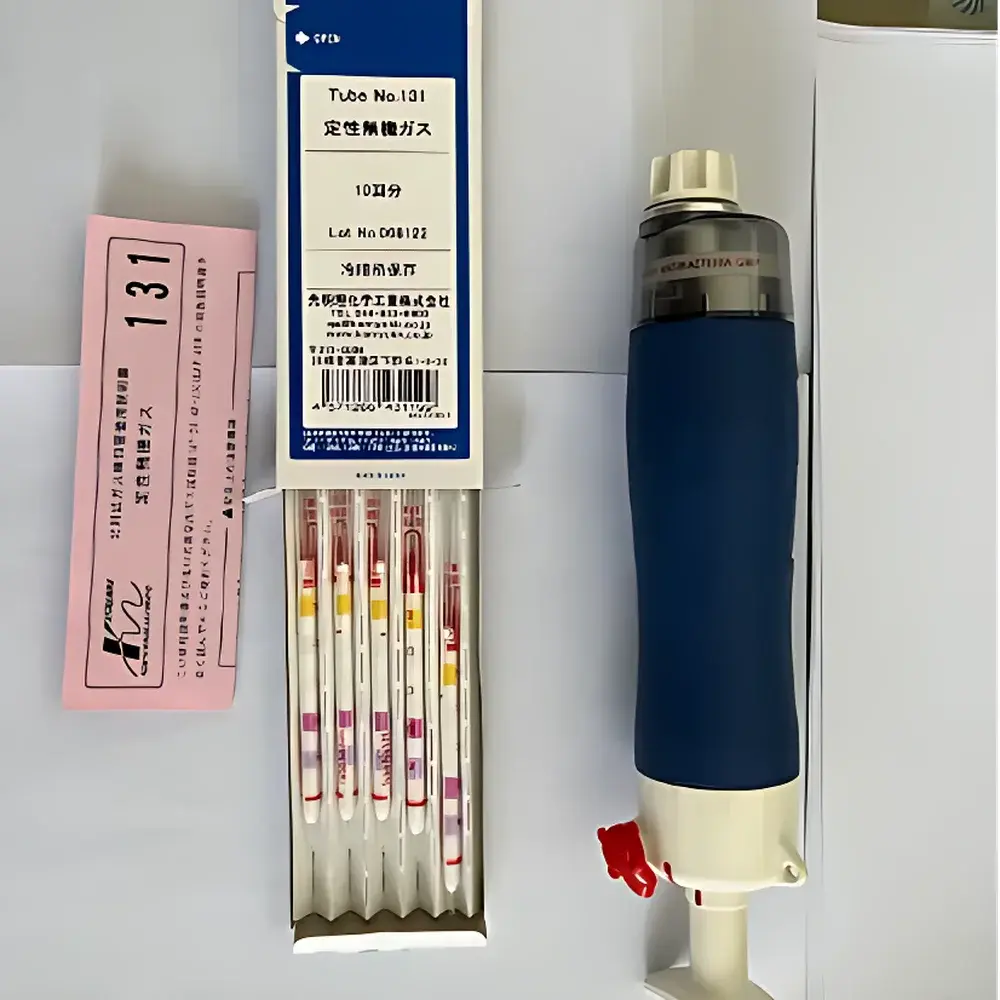
Kitaoka Kogaku Inorganic Gas Qualitative Detection Tube Model 131
| Brand | Ko-mei Rikagaku |
|---|---|
| Origin | Japan |
| Manufacturer Type | Authorized Distributor |
| Origin Category | Imported |
| Model | 131 |
| Pricing | Upon Request |
Overview
The Kitaoka Kogaku Inorganic Gas Qualitative Detection Tube Model 131 is a field-deployable, colorimetric screening tool engineered for rapid identification of inorganic gases in emergency response, industrial hygiene, and environmental incident assessment scenarios. Unlike quantitative gas analyzers requiring power, calibration, or complex operation, this detection tube operates on the principle of selective chemical reaction between target gaseous analytes and immobilized reagents within a sealed glass microtube. When ambient air is drawn through the tube via a calibrated hand pump (e.g., 100 mL per stroke), reactive gases—such as ammonia (NH₃), hydrogen sulfide (H₂S), chlorine (Cl₂), sulfur dioxide (SO₂), nitrogen dioxide (NO₂), carbon monoxide (CO), or hydrogen cyanide (HCN)—induce localized color development along the indicator layer. The position and hue of the resulting stain correspond to qualitative presence, enabling immediate classification of potential hazards prior to targeted quantitative analysis.
Key Features
- Pre-calibrated single-use glass tubes with integrated desiccant and reaction matrix optimized for inorganic gas selectivity
- Visual readout system requiring no electronics, batteries, or software—ideal for hazardous, remote, or power-limited environments
- Compatible with standard 100-mL dual-stroke bellows pumps meeting ISO 8519:2014 requirements for manual sampling devices
- Stable shelf life of ≥24 months when stored at 15–25°C in original foil packaging; lot-specific expiration dates printed on tube labels
- Designed for operator safety: minimal exposure time, no sample preparation, and immediate visual interpretation without analytical training
- Complies with JIS K 0121 (Japanese Industrial Standard for Gas Detection Tubes) and aligns with OSHA Technical Manual Section III: Chapter 2 guidance on preliminary gas screening
Sample Compatibility & Compliance
The Model 131 tube is validated for qualitative detection of common inorganic toxic gases encountered in chemical spills, confined space entries, wastewater treatment facilities, and fire investigation sites. It is not intended for organic vapors, hydrocarbons, or inert gases. Cross-reactivity is minimized through proprietary reagent formulation but may occur with high concentrations of oxidizing or reducing interferents (e.g., ozone, NO, or formaldehyde). Users must consult the included Japanese/English bilingual instruction manual for interference tables, recommended sampling volumes (typically 1–5 strokes), and environmental limitations (operational range: −10°C to +40°C; relative humidity ≤85% RH non-condensing). The product meets CE marking requirements for personal protective equipment accessories under Directive 2016/425/EU when used as part of an integrated gas hazard assessment protocol.
Software & Data Management
This is a passive, analog detection device with no embedded electronics, firmware, or data logging capability. All interpretation is performed visually using the printed color reference chart supplied with each tube batch. No software installation, cloud connectivity, or regulatory-compliant audit trail (e.g., FDA 21 CFR Part 11 or EU Annex 11) is applicable. However, field reports documenting tube lot number, sampling location/time, observed color progression, and interpreted gas class may be integrated into enterprise EHS management systems (e.g., Intelex, Sphera, or ETQ Reliance) as unstructured observational records. Digital photo documentation of color development is recommended for GLP-aligned incident reporting.
Applications
- First-responder triage during chemical release incidents to prioritize evacuation zones and PPE selection
- Preliminary screening before deploying electrochemical sensors or FTIR spectrometers for quantitative verification
- Verification of ventilation effectiveness in laboratories or semiconductor cleanrooms after maintenance
- Training tool for occupational health students to recognize gas-specific colorimetric signatures
- Backup verification method during calibration downtime of fixed gas monitoring networks
FAQ
Can Model 131 quantify gas concentration?
No. This tube provides only qualitative identification. Quantitative measurement requires dedicated concentration-specific tubes (e.g., Kitaoka Model 131-CO for CO) used with the same pump system.
Is calibration required before use?
No. Each tube is factory-calibrated and sealed. Users must verify the expiration date and integrity of the foil seal prior to opening.
Does humidity affect performance?
Yes. Excessive moisture may cause reagent dissolution or diffusion artifacts. Use only within specified RH limits and avoid condensation-prone conditions.
Are replacement tubes traceable to NIST standards?
While not NIST-traceable per se, batch certification includes gravimetric validation against reference gas mixtures prepared per ISO 6141 and certified by JCSS-accredited laboratories in Japan.
How should spent tubes be disposed?
Treat as hazardous chemical waste per local regulations (e.g., EPA 40 CFR Part 261) due to residual reactive reagents; do not incinerate or discard in general waste.
Related Products







