
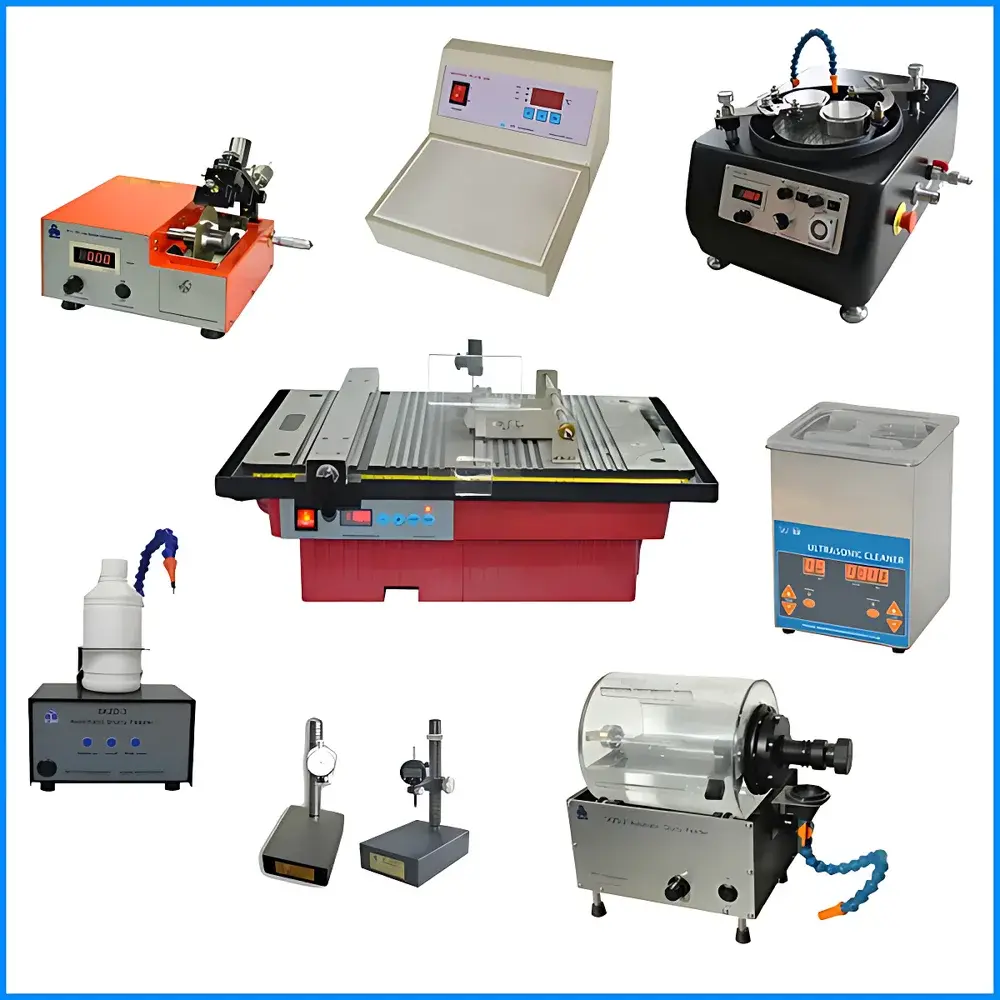
KJ GROUP Economic Series Integrated Sample Preparation System for Brittle Materials (Glass, Crystals, Ceramics)
| Brand | KJ GROUP |
|---|---|
| Origin | Liaoning, China |
| Manufacturer Type | Authorized Distributor |
| Country of Origin | China |
| Model | Economic Series Integrated Sample Preparation System for Brittle Materials (Glass, Crystals, Ceramics) |
| Pricing | Contact for Quotation |
Overview
The KJ GROUP Economic Series Integrated Sample Preparation System for Brittle Materials is a purpose-engineered workflow solution designed to support standardized, reproducible specimen preparation for optical, structural, and analytical characterization of brittle inorganic solids—including fused silica, borosilicate glass, sapphire, quartz, lithium niobate, alumina ceramics, and silicon carbide. The system integrates six core modules operating under controlled mechanical and thermal conditions: precision sectioning (SYJ-200H & SYJ-150), thermally assisted mounting (MTI-250), quantitative material removal control (GPS-50A), automated abrasive and polishing slurry delivery (SKZD-2/SKZD-3), high-stability lapping and polishing (UNIPOL-802), thickness metrology (SKCH-1(A)), and residue-free surface decontamination (VGT-1620QTD). All subsystems are mechanically and operationally compatible, enabling seamless transition from raw bulk material to optically flat, damage-free specimens suitable for XRD, SEM cross-section analysis, TEM lamella preparation, interferometric surface profiling, and refractive index measurement.
Key Features
- Synergistic modular architecture: Each unit is calibrated for inter-system compatibility—e.g., SYJ-200H’s rapid cut geometry aligns with GPS-50A’s layer-removal resolution (±0.5 µm per cycle) and UNIPOL-802’s platen runout tolerance (<2 µm).
- Thermally stable mounting: MTI-250 heating platform maintains 60–120 °C within ±1.5 °C across its 250 mm × 250 mm surface, ensuring uniform wax flow and void-free adhesion of fragile crystals without thermal shock.
- Automated consumable dosing: SKZD-2 delivers aqueous or oil-based abrasives (e.g., SiC, Al₂O₃) at programmable flow rates (0.1–5.0 mL/min); SKZD-3 dispenses colloidal silica or ceria suspensions with pulse-width modulation for consistent slurry concentration during final polishing.
- Unattended operation capability: GPS-50A interfaces directly with UNIPOL-802’s motor controller and load cell to dynamically adjust rotational speed, downforce (1–50 N range), and dwell time based on real-time thickness feedback from SKCH-1(A).
- Non-contact dimensional verification: SKCH-1(A) employs dual-sensor capacitive displacement transduction with 10 nm resolution and <0.1% linearity error over 0–10 mm range—critical for monitoring thinning kinetics during iterative grinding.
Sample Compatibility & Compliance
The system accommodates specimens up to 200 mm in diameter and 100 mm in height, supporting planar, cylindrical, and irregularly shaped brittle substrates. It complies with ASTM E3–22 (Standard Guide for Preparation of Metallographic Specimens), ISO 14873–1:2021 (Ceramic microstructure preparation), and JIS R 1634 (Testing methods for optical crystals). All electrical components meet CE safety directives (2014/35/EU), and the VGT-1620QTD ultrasonic cleaner operates at 40 kHz with degassing and sweep functions validated per IEC 61000-6-3 for electromagnetic compatibility in shared lab environments.
Software & Data Management
GPS-50A includes embedded firmware with USB-C data export (CSV/TXT) for thickness trends, force profiles, and cycle logs. While no proprietary cloud platform is included, exported datasets are compatible with MATLAB, Python (Pandas/NumPy), and LabVIEW for statistical process control (SPC) modeling. Audit trails—including operator ID, timestamp, parameter set version, and hardware calibration status—are stored locally and satisfy GLP documentation requirements for regulated QC labs. Optional RS-232 or Modbus RTU integration enables linkage to LIMS systems compliant with FDA 21 CFR Part 11 when paired with third-party electronic signature modules.
Applications
- Preparation of transmission-grade optical windows for UV–VIS–NIR spectrophotometry (e.g., BK7, CaF₂, MgF₂)
- Sectioning and polishing of piezoelectric single crystals (e.g., PZT, LiTaO₃) prior to poling and electrode deposition
- Thickness-controlled thinning of semiconductor-grade sapphire wafers for epitaxial growth substrate qualification
- Routine QC of architectural glass coatings (low-E, solar control) via cross-sectional SEM/EDS
- Geological thin-section fabrication for polarized light microscopy of silicate minerals and metamorphic textures
FAQ
Is this system suitable for preparing TEM lamellae from brittle ceramics?
Yes—when combined with sequential low-angle grinding (using 9 µm diamond suspension on UNIPOL-802) followed by colloidal silica polishing, specimens achieve sub-50 nm surface roughness (Ra) and minimal subsurface damage, meeting standard TEM sample acceptance criteria.
Can the GPS-50A interface with third-party thickness gauges?
It supports analog voltage input (0–10 V) and digital TTL triggers, enabling integration with non-KJ GROUP capacitance, eddy current, or laser triangulation sensors.
What maintenance intervals are recommended for the SKZD-2/SKZD-3 dispensing units?
Valve seals require replacement every 6 months under continuous operation; tubing should be inspected weekly for particulate clogging when using abrasive slurries.
Does the system include validation documentation for ISO/IEC 17025 accreditation?
Factory calibration certificates are provided for SKCH-1(A) and MTI-250; full IQ/OQ documentation packages can be commissioned separately per client SOP requirements.
Related Products



