
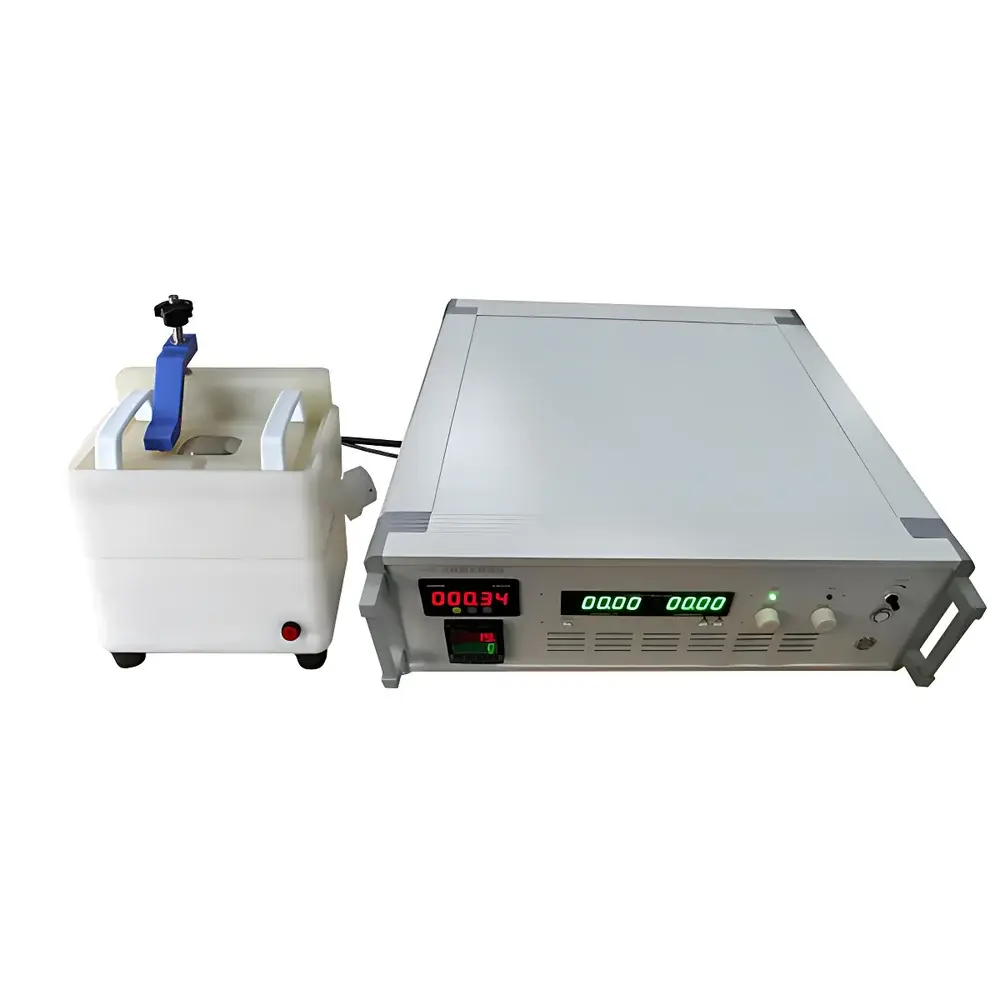
KJ GROUP EP-2060 Electrolytic Polishing and Etching System
| Brand | KJ GROUP |
|---|---|
| Origin | Liaoning, China |
| Model | EP-2060 |
| Input Voltage | AC 220 V, 50 Hz |
| DC Output | 0–60 V / 0–20 A (continuously adjustable, digital display) |
| Timer Range | Programmable (0–999 min) |
| Electrolyte Volume Capacity | 300–1000 mL |
| Sample Holder Apertures | 15 mm, 20 mm, 25 mm (diameter) |
| Cooling | External tap-water circulation |
| Control Modes | Constant Voltage, Constant Current |
| Optional Accessories | PC-based current/voltage/temperature logging software, External recirculating chiller |
Overview
The KJ GROUP EP-2060 Electrolytic Polishing and Etching System is a precision-engineered electrochemical instrument designed for controlled surface preparation of metallic specimens in metallurgical and materials science laboratories. It operates on the principles of anodic dissolution under regulated direct current (DC), enabling reproducible electropolishing and selective electrochemical etching without introducing mechanical deformation, smearing, or subsurface damage—critical limitations inherent to mechanical grinding and polishing methods. The system supports both single-step electropolishing for mirror-finish surface generation and multi-stage electrochemical etching for microstructural contrast enhancement in light optical microscopy (LOM) and scanning electron microscopy (SEM) sample preparation. Its modular architecture integrates a high-stability DC power supply, temperature-managed electrolyte delivery, and configurable sample positioning—making it especially suited for stainless steels, aluminum alloys, titanium, copper, and other non-ferrous metals where oxide layer control and grain boundary delineation are essential.
Key Features
- Wide-range programmable DC output (0–60 V / 0–20 A) with digital real-time monitoring, supporting diverse electrochemical regimes across alloy systems.
- Dual operating modes: constant voltage (CV) and constant current (CC), each selectable via front-panel interface for process optimization and method transferability.
- Adjustable active area control via interchangeable sample holders (15 mm, 20 mm, 25 mm apertures), ensuring consistent current density distribution and eliminating edge effects during localized treatment.
- Integrated electrolyte recirculation with upward-directed spray nozzle design, promoting uniform mass transport and minimizing concentration polarization at the electrode–electrolyte interface.
- External tap-water cooling loop maintains electrolyte temperature stability within ±2 °C over extended operation, critical for repeatability in time-sensitive etching protocols.
- Front-panel timer with 1-second resolution (0–999 minutes), enabling precise endpoint control for both polishing duration and etch dwell time.
Sample Compatibility & Compliance
The EP-2060 accommodates conductive specimens mounted in thermosetting conductive resins (e.g., epoxy–carbon composites) or directly immersed as disc-shaped samples up to 25 mm in diameter. It complies with standard metallurgical specimen preparation workflows defined in ASTM E3-22 (Standard Guide for Preparation of Metallographic Specimens) and ISO 15510:2021 (Metallic materials — Metallographic examination — General rules). While not certified to IEC 61010-1 for industrial safety, its enclosure meets Class I electrical protection requirements per GB 4793.1 (Chinese national equivalent), and all operational parameters align with GLP documentation practices when paired with optional data-logging software. No hazardous gas generation or vacuum requirements are involved, facilitating safe integration into shared academic and QA/QC laboratory environments.
Software & Data Management
An optional Windows-compatible data acquisition module enables synchronized logging of voltage, current, elapsed time, and external thermocouple inputs (via USB interface). Raw time-series data export to CSV format supports post-processing in MATLAB, Python (Pandas), or Excel for statistical analysis of current transients, passivation onset, or etch rate modeling. Audit-trail functionality—including user ID tagging, timestamped parameter changes, and session-level metadata—is available upon software activation, meeting basic traceability requirements for ISO/IEC 17025-accredited labs. All firmware updates are delivered via secure HTTPS download; no cloud connectivity or remote access capabilities are implemented, preserving local data sovereignty.
Applications
- Electropolishing of austenitic stainless steels (e.g., AISI 316) for artifact-free surface finishing prior to EBSD or TEM lamella extraction.
- Controlled grain boundary etching of aluminum alloys (e.g., AA2024, AA7075) using phosphoric–chromic acid electrolytes to reveal precipitate distribution.
- Rapid surface deburring and edge rounding of additively manufactured metal parts without altering bulk hardness or residual stress profiles.
- Preparation of corrosion-resistant coatings (e.g., Ni–P, CrN) for cross-sectional SEM imaging by selective matrix dissolution.
- Teaching laboratories: quantitative demonstration of Faraday’s laws, Tafel kinetics, and polarization resistance in undergraduate materials electrochemistry courses.
FAQ
What electrolytes are compatible with the EP-2060 system?
Common electrolytes include perchloric acid–ethanol mixtures (for stainless steel), orthophosphoric acid (for aluminum), and oxalic acid solutions (for titanium). Compatibility must be verified against material safety data sheets (MSDS) and local fume hood specifications.
Can the EP-2060 perform both polishing and etching in a single run?
No—it operates in discrete mode: either electropolishing (anodic dissolution above critical current density) or electrochemical etching (sub-critical potential-controlled selective phase attack). Sequential steps require manual parameter reconfiguration.
Is the system suitable for automated batch processing?
It is designed for manual, operator-supervised use. No robotic sample handling or auto-loading mechanisms are integrated; throughput is optimized for method development and low-to-medium volume R&D workflows.
Does the EP-2060 meet FDA 21 CFR Part 11 requirements?
The base unit does not include electronic signature, audit trail, or system validation documentation required for regulated pharmaceutical or medical device manufacturing. Optional software adds partial audit capability but lacks full Part 11 compliance out-of-the-box.
What maintenance is required for long-term reliability?
Annual inspection of DC output calibration, electrolyte pump seals, and cooling line integrity is recommended. Electrode contact points should be cleaned with isopropyl alcohol after each use to prevent salt residue buildup.



