
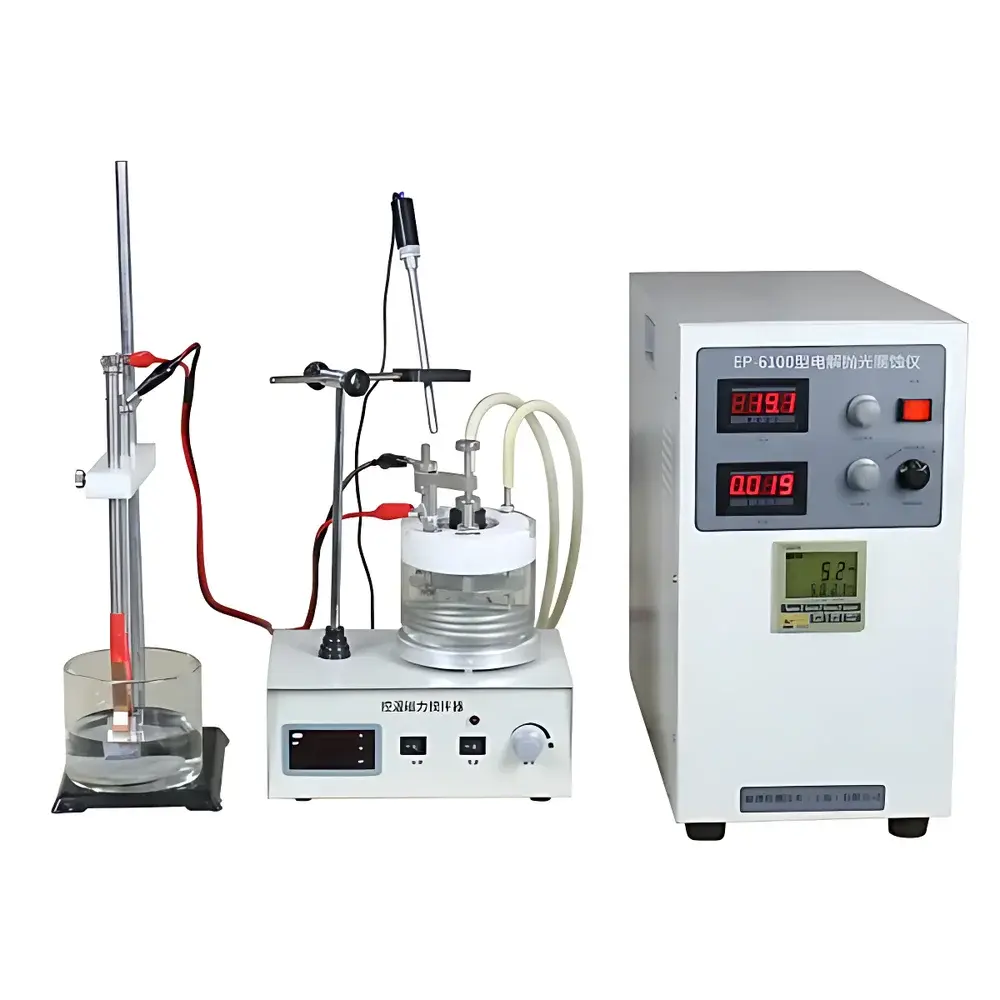
KJ GROUP EP-6100 Electrolytic Polishing and Etching System
| Brand | KJ GROUP |
|---|---|
| Origin | Liaoning, China |
| Model | EP-6100 |
| Input Voltage | AC 220 V, 50 Hz |
| Output Voltage Range | 0–100 V (digital display, presettable) |
| Output Current Range | 0–6 A (digital display, presettable, overload protection) |
| Max. Power | 900 W |
| Timing Range | 1 s – 99 min 59 s (digital, audible alert at end) |
| Temperature Control Range | Ambient to 100 °C |
| Control Unit Dimensions | 290 × 375 × 120 mm |
| Magnetic Stirrer Dimensions | 240 × 200 × 132 mm |
| Net Weight | 15.5 kg |
| Sample Area Control | Interchangeable sample masks (Ø10 mm, Ø20 mm, Ø30 mm) |
| Operating Modes | Constant Voltage / Constant Current |
| Optional Features | Dual-range voltage/current fine/coarse adjustment, ±0.01 V/A resolution, customizable output limits |
Overview
The KJ GROUP EP-6100 Electrolytic Polishing and Etching System is a precision-engineered benchtop instrument designed for the electrochemical preparation of metallographic specimens. Based on controlled anodic dissolution in conductive electrolytes, the system enables reproducible surface finishing—either via electropolishing (anodic smoothing and leveling) or electrochemical etching (selective phase delineation)—without introducing mechanical deformation, smearing, or subsurface damage. This principle is particularly critical for microstructural analysis of austenitic stainless steels, aluminum alloys, titanium, copper-based alloys, and other non-ferrous metals where conventional mechanical polishing may obscure grain boundaries or induce artifact layers. The EP-6100 integrates power regulation, thermal management, fluid dynamics control, and programmable timing into a single coordinated platform, supporting both routine QC workflows and research-grade specimen preparation under standardized laboratory conditions.
Key Features
- Programmable dual-mode operation: Selectable constant-voltage (CV) or constant-current (CC) output, ensuring process stability across varying electrolyte conductivity and electrode geometry.
- Digital voltage (0–100 V, ±0.01 V resolution) and current (0–6 A, ±0.01 A resolution) control with front-panel presetting and real-time display; optional coarse/fine adjustment switches for precise parameter tuning.
- Integrated temperature regulation (ambient to 100 °C) with PID-controlled heating element and embedded sensor—critical for maintaining consistent electrolyte viscosity and reaction kinetics during extended runs.
- Magnetic stirring subsystem ensures uniform electrolyte concentration and heat distribution across the working volume, minimizing localized depletion or thermal gradients at the sample interface.
- Modular sample masking system with three interchangeable apertures (Ø10 mm, Ø20 mm, Ø30 mm), enabling controlled exposure area and repeatable current density calculation (A/cm²).
- Time-controlled operation from 1 second to 99 minutes 59 seconds, with automatic termination and audible notification; supports multi-step protocols when combined with external sequencing logic.
- Overload-protected power stage with thermal cutoff and short-circuit detection, compliant with IEC 61010-1 safety requirements for laboratory electrical equipment.
Sample Compatibility & Compliance
The EP-6100 accommodates a broad range of conductive metallic specimens—including but not limited to austenitic and duplex stainless steels, nickel-based superalloys, aluminum-magnesium composites, and refractory metals—when paired with appropriate electrolytes (e.g., perchloric acid–ethanol for stainless steel, phosphoric–chromic acid mixtures for aluminum). Its design adheres to ASTM E3-22 (Standard Guide for Preparation of Metallographic Specimens) and ISO 16700:2017 (Metallographic etching procedures), facilitating traceable, auditable preparation workflows. While the unit itself does not carry CE or UL certification out-of-the-box, its electrical architecture meets fundamental insulation and grounding provisions required for GLP-compliant laboratories. Users are advised to validate electrolyte handling procedures against local chemical safety regulations (e.g., OSHA HCS, CLP/GHS).
Software & Data Management
The EP-6100 operates as a standalone hardware platform with no embedded firmware-based data logging or PC connectivity. All operational parameters—voltage, current, time, and temperature—are set manually and displayed locally via LED indicators. For laboratories requiring electronic record retention, integration with external data acquisition systems (e.g., USB-connected multimeters, thermocouple loggers, or PLC-triggered timers) is feasible using standard analog outputs or relay dry-contact signals (available upon request). When deployed in regulated environments (e.g., ISO 17025-accredited testing labs or FDA-regulated manufacturing sites), users must implement procedural controls—including operator training records, calibration logs for external measurement tools, and written SOPs referencing ASTM E407 or ISO 4885—to satisfy audit requirements for instrument qualification (IQ/OQ/PQ) and data integrity (ALCOA+ principles).
Applications
- Routine metallographic preparation of corrosion-resistant alloys prior to SEM/EDS or EBSD analysis.
- Removal of cold-worked layers from rolled or forged stainless steel sections to reveal true grain structure.
- Controlled etching of multiphase aluminum castings to differentiate α-Al, eutectic Si, and intermetallic phases.
- Surface activation of titanium implants for subsequent coating adhesion studies.
- Electrochemical thinning of transmission electron microscopy (TEM) foils, especially for electron-transparent zone refinement in beam-sensitive alloys.
- Process development and optimization of electropolishing baths in R&D settings, leveraging adjustable current density and temperature profiles.
FAQ
What electrolytes are compatible with the EP-6100?
The system supports common aqueous and organic electrolytes used in metallography, including but not limited to: 10% oxalic acid (for aluminum), 20% sulfuric acid + 5% chromic acid (for austenitic steels), and 10% perchloric acid in ethanol (for stainless steels and nickel alloys). Always consult SDS documentation and perform compatibility testing before full-scale use.
Can the EP-6100 be used for TEM foil preparation?
Yes—when configured with appropriate masking, low-current density settings (<0.1 A/cm²), and cryogenic electrolytes (e.g., perchloric acid–methanol at −20 °C), the EP-6100 supports electropolishing of TEM discs. However, dedicated twin-jet systems are recommended for high-throughput or ultra-thin foil production.
Is temperature control mandatory during electropolishing?
Temperature stabilization is strongly recommended, especially above 40 °C, as uncontrolled exothermic reactions can accelerate pitting, cause uneven material removal, or decompose sensitive electrolytes. The built-in heater/stirrer ensures process repeatability across ambient fluctuations.
How is current density calculated for a given sample mask?
Current density (A/cm²) = Measured current (A) ÷ Exposed sample area (cm²). The EP-6100’s calibrated aperture set allows direct area determination: Ø10 mm = 0.785 cm², Ø20 mm = 3.142 cm², Ø30 mm = 7.069 cm².
Does the EP-6100 support remote operation or automation?
No native RS-232, USB, or Ethernet interface is included. Automation requires third-party integration via analog voltage/current monitoring or digital I/O modules connected to external controllers.



