
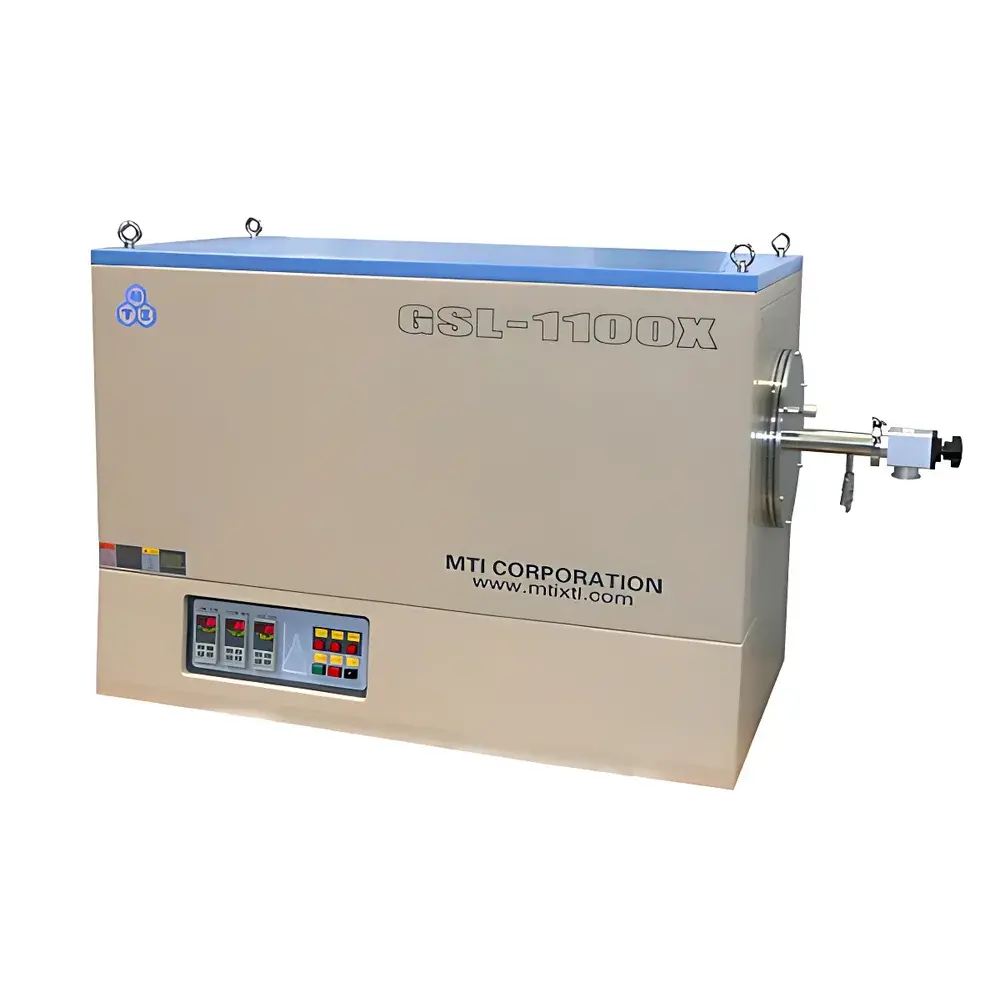
KJ GROUP GSL-1100X-III-D11-8 Dual-Tube Triple-Zone High-Temperature Tube Furnace
| Brand | KJ GROUP |
|---|---|
| Origin | Liaoning, China |
| Manufacturer Type | Authorized Distributor |
| Country of Origin | China |
| Model | GSL-1100X-III-D11-8 |
| Max Operating Temperature | 1100 °C (short-term), 1000 °C (continuous) |
| Tube Configuration | Outer quartz tube Ø279 mm (OD), inner quartz tube Ø216 mm (OD), dual-ended sealing capability |
| Heating Zones | 3 independent zones (300 mm each) |
| Total Heating Length | 900 mm |
| Uniform Zone Length | 500 mm |
| Max Ramp Rate | 10 °C/min |
| Temperature Control | 30-segment programmable PID with K-type thermocouples |
| Temp Accuracy | ±1 °C |
| Vacuum Level | ≤10⁻² torr (with mechanical pump) |
| Power Supply | AC 220 V, 50/60 Hz, 8 kW (50 A circuit required) |
| Dimensions (w/o flanges) | 1300 × 623 × 940 mm |
| Weight | 200 kg |
| Compliance | CE-certified |
| Cooling | Integrated forced-air shell cooling system |
| Chamber Material | High-purity alumina furnace lining |
| Sealing | Stainless steel KF-40 vacuum flanges with silicone O-rings |
| Gas Inlet/Outlet | Dual CVD gas ports on left flange |
Overview
The KJ GROUP GSL-1100X-III-D11-8 is a precision-engineered dual-tube triple-zone tube furnace designed for controlled thermal processing in advanced materials synthesis—particularly chemical vapor deposition (CVD) of two-dimensional materials such as graphene, transition metal dichalcogenides (TMDs), and ultrathin oxide films. Its architecture supports independent thermal zoning across three 300 mm heating segments, enabling precise axial temperature gradients essential for nucleation-controlled growth on catalytic metal foils (e.g., Cu or Ni). The furnace employs NiCrAl resistance wire heating elements embedded within a high-purity alumina insulation matrix, minimizing thermal mass while maximizing radial uniformity and energy efficiency. With a maximum rated temperature of 1100 °C (1-hour duty cycle) and continuous operation up to 1000 °C, it meets stringent requirements for high-fidelity CVD process replication in academic laboratories and R&D pilot lines.
Key Features
- Dual-quartz tube configuration: Outer tube (Ø279 mm OD) provides structural integrity and vacuum containment; inner tube (Ø216 mm OD, one-end sealed) defines the reaction zone and accommodates substrates up to 200 mm (8-inch) diameter.
- Triple independent PID-controlled heating zones, each with dedicated K-type thermocouple feedback and 30-segment programmable ramp-soak profiles—enabling complex thermal sequences such as pre-annealing, nucleation, growth, and controlled cooldown.
- Integrated forced-air cooling system maintains external shell surface temperature below 70 °C under full-load operation, ensuring operator safety and long-term electrical component reliability.
- CE-certified stainless steel vacuum flanges (KF-40 standard) with dual silicone O-ring seals achieve leak rates compatible with low-pressure CVD (<10⁻² torr with optional mechanical pump); left-side flange integrates multiple gas inlets (process + purge + cooling) and pressure monitoring ports.
- High-thermal-stability alumina furnace chamber reduces parasitic heat loss and improves temperature homogeneity across the 500 mm uniform zone—critical for reproducible film thickness and morphology.
- Pre-installed quartz tube plugs minimize radiative heat loss during heating cycles, improving thermal response time and energy efficiency.
Sample Compatibility & Compliance
This furnace is optimized for substrate-based thin-film synthesis on conductive metal foils (Cu, Ni), Si/SiO₂ wafers, and ceramic carriers. Its dual-tube geometry isolates the reactive gas environment from the outer heating envelope, mitigating cross-contamination and enabling rapid gas exchange between growth and annealing steps. All wetted components—including quartz tubes, stainless steel flanges, and gas fittings—are compatible with high-purity argon (≥99.99%), hydrogen, methane, ammonia, and other CVD precursors. The system complies with CE Directive 2014/35/EU (Low Voltage Directive) and 2014/30/EU (EMC Directive). While not inherently GLP/GMP-validated, its programmable controller supports audit-ready operation when paired with optional PC-based logging software (KJ-TCM v3.2) that records timestamped temperature setpoints, actual readings, and alarm events—facilitating compliance with ISO/IEC 17025 and internal quality protocols.
Software & Data Management
The integrated 30-segment digital controller features RS485 communication interface (Modbus RTU protocol) for integration into centralized lab automation systems. Optional KJ-TCM PC control software enables remote parameter upload/download, real-time graphing of multi-zone temperature profiles, and CSV export of full-cycle thermal logs—including ramp rates, dwell times, and deviation alerts. Data files include metadata (operator ID, sample ID, date/time stamp) and support post-process statistical analysis (e.g., Cpk calculation for thermal stability validation). The software adheres to FDA 21 CFR Part 11 principles through optional electronic signature modules and configurable user access levels (admin/operator/viewer), making it suitable for regulated environments where traceability and data integrity are mandatory.
Applications
- CVD growth of monolayer and multilayer graphene on polycrystalline Cu foil under low-pressure argon/hydrogen/methane atmospheres.
- Synthesis of MoS₂, WS₂, and h-BN films via sulfurization/selenization of pre-deposited metal precursors.
- Controlled oxidation of silicon carbide (SiC) for epitaxial graphene formation.
- Thermal annealing of perovskite precursors for optoelectronic thin-film devices.
- Post-deposition crystallization of amorphous metal oxides (e.g., IGZO) used in TFT backplanes.
- Graphitization and purification of carbon nanomaterials under inert or reducing atmospheres.
FAQ
What vacuum level can this furnace achieve, and what pumping system is recommended?
With a standard two-stage rotary vane mechanical pump, the system achieves ≤10⁻² torr. For lower base pressures (≤10⁻⁵ torr), a turbomolecular pump with KF-40 interface is recommended and compatible via optional adapter kits.
Is the inner tube permanently sealed, or can it be reconfigured for different gas flow directions?
The inner tube is supplied with one end sealed and the other open for gas inlet/outlet connection. Custom configurations—including dual-open ends or side-port manifolds—are available upon request for specialized flow dynamics.
Does the furnace support inert gas purging during cool-down to prevent oxidation of sensitive films?
Yes. The left-side flange includes dedicated cooling gas inlets, allowing continuous argon or nitrogen flow throughout the entire thermal cycle—including ramp-down—to maintain reducing or inert ambient conditions.
What is the maximum recommended substrate size for uniform film growth?
For optimal temperature uniformity and gas laminar flow, substrates up to 200 mm (8-inch) diameter are supported within the inner tube’s 500 mm uniform heating zone.
Can the system be integrated into an existing cleanroom gas delivery network?
Yes. Standard 6 mm double-ferrule VCR-style gas fittings are provided; custom Swagelok or CGA adapters can be supplied to match facility-specific manifold interfaces.



