
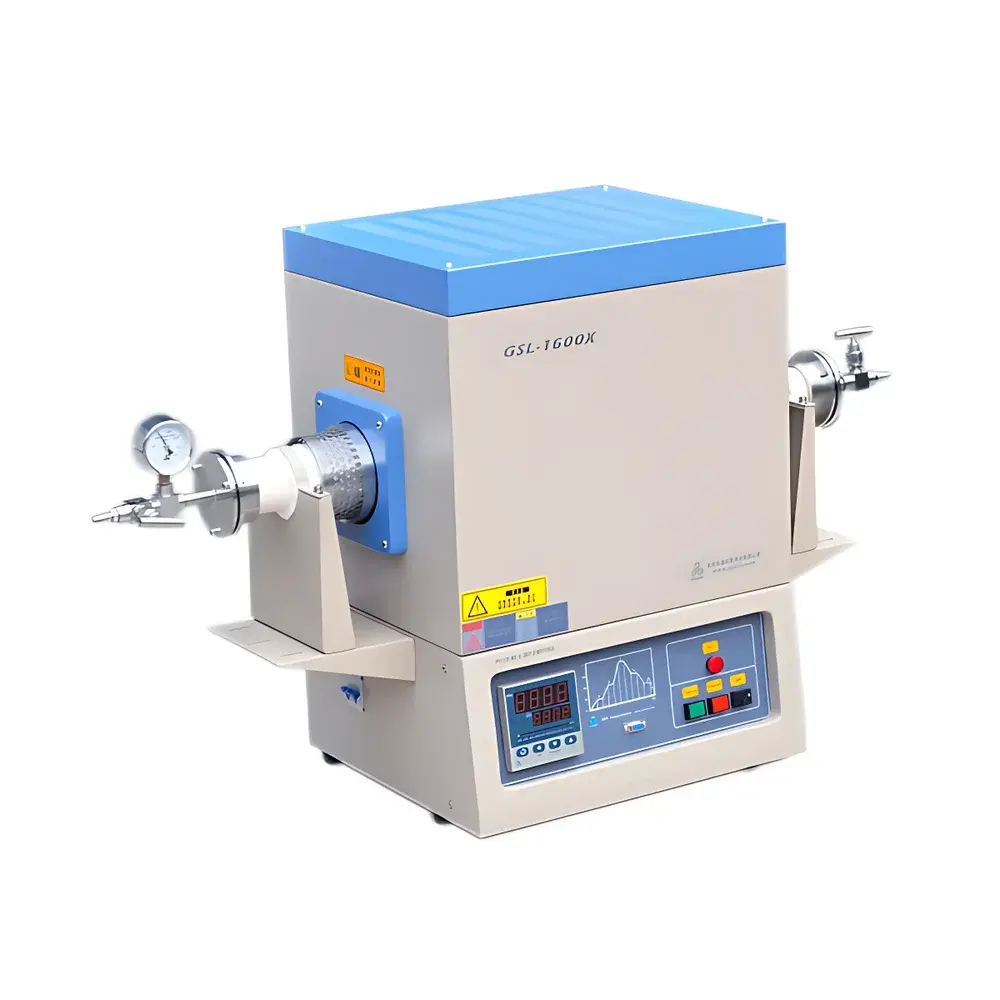
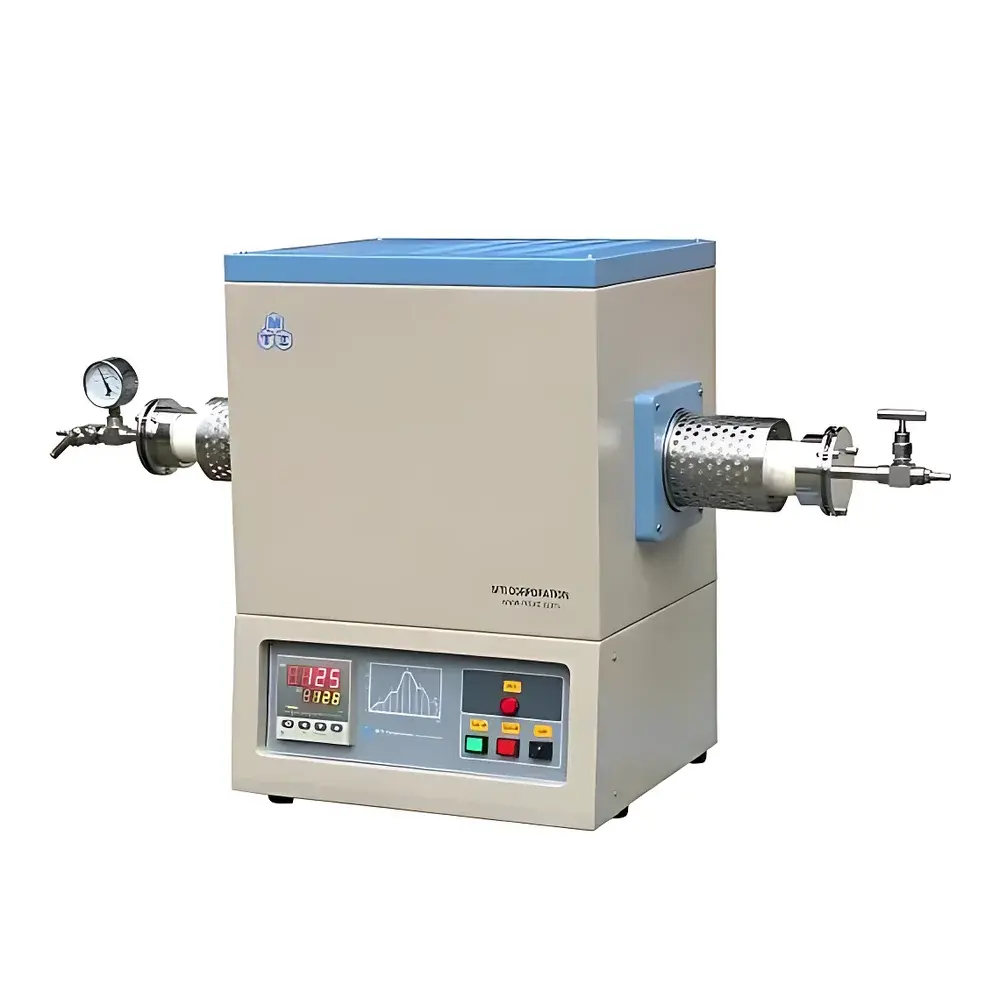
KJ GROUP GSL-1600X Vacuum High-Temperature Tube Furnace
| Brand | KJ GROUP |
|---|---|
| Origin | Liaoning, China |
| Manufacturer Type | Authorized Distributor |
| Origin Category | Domestic (China) |
| Model | GSL-1600X |
| Heating Element | MoSi₂ Rods (Rated to 1750°C) |
| Max Operating Temperature | 1600°C (Continuous: 800–1500°C) |
| Heating Zone Length | 457 mm |
| Uniform Temperature Zone | 150 mm |
| Tube Dimensions | Φ60 mm OD × Φ54 mm ID × 1000 mm L |
| Power Supply | AC 220 V, 50/60 Hz, 5 kW |
| Temp. Control | 30-Stage PID Programmable Controller |
| Temp. Accuracy | ±1°C |
| Cooling | Forced Air (Dual-Layer Shell) |
| Surface Temp. | <55°C |
| Vacuum Performance | 1×10⁻³ Torr (Mechanical Pump), 1×10⁻⁵ Torr (Turbomolecular Pump) |
| Certifications | CE |
| Dimensions (W×D×H) | 590×490×760 mm |
| Weight | 150 kg |
| Standard Accessories | 1× Al₂O₃ Tube, 2× Al₂O₃ End Plugs, 1× SS Flange Set |
Overview
The KJ GROUP GSL-1600X Vacuum High-Temperature Tube Furnace is a precision-engineered thermal processing system designed for controlled atmosphere synthesis, annealing, sintering, and chemical vapor deposition (CVD) of advanced functional materials. It operates on the principle of resistive heating via high-purity molybdenum disilicide (MoSi₂) heating elements—rated to 1750°C—enabling stable, repeatable operation up to 1600°C under vacuum or inert gas environments. The furnace features a double-walled stainless steel housing with integrated forced-air cooling, ensuring operator safety and long-term thermal stability. Its high-purity alumina fiber insulation (≥99.7% Al₂O₃) minimizes thermal mass and improves energy efficiency, while the U.S.-sourced alumina coating on the inner chamber surface enhances infrared emissivity and thermal uniformity across the 150 mm isothermal zone. This architecture meets the stringent thermal homogeneity and repeatability requirements of R&D labs engaged in ceramic matrix composites, solid-state electrolytes, 2D material growth, and oxide superconductor development.
Key Features
- Dual-layer water-cooled (air-cooled) stainless steel shell with surface temperature maintained below 55°C during continuous operation at 1500°C.
- High-density alumina fiber insulation (fiber diameter ≤3 µm) with proprietary U.S.-imported alumina reflective coating applied to internal chamber walls for improved radiative heat transfer and extended service life.
- 30-segment programmable PID temperature controller with ramp-soak profiles, real-time data logging, and over-temperature cutoff protection (dual independent thermocouple inputs).
- CE-certified design compliant with EN 61000-6-3 (EMC) and EN 61000-6-4 (immunity); includes grounding continuity verification and reinforced electrical isolation per IEC 61010-1.
- Modular flange interface (standard KF25-compatible) supports rapid integration with vacuum manifolds, mass flow controllers, and residual gas analyzers for CVD or annealing process automation.
Sample Compatibility & Compliance
The GSL-1600X accommodates cylindrical samples up to Φ52 mm in diameter and 800 mm in length within its 1000 mm alumina tube. It is compatible with oxidation-sensitive materials (e.g., Ti₃C₂Tₓ MXenes), air-sensitive precursors (e.g., Li-rich layered oxides), and volatile halide-based CVD precursors (e.g., WCl₆, MoCl₅). The furnace supports GLP-compliant workflows when paired with validated vacuum gauges (e.g., capacitance manometer + ion gauge) and calibrated Type S thermocouples traceable to NIST standards. Vacuum integrity has been verified per ASTM E595 for outgassing rates (<1.0% TML, <0.1% CVCM), making it suitable for space-grade material qualification protocols. Optional digital vacuum controllers enable automated pressure ramping aligned with ISO 14644-1 cleanroom classification requirements for low-particulate thermal processing.
Software & Data Management
The integrated PID controller supports RS485 Modbus RTU communication for external SCADA integration (e.g., LabVIEW, Ignition, or DeltaV). Optional KJ-DataLink software provides time-stamped temperature/vacuum trend logging, user-access-level management (admin/operator), and audit-trail generation compliant with FDA 21 CFR Part 11 Annex 11 requirements—including electronic signatures, change history, and exportable CSV/PDF reports. All firmware updates are digitally signed and delivered via secure HTTPS endpoint; no cloud dependency is required for local deployment.
Applications
- Sintering of ultra-high-temperature ceramics (UHTCs) such as ZrB₂–SiC composites under 10⁻⁵ Torr vacuum.
- Controlled-atmosphere annealing of perovskite solar cell absorber layers (e.g., MAPbI₃) under N₂/H₂ mixtures.
- Graphene and transition metal dichalcogenide (TMD) growth via atmospheric-pressure or low-pressure CVD.
- Thermal stabilization of battery cathode materials (e.g., Ni-rich NMC, LiCoO₂) with precise oxygen partial pressure control.
- Heat treatment of optical fibers and scintillation crystals (e.g., LuAG:Ce) requiring sub-±2°C thermal uniformity over 100 mm axial length.
FAQ
What vacuum level is achievable with the standard mechanical pump configuration?
The base configuration achieves ≤1×10⁻³ Torr using a two-stage rotary vane pump; optional turbomolecular pumping upgrades extend capability to ≤1×10⁻⁵ Torr.
Can the furnace be operated continuously at 1600°C?
No—1600°C is the maximum short-term limit (≤2 hours); continuous operation is rated from 800°C to 1500°C per IEC 60519-12 thermal endurance guidelines.
Is the alumina tube included with thermal shock resistance certification?
Yes—the supplied high-purity α-Al₂O₃ tube (99.8% purity) is certified to withstand ≥50 thermal cycles between 25°C and 1500°C without microcracking per ASTM C20.
Does the system support inert gas purging with automatic flow regulation?
Standard configuration includes manual needle valves; optional MFC-integrated gas delivery modules (N₂, Ar, H₂, forming gas) are available with 0–500 sccm range and ±1% FS accuracy.
What maintenance intervals are recommended for the MoSi₂ heating elements?
Under continuous use at ≤1400°C with proper atmosphere control, MoSi₂ elements typically require inspection every 6 months and replacement after ~2000 cumulative operating hours at peak temperature.
Related Products



