
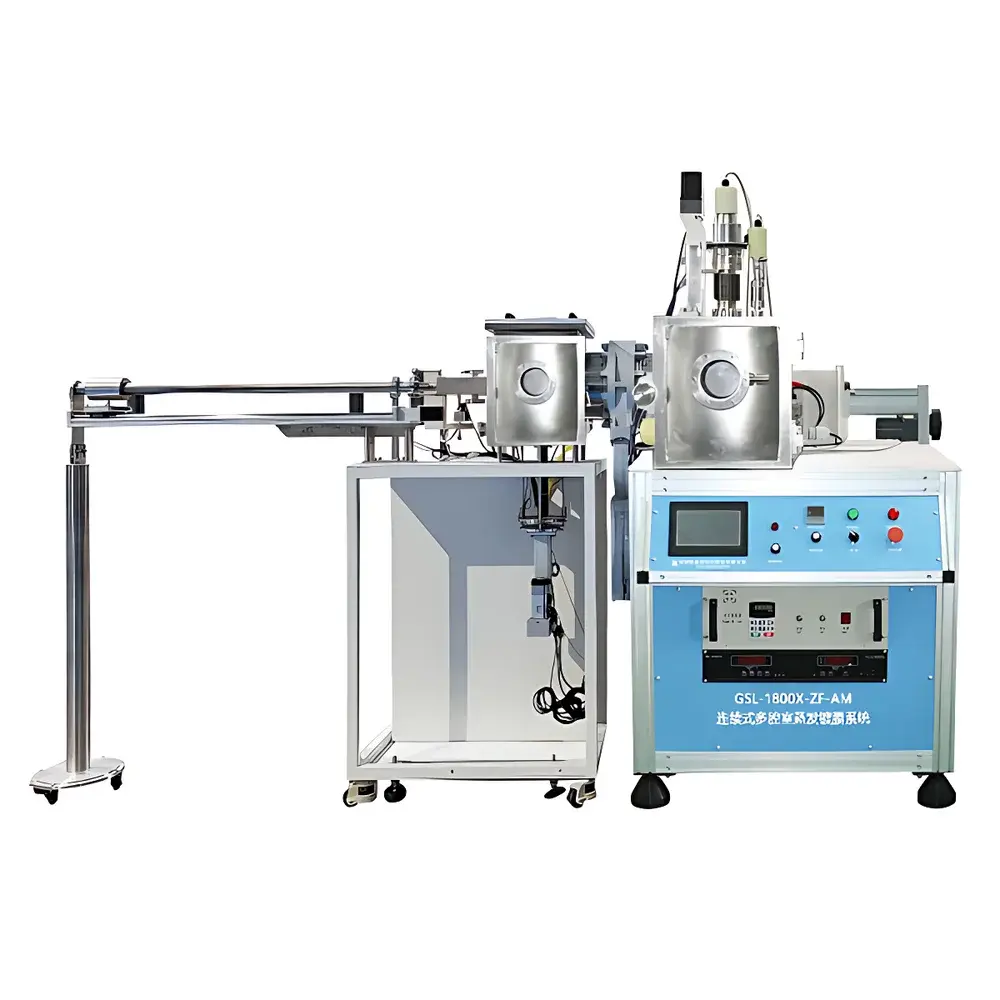
KJ GROUP GSL-1800X-ZF-AM Continuous Multi-Chamber Thermal Evaporation Deposition System
| Brand | KJ GROUP |
|---|---|
| Origin | Liaoning, China |
| Manufacturer Type | Direct Manufacturer |
| Product Origin | Domestic (China) |
| Model | GSL-1800X-ZF-AM |
| Pricing | Upon Request |
| Vacuum Chamber | Ø300 mm × 360 mm (stainless steel, electropolished interior) |
| Base Pressure | 8.0 × 10⁻⁵ Pa |
| Operating Vacuum Range | 8.0 × 10⁻⁴ Pa |
| Leak Rate | 6.7 × 10⁻⁸ Pa·L/s |
| Evaporation Power Supply | AC 0–8 V, up to 200 A (max. 1.6 kW) |
| Substrate Heater | RT–500 °C, PID-controlled |
| Film Thickness Resolution (Al) | 0.1 Å |
| Water Cooling Requirement | 15 L/min |
| Substrate Holder Diameter | Ø120 mm |
| Source-to-Substrate Distance | 140–200 mm |
| Observation Port | Ø100 mm quartz window with metal-sealed O-ring |
| Pumping Configuration | 600 L/s turbo-molecular pump + mechanical roughing pump |
| Vacuum Valves | 1 × KF40 bypass valve, 1 × CF150 gate valve, 1 × KF16 flange (for resistance gauge), 6 × CF35 flanges (including for ion gauge, 2-pin electrode, quartz crystal microbalance) |
Overview
The KJ GROUP GSL-1800X-ZF-AM Continuous Multi-Chamber Thermal Evaporation Deposition System is a high-vacuum, automated thin-film fabrication platform engineered for reproducible, contamination-controlled physical vapor deposition (PVD) of metals and small-molecule organic materials. It operates on the principle of resistive thermal evaporation—where electrically heated tungsten boats generate vapor fluxes under ultra-high vacuum conditions—enabling precise stoichiometric transfer of source material onto substrates. The system’s dual-chamber architecture—comprising an integrated load-lock transfer chamber and a dedicated evaporation chamber—eliminates air exposure between successive depositions, making it especially suitable for oxygen-sensitive films such as Ti, Al, Au, and reactive organics used in OLEDs and organic photovoltaics (OPVs). Its modular design supports sequential multi-source deposition without venting, while the synchronized shuttle stage—driven by a frequency-controlled motor—ensures repeatable positioning accuracy (< ±0.1 mm) and programmable translation velocity (0.1–10 mm/s), critical for uniform film thickness across wafer-scale or multi-sample arrays.
Key Features
- Dual-chamber configuration with independent vacuum control: load-lock transfer chamber and evaporation chamber both equipped with origin-referenced position sensors and auto-homing capability.
- Four independently controllable tungsten evaporation boats, each paired with a motorized rotating shutter to isolate active sources and prevent cross-contamination during multi-material deposition.
- Top-mounted substrate holder (Ø120 mm) with integrated PID-controlled heating (RT–500 °C), enabling in-situ annealing and stress-modulated growth.
- High-resolution quartz crystal microbalance (QCM) compatible via dedicated CF35 port; calibrated thickness resolution of 0.1 Å for aluminum reference films.
- Stainless-steel vacuum chamber (Ø300 mm × 360 mm) with electropolished interior surface to minimize outgassing and enhance base vacuum stability.
- Integrated water-cooled electrode assembly (5 × electrodes) at chamber base, rated for continuous 200 A operation and compatible with external recirculating chillers (15 L/min flow rate).
- Centralized vacuum control unit housing all pneumatic valves, pressure gauges (Bayard-Alpert ion gauge + Pirani resistance gauge), and interlock logic for safe pump-down sequencing.
Sample Compatibility & Compliance
The GSL-1800X-ZF-AM accommodates rigid planar substrates up to Ø100 mm—including silicon wafers, glass slides, ITO-coated PET, and pre-patterned OLED test chips—mounted on a kinematically aligned top-stage holder. Its oxygen-free environment (base pressure ≤ 8.0 × 10⁻⁵ Pa, leak rate ≤ 6.7 × 10⁻⁸ Pa·L/s) meets ASTM F1929-19 requirements for residual gas analysis in clean vacuum systems. All wetted surfaces comply with ISO 10110-7 optical surface finish standards for low-particulate chambers. While not certified to FDA 21 CFR Part 11, the system supports GLP/GMP-aligned documentation workflows when paired with validated third-party data acquisition software. Electrical safety conforms to IEC 61000-6-4 (EMC) and IEC 61000-6-2 (immunity) standards.
Software & Data Management
The system operates via a local industrial PC running real-time embedded control firmware. All process parameters—including boat current/voltage, substrate temperature, chamber pressure, shutter position, and QCM deposition rate—are logged at 10 Hz resolution and exported in CSV/ASCII format. Optional integration with LabVIEW™ or Python-based APIs enables remote monitoring and script-driven batch processing. Audit trails include timestamped operator ID, parameter setpoints, and alarm events (e.g., overtemperature, pressure excursion, shutter timeout). Raw data files are stored on encrypted internal SSD with automatic daily backup to network-attached storage (NAS) upon user configuration.
Applications
- Development of emissive and charge-transport layers in small-molecule OLED research.
- Fabrication of reflective metal electrodes (Ag, Al, Mg:Ag) for perovskite and organic solar cells.
- Deposition of adhesion-promoting interlayers (e.g., LiF, MoO₃) in tandem device architectures.
- Controlled co-evaporation of donor–acceptor blends for bulk heterojunction OPV optimization.
- In-situ thermal annealing studies of phase-separated organic thin films under inert vacuum conditions.
- Calibration and validation of optical simulation models using precisely controlled single-layer metal films.
FAQ
What vacuum level is required before initiating evaporation?
A stable base pressure ≤ 5.0 × 10⁻⁵ Pa must be achieved and maintained for ≥ 15 minutes prior to power ramp-up, verified by both ion and Pirani gauges.
Can the system deposit insulating materials like LiF or CaF₂?
Yes—provided appropriate boat geometry and current ramping profiles are applied to avoid thermal runaway; optional electron-beam source upgrade available for high-melting-point dielectrics.
Is the substrate heater compatible with quartz crystal monitoring during deposition?
Yes—the top-mounted heater design ensures unobstructed line-of-sight between QCM sensor and substrate, with thermal drift compensated via real-time temperature feedback.
How is cross-contamination prevented between sequential depositions?
Through synchronized shutter actuation, source isolation via rotating baffle, and mandatory 30-second N₂ purge cycle between chamber transfers.
What maintenance intervals are recommended for the turbo-molecular pump?
Annual bearing inspection and oil replacement per manufacturer guidelines; vibration monitoring logs should be reviewed quarterly for early failure detection.



