
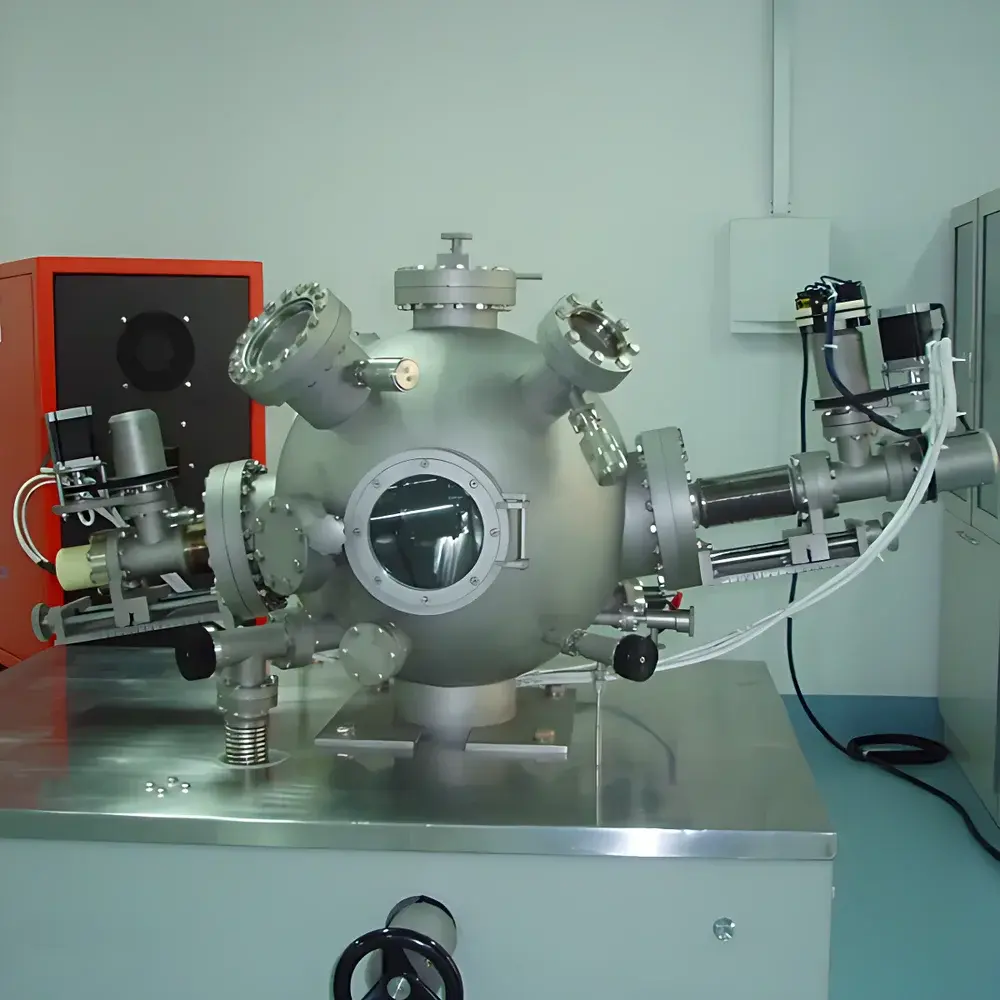
KJ GROUP GSL-450-PLD Pulsed Laser Deposition System
| Brand | KJ GROUP |
|---|---|
| Origin | Liaoning, China |
| Manufacturer Type | Authorized Distributor |
| Country of Origin | China |
| Model | GSL-450-PLD |
| Pricing | Upon Request |
| Ultimate Vacuum | ≤6.67×10⁻⁵ Pa (after bake-out) |
| Leak Rate | ≤5.0×10⁻⁷ Pa·L/s |
| Pump-down Time | ≤20 min to 5×10⁻³ Pa after N₂ purge |
| Chamber Diameter | Ø450 mm |
| Base Pressure Recovery | Achieves 5×10⁻³ Pa within 20 min after brief atmospheric exposure and dry N₂ backfill |
| Substrate Holder | Accommodates Ø2″ wafers with shutter |
| Target Assembly | 4-position rotating turret (Ø1″ or Ø2″ targets) |
| Optical Ports | One RF100 UV-grade fused silica viewport (for laser beam delivery), one RF100 IR-grade fused silica viewport (optional, for pyrometric temperature monitoring), one RF100 standard optical glass viewport (visual observation) |
| Cooling | Integrated closed-loop chiller |
| Power Supply | AC 380 V, 50 Hz, ≥10 kW, voltage fluctuation <±6%, grounding resistance <2 Ω |
| Process Gases | High-purity N₂ or Ar (≥99.99%) |
| Ventilation | Mandatory external exhaust ducting for ablation byproducts |
| Footprint | 1800 mm × 1000 mm × 1600 mm (W×D×H) |
Overview
The KJ GROUP GSL-450-PLD is a compact, high-vacuum pulsed laser deposition (PLD) system engineered for precise, stoichiometric thin-film synthesis under controlled inert or reactive atmospheres. Operating on the principle of laser-induced plasma plume generation—where high-energy nanosecond pulses (typically from excimer or Nd:YAG lasers, not included) ablate solid targets to produce transient, highly energetic species—the system enables direct transfer of complex multi-element compositions onto heated substrates without significant elemental fractionation. Unlike sputtering or evaporation techniques, PLD preserves the chemical stoichiometry of ceramic oxides, nitrides, high-temperature superconductors (e.g., YBCO), ferroelectrics (e.g., PZT, SBT), and hard transition-metal carbides/nitrides—making it indispensable for functional oxide research, epitaxial heterostructure development, and combinatorial materials screening in academic and industrial R&D laboratories.
Key Features
- Four-position motorized target turret with independent rotational control (5–60 rpm) and physical metal shielding between targets—ensuring zero cross-contamination during sequential or multi-layer deposition.
- High-precision substrate stage with programmable rotation (5–60 rpm), axial positioning (30–90 mm from target), and closed-loop thermocouple-regulated heating up to 800 °C ±1 °C using oxidation-resistant heating elements.
- Ultra-high-vacuum-compatible stainless-steel spherical chamber (Ø450 mm), argon-welded and electropolished, sealed with metal gaskets (CF/ISO-K) and fluorosilicone O-rings where appropriate—achieving ≤6.67×10⁻⁵ Pa after bake-out and maintaining leak integrity at ≤5.0×10⁻⁷ Pa·L/s.
- Dedicated optical train integration: RF100 UV-grade fused silica window (190–400 nm transmission) for laser beam coupling; optional RF100 IR-grade fused silica viewport (for non-contact pyrometry); plus a standard RF100 optical glass viewport for real-time visual alignment and process monitoring.
- Integrated closed-loop deionized water cooling system (≥12 L/min, <25 °C inlet) compatible with high-repetition-rate laser operation and thermal management of plasma plume interaction zones.
- Rapid vacuum recovery protocol: Reaches 5×10⁻³ Pa within 20 minutes following dry nitrogen backfill and re-pumping—minimizing downtime between experimental runs.
Sample Compatibility & Compliance
The GSL-450-PLD accommodates standard Ø2″ (50.8 mm) planar substrates—including single-crystal Si, SrTiO₃, MgO, LaAlO₃, Al₂O₃, and flexible metallic foils—with mechanical shuttering for sharp layer interfaces. Target compatibility spans conductive metals, insulating ceramics, and composite pellets (Ø1″ or Ø2″, thickness 3–6 mm), with no intrinsic limitation on material class or volatility. The system conforms to general laboratory safety standards for Class 3B/4 laser environments (when externally integrated), adheres to IEC 61000-6-3 (EMC emission limits), and supports GLP-compliant documentation when paired with validated data acquisition protocols. While not pre-certified to ISO 14644 (cleanroom) or ASTM F2655 (vacuum system performance), its design enables traceable calibration of base pressure, temperature, and gas flow—facilitating internal SOP development aligned with ISO/IEC 17025 requirements for testing laboratories.
Software & Data Management
The system operates via an industrial PLC-based control interface with discrete I/O modules managing vacuum sequencing, heater ramp/soak profiles, rotary stage motion, and gas dosing logic. All operational parameters—including chamber pressure (via Bayard-Alpert and capacitance manometer), substrate temperature, rotation speed, and shutter actuation—are logged in timestamped ASCII or CSV format at user-defined intervals (100 ms to 10 s resolution). Optional Ethernet-enabled SCADA integration allows remote monitoring and archival to networked storage systems compliant with FDA 21 CFR Part 11 principles (audit trail, electronic signature support, and data integrity controls) when deployed with validated third-party software platforms such as LabVIEW or Ignition SCADA.
Applications
- Growth of epitaxial high-Tc superconducting films (e.g., YBa₂Cu₃O7−δ) on lattice-matched perovskite substrates for transport and microwave characterization.
- Deposition of multiferroic BiFeO₃ and strain-engineered Pb(Zr,Ti)O₃ heterostructures for ferroelectric memory and piezoelectric MEMS prototyping.
- Preparation of transparent conducting oxides (In₂O₃:Sn, ZnO:Al) and wide-bandgap semiconductors (GaN, AlN) for optoelectronic device stacks.
- Combinatorial synthesis of composition-spread libraries (e.g., Ni–Co–Fe–O spinels) using gradient-target ablation and spatially resolved substrate masking.
- In situ monitoring of nucleation kinetics via time-resolved reflection high-energy electron diffraction (RHEED)—when retrofitted with compatible electron optics and UHV viewports.
FAQ
What laser specifications are required to operate the GSL-450-PLD?
The system is designed for external integration with nanosecond-pulsed lasers operating in the UV (e.g., KrF excimer, 248 nm) or near-IR (e.g., frequency-quadrupled Nd:YAG, 266 nm) spectral ranges, delivering fluences of 1–5 J/cm² at repetition rates up to 10 Hz. Laser delivery optics must be compatible with the RF100 UV-grade fused silica viewport.
Can the system be upgraded for reactive PLD (e.g., O₂ or NO₂ ambient)?
Yes—gas inlet ports support mass-flow-controlled introduction of reactive gases up to 100 Pa partial pressure. For oxidizing environments, optional hot-wall chamber heating (up to 400 °C) and oxygen-compatible seals are available as factory-configured options.
Is remote diagnostics or service support available?
KJ GROUP provides secure remote access capability via encrypted VPN for firmware updates, parameter validation, and diagnostic log retrieval—subject to end-user network policy approval and compliance with local data sovereignty regulations.
What vacuum pumping configuration is standard?
The base configuration includes a turbomolecular pump (≥600 L/s N₂ speed) backed by a dry scroll pump, coupled with a full-range capacitance manometer and Bayard-Alpert gauge for pressure measurement across 10⁵ Pa to 10⁻⁷ Pa.
Are custom substrate holders or shadow masks supported?
Yes—custom-machined holders (e.g., for patterned Si wafers, fiber substrates, or micro-electrode arrays) and precision tungsten or molybdenum shadow masks can be fabricated to specification and qualified for UHV compatibility prior to installation.



