
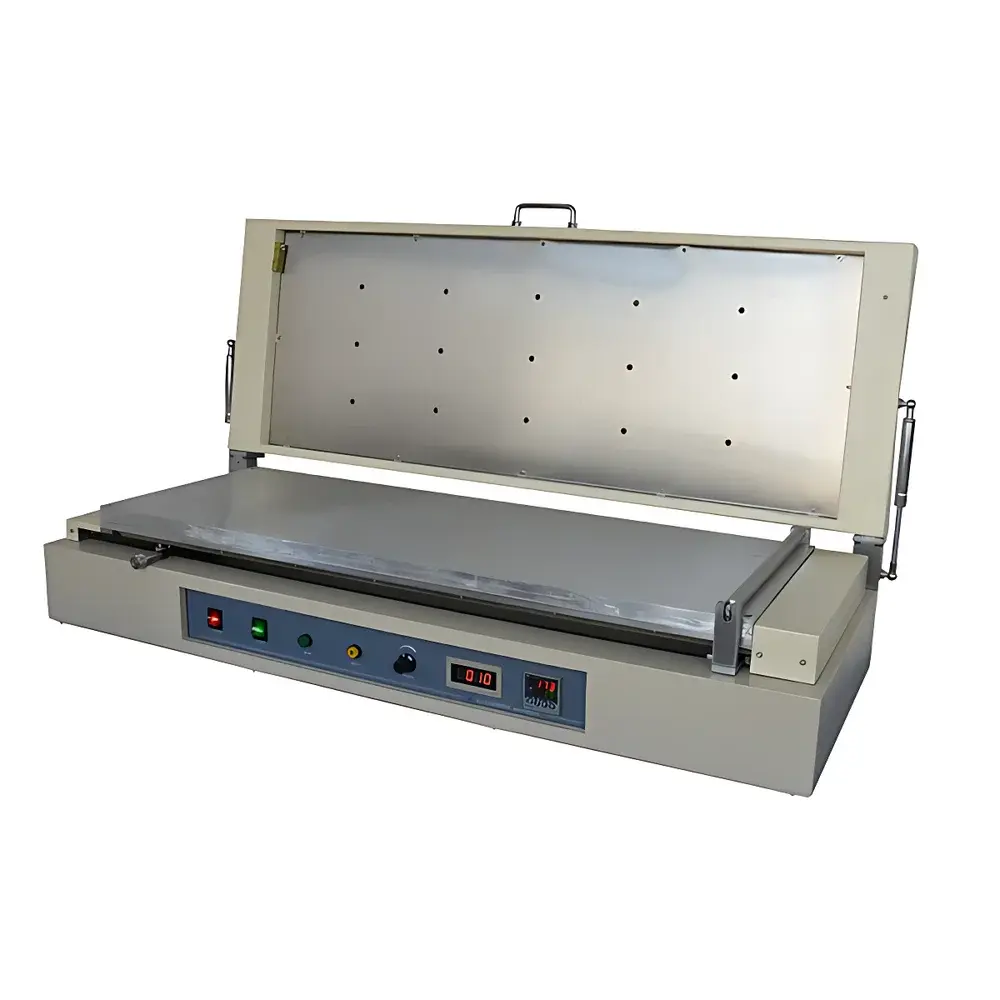
KJ GROUP MSK-AFA-L1000 Benchtop Automated Coating and Hot-Drying Film Applicator
| Brand | KJ GROUP |
|---|---|
| Origin | Liaoning, China |
| Manufacturer Type | Authorized Distributor |
| Country of Origin | China |
| Model | MSK-AFA-L1000 |
| Pricing | Upon Request |
| Power Supply | AC 220 V, 50 Hz, 16 A |
| Total Power Consumption | 3050 W |
| Coating Bed Dimensions (L×W) | 1000 mm × 350 mm |
| Vacuum Adsorption Area (L×W) | 930 mm × 300 mm |
| Coating Speed | 10–100 mm/s (infinitely variable) |
| Adjustable Coating Length | 0–900 mm |
| KTQ300 Adjustable Blade | 300 mm wide, film thickness range 0–5000 µm |
| Heating Method | Bottom-mounted vacuum platen with PID-controlled resistive heating |
| Max. Heating Temperature | 120 °C |
| Temperature Control Accuracy | ±2 °C |
| Operating Ambient | 0–45 °C, 10–85% RH (non-condensing) |
| Unit Dimensions (closed lid) | 1240 mm × 460 mm × 260 mm |
| Unit Weight | 60 kg |
Overview
The KJ GROUP MSK-AFA-L1000 Benchtop Automated Coating and Hot-Drying Film Applicator is an engineered solution for precise, repeatable thin-film deposition in R&D laboratories and quality control environments. Designed around the principle of doctor-blade coating—where a fixed-gap or adjustable blade shears liquid or colloidal suspensions across a substrate under controlled linear motion—the system integrates real-time thermal drying via a temperature-regulated vacuum platen. This dual-function architecture enables simultaneous coating and solvent evaporation, significantly reducing process time and minimizing film defects such as cracking, dewetting, or edge beading caused by uncontrolled solvent migration. The unit operates on a robust mechanical platform featuring a high-torque, infinitely variable DC motor drive, ensuring stable translational velocity across the full 10–100 mm/s range. Its bottom-mounted vacuum adsorption system secures substrates—including flexible foils, rigid wafers, glass slides, and polymer films—without edge clamping interference, while maintaining flatness critical for uniform wet-film thickness distribution.
Key Features
- Infinitely variable speed control (10–100 mm/s) via precision DC motor and digital encoder feedback, enabling reproducible shear-rate profiles across diverse rheologies.
- KTQ300 stainless-steel adjustable doctor blade (300 mm width) with micrometer-driven gap setting; supports film thickness tuning from 0 to 5000 µm without blade replacement.
- Integrated vacuum-assisted substrate holding system (930 mm × 300 mm active area) with independent vacuum port for connection to external vacuum pumps (recommended ultimate pressure ≤ −80 kPa).
- Bottom-heated vacuum platen with PID-controlled resistive elements; programmable setpoint range 25–120 °C, stability ±2 °C over full operating range.
- Motorized blade carriage with programmable end-limit detection and automatic return stroke—eliminates manual reset and improves throughput consistency.
- Dedicated waste collection tray positioned at the left edge of the vacuum bed captures excess slurry, preventing cross-contamination and simplifying maintenance.
- Insulated hinged lid provides dust protection, thermal retention during heating cycles, and ergonomic access—designed for ISO Class 7 cleanroom-compatible operation.
Sample Compatibility & Compliance
The MSK-AFA-L1000 accommodates substrates up to 930 mm in length and 300 mm in width, including silicon wafers, PET/PI flexible films, aluminum foil, ceramic plates, and conductive glass (ITO/FTO). Its non-contact vacuum fixation avoids surface deformation or adhesive residue, supporting both brittle and low-modulus materials. The system meets general electrical safety requirements per GB 4793.1–2019 (equivalent to IEC 61010-1) and incorporates grounding continuity verification per national lab infrastructure standards. While not certified to UL/CE for standalone CE marking, it is routinely deployed in GLP-compliant battery electrode development labs, per ASTM D823 (Standard Practice for Producing Films of Uniform Thickness) and aligned with internal SOPs for cathode/anode slurry qualification under ISO 17025-accredited testing workflows.
Software & Data Management
The MSK-AFA-L1000 operates via front-panel membrane keypad with LED digital display for real-time monitoring of coating speed, platen temperature, and elapsed cycle time. No embedded software or PC interface is included; however, all operational parameters are manually logged per batch record requirements. For traceability in regulated environments, users integrate the device into broader LIMS or ELN platforms using external data loggers (e.g., Omega OM-DAQPRO-5300) connected to the analog temperature output (0–5 V) and digital status signals (coating start/stop, heater on/off). Audit trails, user access controls, and electronic signatures are implemented externally to comply with FDA 21 CFR Part 11 when used in pharmaceutical or medical device coating validation studies.
Applications
- Battery R&D: Uniform electrode slurry coating on current collectors (Cu/Al foil), enabling consistent areal loading and calendering precursor preparation.
- Perovskite & OPV research: Controlled deposition of precursor inks for photovoltaic absorber layers, where solvent evaporation kinetics directly influence crystallinity and phase segregation.
- Functional coatings: Fabrication of anti-reflective, hydrophobic, or conductive polymer films on optical or sensor substrates.
- Quality assurance: Reproducible reference film generation for FTIR mapping, SEM cross-section analysis, and adhesion testing per ASTM D3359.
- Materials science: Screening of rheological modifiers, dispersants, or binder systems through systematic variation of coating speed and temperature ramp profiles.
FAQ
What vacuum pump specifications are recommended for optimal substrate adhesion?
A two-stage rotary vane pump capable of achieving ≤ −80 kPa (gauge) is advised; minimum flow rate: 12 L/min. Use of oil-free diaphragm pumps is acceptable for low-outgassing substrates but may limit hold-down force on porous or warped samples.
Can the KTQ300 blade be replaced with custom geometries (e.g., notched, tapered, or multi-edge)?
Yes—the blade mounting interface follows standardized T-slot rail dimensions (ISO 2768-mK tolerance); third-party blades with compatible clamping fixtures can be installed without modification.
Is the heating system suitable for solvent mixtures with flash points below 60 °C?
Yes, provided the vacuum level is maintained above −60 kPa during heating to suppress boiling and ensure safe vapor extraction through standard lab fume hood ventilation.
Does the unit support programmable multi-step coating protocols (e.g., speed ramping or segmented heating)?
No—this is a manually operated, single-parameter-set instrument. Multi-step sequences require external PLC integration or operator intervention between stages.
What maintenance intervals are recommended for long-term reliability?
Vacuum hose inspection every 6 months; blade edge polishing or replacement annually (or after ~500 coating cycles); calibration of temperature sensor against NIST-traceable reference every 12 months.



