
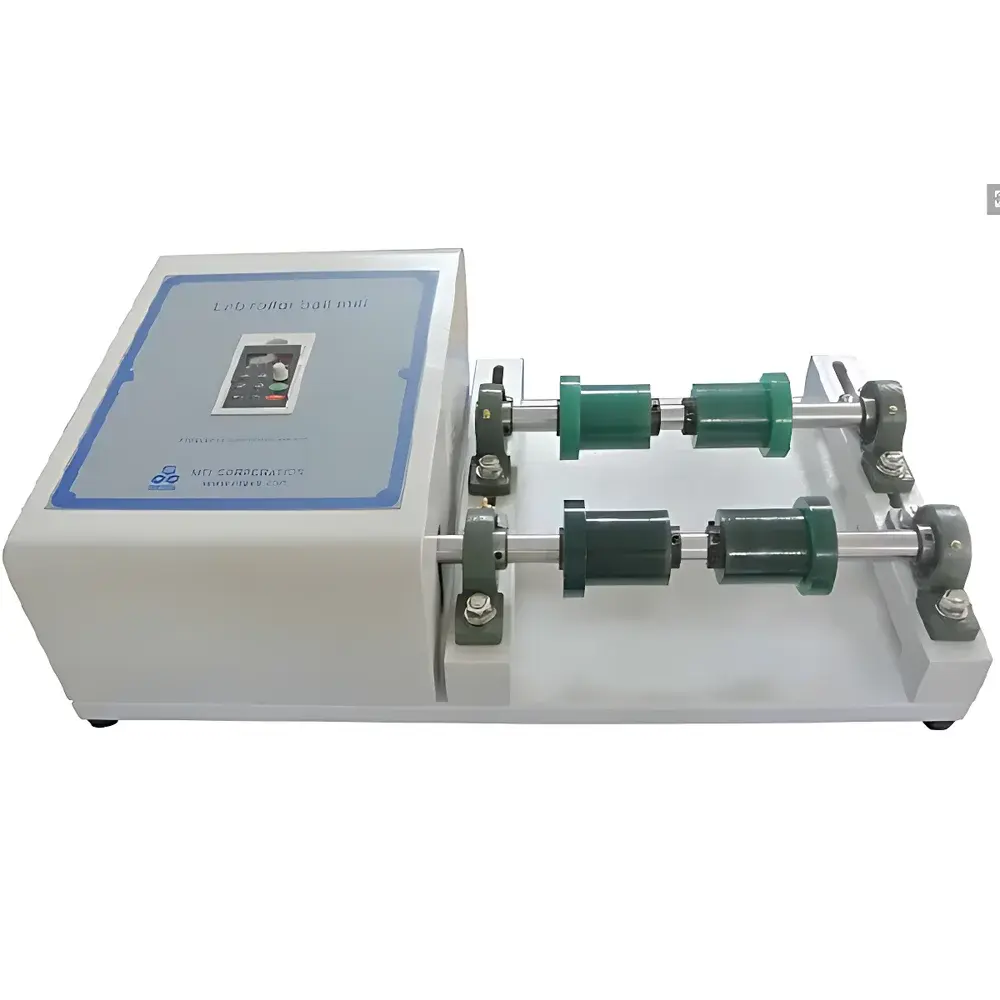
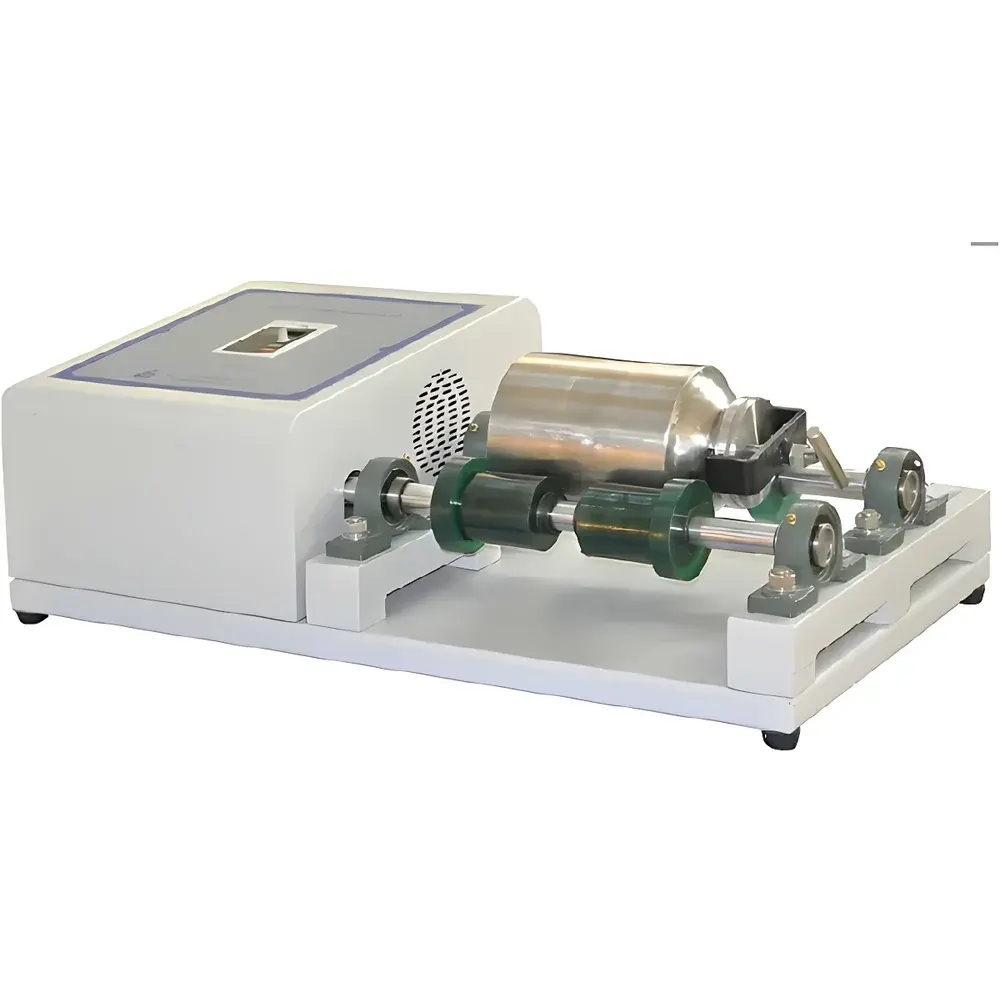
KJ GROUP MSK-SFM-14 Rotary Drum Mixer
| Brand | KJ GROUP |
|---|---|
| Origin | Liaoning, China |
| Manufacturer Type | Authorized Distributor |
| Country of Origin | China |
| Model | MSK-SFM-14 |
| Price | Upon Request |
| Power Supply | AC 220 V, 50/60 Hz, 400 W |
| Rotation Mode | Programmable continuous bidirectional rotation (CW/CCW) |
| Speed Range | 60–600 rpm (digital display) |
| Timer Range | 1–9999 minutes |
| Maximum Load Capacity | 25 kg |
| Max. Compatible Jar Dimensions | Ø250 mm × 175 mm |
| Standard Stainless Steel Jar | Ø130 mm × 162 mm |
| Jar Material Options | Ceramic, Alumina, Zirconia, Stainless Steel, Polyurethane, Nylon |
| Grinding Media Compatibility | Alumina, Zirconia, Agate, Chrome Steel, Stainless Steel |
| Overall Dimensions (L×W×H) | 730 × 415 × 250 mm |
| Net Weight | 60 kg |
Overview
The KJ GROUP MSK-SFM-14 Rotary Drum Mixer is an engineered laboratory-scale mixing and homogenization system designed for reproducible, low-shear blending of powders, slurries, and granular materials. It operates on the principle of controlled rotational motion—utilizing dual precision-machined support rollers to drive a cylindrical mixing vessel along its central axis. Unlike planetary or high-energy ball mills, the MSK-SFM-14 employs gentle, gravity-assisted tumbling action, minimizing particle attrition while ensuring uniform distribution across heterogeneous formulations. This makes it particularly suitable for applications where mechanical integrity of active ingredients, coating layers, or fragile microstructures must be preserved—such as cathode/anode slurry preparation in battery R&D, ceramic green body formation, pharmaceutical blend development, and advanced composite precursor mixing. Its programmable bidirectional rotation sequence mitigates material stratification and wall adhesion, significantly improving batch-to-batch consistency under GLP-aligned lab protocols.
Key Features
- Programmable bidirectional rotation control with precise dwell time per direction, enabling optimized mixing trajectories for diverse material rheologies.
- Digital speed display and real-time RPM monitoring via integrated encoder feedback—calibrated to ±2 rpm accuracy across the full 60–600 rpm operating range.
- High-torque, low-noise AC induction motor (400 W) with thermal overload protection and electromagnetic braking for safe, repeatable start/stop cycles.
- Modular jar-mounting interface accommodating interchangeable vessels up to Ø250 mm × 175 mm, supporting rapid changeover between chemically inert and abrasion-resistant materials.
- Stainless steel frame with powder-coated structural housing (730 × 415 × 250 mm), engineered for stability during extended operation and compatible with standard fume hood or glovebox integration.
- Compliance-ready design: All electrical components meet IEC 61000-6-3 (EMC emission) and IEC 61000-6-2 (immunity) standards; mechanical safety conforms to ISO 12100:2012 risk assessment principles.
Sample Compatibility & Compliance
The MSK-SFM-14 accommodates a broad spectrum of container materials—including high-purity alumina and zirconia ceramics, medical-grade 316 stainless steel, food-contact-compliant polyurethane, and wear-resistant nylon—ensuring compatibility with corrosive, reactive, or ultra-high-purity samples. Its open-jar architecture supports both dry blending and wet slurry mixing using common grinding media such as yttria-stabilized zirconia (YSZ), α-alumina spheres, agate beads, and hardened stainless steel balls. The system is routinely deployed in environments requiring adherence to ASTM D344, ISO 8503-2 (surface profile assessment), and USP analytical instrument qualification frameworks. While not intrinsically certified for GMP manufacturing, its traceable parameter logging (via optional RS-232/USB interface) supports 21 CFR Part 11-compliant data governance when paired with validated third-party software.
Software & Data Management
The base unit features a front-panel membrane keypad and LED display for local setup of speed, direction sequence, and timer duration. For enhanced traceability, optional digital interfaces (RS-232 or USB-to-serial) enable remote parameter configuration and runtime logging via host PC. When integrated with KJ GROUP’s optional LabControl Suite (v3.2+), users gain access to audit-trail-enabled session records, exportable CSV datasets, and configurable alarm thresholds for deviation detection. All stored parameters are timestamped and user-ID tagged—facilitating alignment with internal SOPs for method validation, equipment qualification (IQ/OQ), and routine performance verification.
Applications
- Electrode slurry homogenization for Li-ion, solid-state, and sodium-ion battery research—ensuring uniform conductive network dispersion without carbon nanotube fragmentation.
- Precursor blending in ceramic processing, including piezoelectric PZT, dielectric BaTiO₃, and bioceramic hydroxyapatite formulations.
- Pharmaceutical solid dosage form development, especially for direct compression blends containing low-dose APIs and highly cohesive excipients.
- Homogenization of metal-organic framework (MOF) composites, catalyst supports, and functionalized polymer masterbatches.
- Preparation of calibration standards and reference materials requiring macroscopic uniformity verification per ISO Guide 35.
FAQ
What jar sizes are supported beyond the standard Ø130 mm × 162 mm stainless steel vessel?
The MSK-SFM-14 accepts custom jars up to Ø250 mm × 175 mm in external dimensions, provided center-of-gravity alignment remains within ±5 mm of the roller contact plane.
Can the mixer operate unattended for overnight runs?
Yes—its 9999-minute maximum timer (166.6 hours) and auto-shutdown function support fully autonomous long-duration mixing, contingent upon thermal and mechanical load limits being observed.
Is the unit compatible with inert atmosphere gloveboxes?
The compact footprint and rear-accessible power/data ports allow seamless integration into Class I or II gloveboxes; optional argon-purged jar lids are available separately.
Does KJ GROUP provide IQ/OQ documentation support?
Standard factory test reports (including speed calibration certificates and mechanical run-in logs) are supplied; full IQ/OQ protocol templates and on-site validation assistance are available under extended service agreements.
How frequently should maintenance be performed?
Roller bearing lubrication and belt tension verification are recommended every 500 operational hours; full preventive maintenance—including encoder recalibration and motor insulation resistance testing—is advised annually per ISO 55001 asset management guidelines.



