
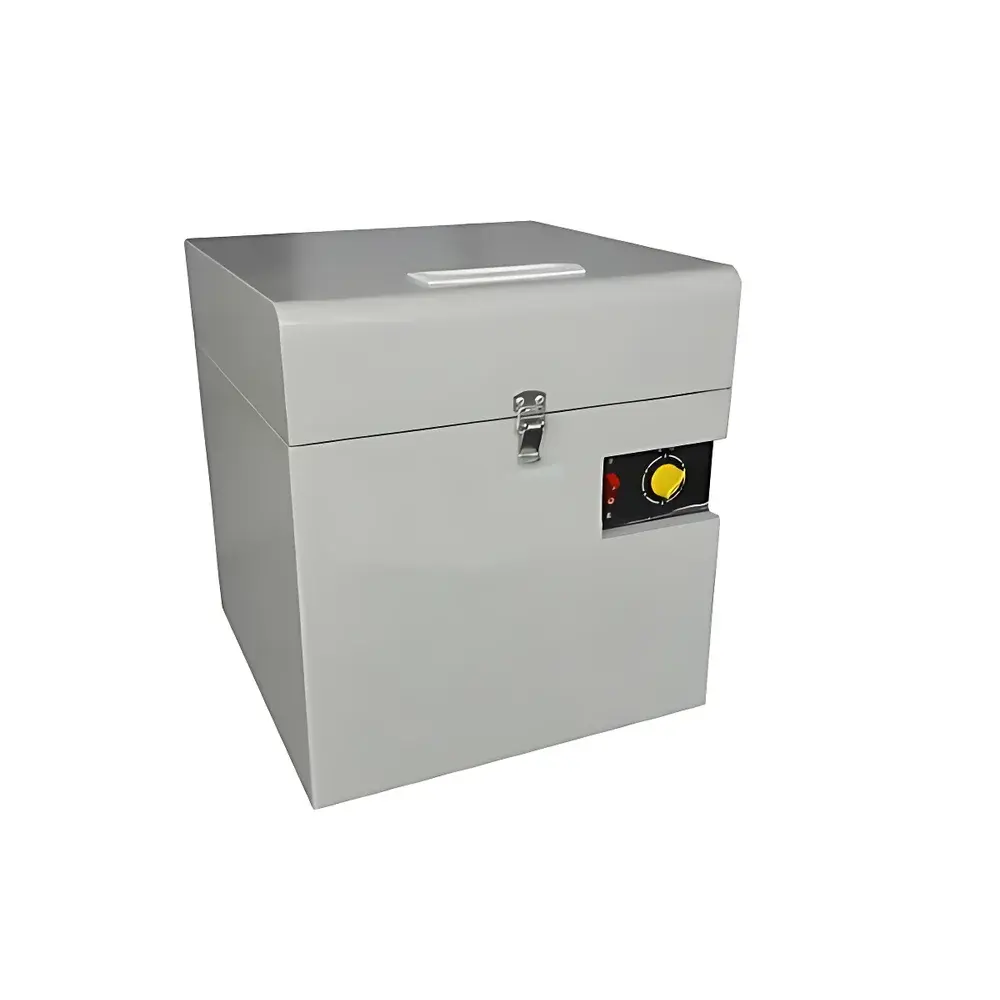
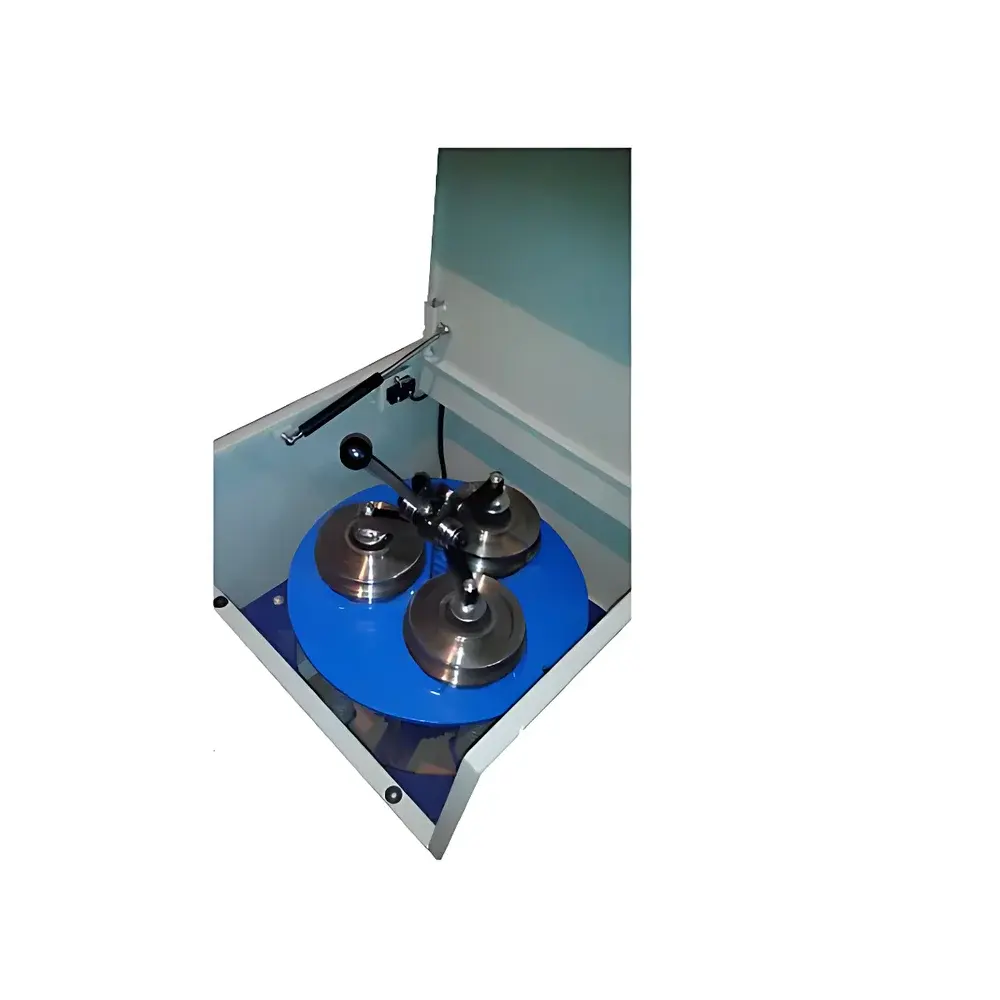
KJ GROUP MSK-SFM-DS Disc-Type Sample Crusher and Grinder
| Brand | KJ GROUP |
|---|---|
| Origin | Liaoning, China |
| Manufacturer Type | Authorized Distributor |
| Country of Origin | China |
| Model | MSK-SFM-DS |
| Power Supply | 208–240 V AC, 50 Hz, 180 W motor (300 W transformer required for 110 V operation) |
| Grinding Time Range | 0–5 min (adjustable) |
| Net Weight | 25 kg |
| Shipping Weight | 43 kg |
| Chamber Volume | 100 mL (max. sample mass: ~50 g) |
| Grinding Vessel Dimensions | Ø115 mm × 35 mm H |
| Max. Sample Size | Ø < 20 mm, H < 35 mm |
| Max. Sample Mohs Hardness | < 8 |
| Output Particle Size | 80–200 mesh (achieved with optional KJ GROUP 3-inch sieves: No. 200 & No. 450) |
| Overall Dimensions | 250 × 250 × 330 mm (L × W × H) |
| Safety | Interlocked lid switch (power cutoff upon lid opening) |
| Mounting | Four threaded base feet for floor or benchtop anchoring |
| Certification | CE-compliant |
| Warranty | 12 months standard, lifetime technical support |
| Material | Manganese steel grinding disc and chamber |
Overview
The KJ GROUP MSK-SFM-DS is a compact, disc-type mechanical crusher and grinder engineered for controlled, repeatable size reduction of brittle, non-fibrous solid materials in laboratory and pilot-scale sample preparation workflows. It operates on the principle of high-speed compression and shear between a rotating manganese steel grinding disc and a stationary annular grinding ring within a sealed, interlocked chamber. This configuration enables rapid comminution—primarily through impact fracture and abrasive attrition—without significant heat accumulation or phase transformation, making it suitable for pre-analytical processing where structural integrity or chemical stability of the bulk material must be preserved. Designed for use in geological, metallurgical, ceramic, and coal analysis laboratories, the MSK-SFM-DS supports standardized downstream procedures including X-ray fluorescence (XRF), X-ray diffraction (XRD), inductively coupled plasma (ICP) sample digestion, and sieve analysis per ASTM E11 and ISO 3310-1.
Key Features
- Interlocked safety lid mechanism: Instantaneous power cutoff upon lid removal—fully compliant with EN 61000-6-2/6-4 electromagnetic compatibility and EN 60204-1 machinery safety directives.
- Manganese steel grinding components: High wear resistance and consistent crushing performance across repetitive batches; optimized for materials with Mohs hardness < 8.
- Precision-timed operation: Digital timer (0–5 minutes, ±5 s accuracy) ensures reproducible particle size distribution across replicates.
- Modular anchoring system: Four M10 threaded mounting feet allow rigid fixation to concrete floors or heavy-duty lab benches—critical for vibration control and acoustic attenuation.
- CE-certified electrical architecture: 180 W AC induction motor with thermal overload protection; optional 300 W step-up transformer available for 110 V / 60 Hz regions (e.g., North America).
- Compact footprint: Occupies only 0.021 m² of bench/floor space—ideal for space-constrained QA/QC labs or field-deployable mobile laboratories.
Sample Compatibility & Compliance
The MSK-SFM-DS is validated for use with dry, granular, or sintered inorganic solids exhibiting low ductility and moderate brittleness—including coal briquettes, crushed ore concentrates, fired ceramic bodies, refractory aggregates, and geological core fragments. It is not suitable for polymers, metals > HRB 40, fibrous materials, or hygroscopic samples requiring inert atmosphere handling. All grinding parameters align with ASTM D2974 (coal and coke analysis), ASTM C782 (ceramic powder characterization), and ISO 6506-1 (hardness testing sample prep). The manganese steel contact surfaces meet EU Directive 2002/72/EC for incidental metal migration in non-food-contact research applications. Note: For GLP-regulated environments, users must document batch-specific grinding time, ambient temperature, and post-grinding sieve validation (e.g., using certified KJ GROUP No. 200 or No. 450 test sieves per ISO 2591-1).
Software & Data Management
The MSK-SFM-DS is a standalone electromechanical instrument with no embedded firmware or digital connectivity. All operational parameters are set manually via front-panel controls; no software installation, cloud synchronization, or audit trail functionality is provided. However, its deterministic behavior—fixed rotational speed (~1,450 rpm nominal), calibrated timer, and geometrically invariant grinding geometry—enables full traceability when integrated into LIMS or ELN systems. Users may log grinding cycles, sample IDs, sieve verification results, and maintenance records (e.g., disc wear inspection per 200 operating hours) in accordance with FDA 21 CFR Part 11–aligned documentation practices where required.
Applications
- Routine homogenization of coal samples prior to proximate/ultimate analysis (ASTM D3172–D3176).
- Size reduction of sintered ceramic compacts for XRD phase quantification (ISO 21363).
- Preparation of representative subsamples from heterogeneous rock cores for geochemical assay.
- Crushing of spent catalyst pellets or metallurgical slags for ICP-OES multi-element screening.
- Generation of narrow-distribution particulates for BET surface area measurement (ISO 9277).
- Quality control grinding of refractory raw materials prior to pressing and firing trials.
FAQ
Can the MSK-SFM-DS process wet or sticky samples?
No. It is strictly designed for dry, free-flowing solids. Moisture content > 1 wt% may cause caking, uneven wear, or motor stalling.
Is the manganese steel chamber compatible with acid digestion protocols?
Manganese steel is not corrosion-resistant to strong mineral acids. Samples intended for subsequent HNO₃/HF digestion must be transferred immediately after grinding to avoid elemental leaching.
What maintenance intervals are recommended?
Inspect grinding disc and ring for wear every 200 operating hours; replace if surface grooving exceeds 0.3 mm depth. Clean chamber and lid gasket after each use with non-abrasive solvent.
Does KJ GROUP supply calibration certificates for the timer or dimensional specifications?
No factory calibration certificate is issued. Users should verify timer accuracy annually using a Class A stopwatch traceable to NIST or equivalent national metrology institute.
Can the output particle size be narrowed beyond 200 mesh?
Not directly. The unit achieves 80–200 mesh under standard conditions. Finer sizing requires secondary milling (e.g., planetary ball mill) or air classification—both outside the design scope of this disc grinder.



