
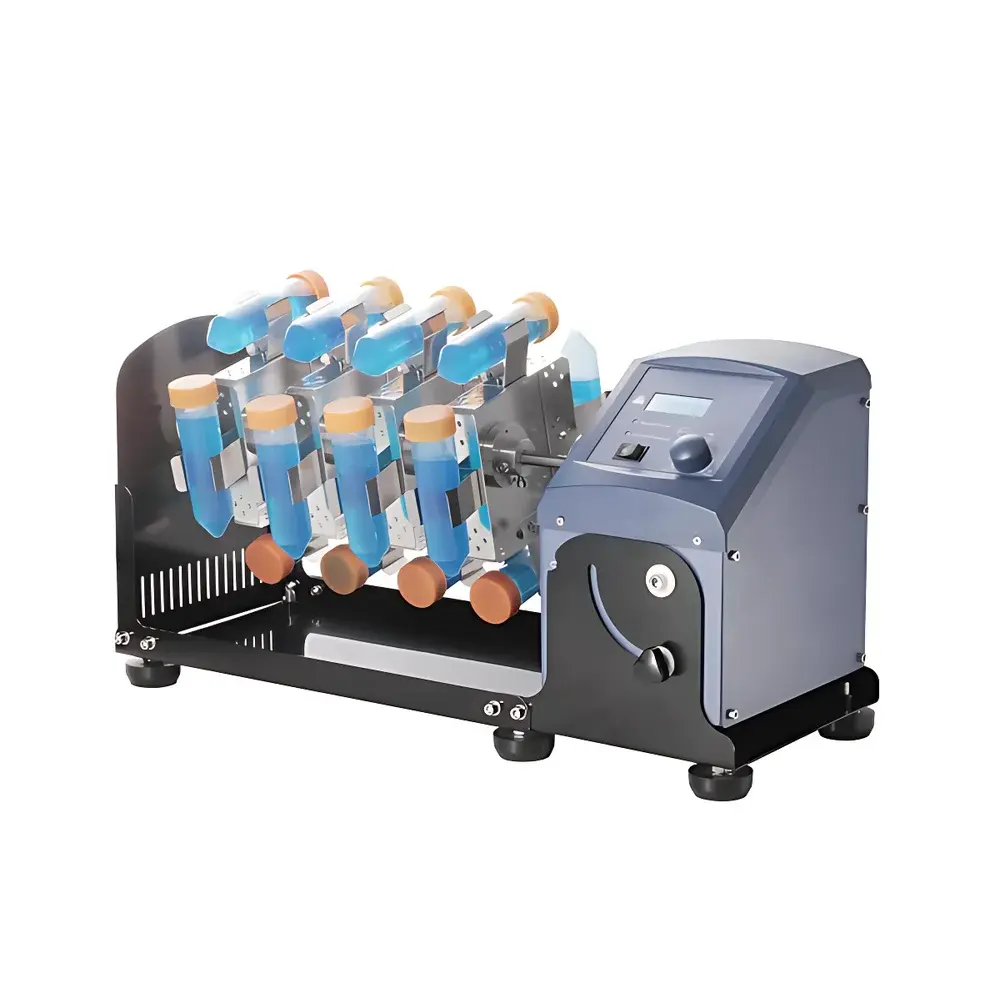
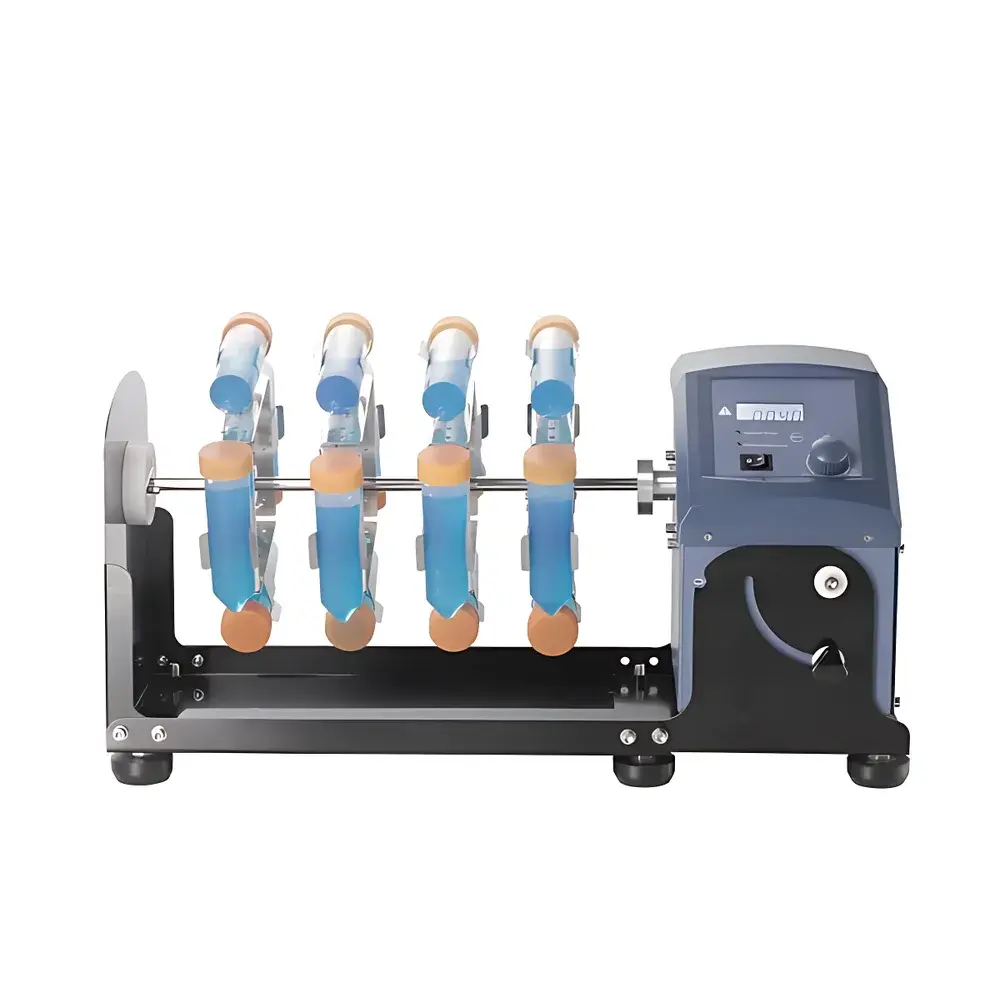
KJ GROUP MSK-SFM-HT16 High-Throughput Orbital Mixer
| Brand | KJ GROUP |
|---|---|
| Origin | Liaoning, China |
| Manufacturer Type | Authorized Distributor |
| Country of Origin | China |
| Model | MSK-SFM-HT16 |
| Price | Upon Request |
| Motor | 24 VDC |
| Speed Range | 10–70 rpm |
| Tilt Angle Adjustment | 0–90° |
| Timer Range | 1–1199 min |
| Operating Temperature | 5–40 °C |
| Relative Humidity Limit | ≤80% RH |
| Input Voltage | 100–240 VAC, 50/60 Hz |
| Power Consumption | 40 W |
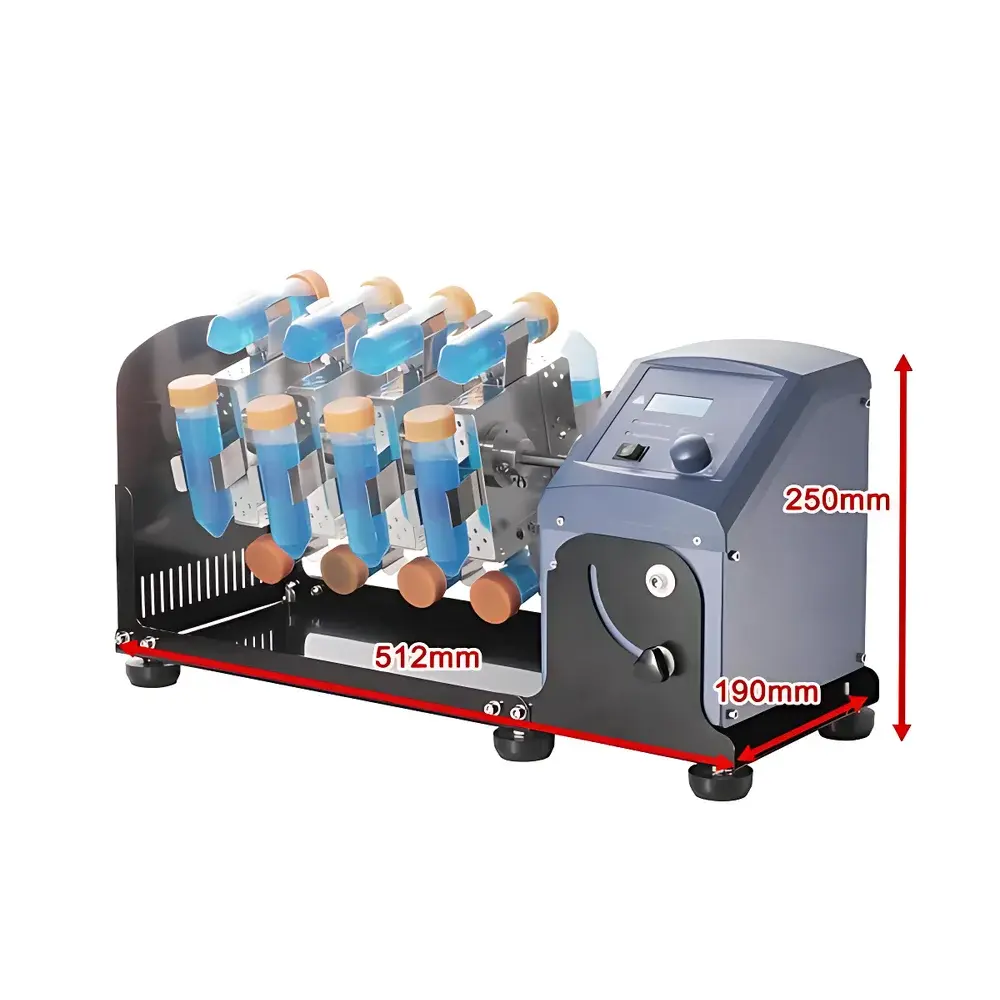
| Dimensions (D×W×H) | 220×510×260 mm |
| Weight | 8 kg |
| Sample Capacity | 16 positions × 50 mL max per vial |
| Display | Dual-line LCD (speed + time) |
| Operation Modes | Timed or Continuous |
| Compatibility | Glovebox-ready (Ar-compatible) |
| Standard Fixtures | 8× 50 mL centrifuge tube holders |
| Optional Fixtures | 60× 1.5 mL, 16× 15 mL centrifuge tube holders |
Overview
The KJ GROUP MSK-SFM-HT16 High-Throughput Orbital Mixer is an engineered solution for parallel sample preparation in combinatorial materials science and high-throughput experimentation (HTE). It operates on the principle of controlled orbital shaking—generating gentle yet effective mixing through synchronized rotational motion of multiple sample carriers around a central axis. Unlike vortexing or magnetic stirring, orbital agitation minimizes shear-induced particle degradation while ensuring uniform dispersion of dry powders, granules, or low-viscosity suspensions across all 16 independent stations. Designed specifically for integration into inert-atmosphere environments—including argon-purged gloveboxes—the device utilizes a 24 VDC brushless motor to eliminate sparking risks and ensure stable, low-EMI operation under strict containment conditions. Its compact footprint (220 × 510 × 260 mm) and lightweight construction (8 kg) facilitate benchtop deployment in shared core facilities, QC labs, and MGI (Materials Genome Initiative) workflows where reproducible, scalable powder homogenization is critical.
Key Features
- 16-position parallel mixing capability with independent mechanical coupling—enabling simultaneous processing of up to 16 discrete samples without cross-contamination.
- Adjustable orbital tilt angle (0–90°) to modulate mixing intensity: horizontal orientation maximizes surface coverage for light blending; vertical orientation enhances gravitational turnover for denser powders.
- Precise digital control via dual-line LCD interface displaying real-time rpm and remaining timer duration—no external software required for basic operation.
- Programmable timer range from 1 minute to 19 hours 59 minutes, supporting both single-cycle timed runs and indefinite continuous operation.
- Glovebox-compatible architecture: fully enclosed drive train, non-outgassing housing materials, and 24 VDC power input eliminate electrical hazards and compatibility constraints in inert-gas environments.
- Modular fixture system accommodating standardized centrifuge tubes—standard configuration includes eight 50 mL holders; optional kits support 1.5 mL (60-position) and 15 mL (16-position) formats for assay miniaturization.
Sample Compatibility & Compliance
The MSK-SFM-HT16 is validated for use with dry powders, agglomerated ceramics, metal oxides, battery electrode precursors, MOF precursors, and polymer blends—provided samples remain within the specified viscosity and density limits of orbital mixing (<500 cP, bulk density <3 g/cm³). It complies with IEC 61000-6-3 (EMC emission standards) and meets basic safety requirements per IEC 61010-1 for laboratory electrical equipment. While not certified to ISO/IEC 17025 or GLP as a standalone instrument, its repeatable speed/timing control and audit-ready parameter logging (via optional RS232/USB interface firmware upgrade) support traceability in regulated development workflows. The device is routinely deployed in academic and industrial settings aligned with ASTM E2704 (Standard Guide for High-Throughput Experimentation in Materials Science) and supports DOE (Design of Experiments) protocols requiring systematic variation of mixing parameters across sample arrays.
Software & Data Management
Out-of-the-box operation requires no software installation—parameter entry and monitoring occur directly through the front-panel LCD and rotary encoder. For laboratories requiring centralized control or data archiving, optional firmware upgrades enable serial communication (RS232 or USB virtual COM port), allowing integration with LabVIEW, Python-based automation scripts, or LIMS platforms. Timestamped operational logs—including start/stop events, setpoints, and actual speed deviations—can be exported for QA documentation. Though not natively compliant with FDA 21 CFR Part 11, the system supports third-party electronic signature and audit trail modules when interfaced with validated enterprise software stacks.
Applications
- Rapid formulation screening of cathode/anode precursor blends in lithium-ion battery R&D.
- Homogenization of multi-component oxide mixtures prior to solid-state sintering or sol-gel synthesis.
- Preparation of calibration standards and reference material batches in analytical chemistry labs.
- High-throughput dilution and reconstitution of lyophilized biopolymers or catalysts under inert atmosphere.
- Parallel mixing of additive manufacturing feedstocks (e.g., metal/polymer composites) before extrusion or printing.
- Accelerated aging studies involving powder-phase reactant combinations under controlled thermal-humidity conditions (when paired with environmental chamber).
FAQ
Can the MSK-SFM-HT16 operate inside a nitrogen-filled glovebox?
Yes—the 24 VDC motor, sealed electronics, and absence of ventilation grilles allow safe, uninterrupted operation in N₂ or Ar gloveboxes rated to <1 ppm O₂/H₂O.
Is speed accuracy traceable to NIST standards?
The unit maintains ±2 rpm repeatability under load; formal calibration certificates are available upon request through KJ GROUP’s metrology service (traceable to national standards via accredited third-party lab).
Does it support programmable multi-step mixing sequences?
No—the base model offers only single-setpoint timing; multi-stage protocols require external PLC or PC-based sequencing via optional serial interface.
What maintenance is required for long-term reliability?
Annual inspection of bearing preload and belt tension (if equipped with timing belt drive variant); no lubrication needed for the core planetary geartrain.
Are custom fixtures available for non-standard vial geometries?
Yes—KJ GROUP provides mechanical drawings and tolerancing guidance for OEM fixture design; lead time typically 4–6 weeks for machined aluminum or PTFE-composite holders.



