
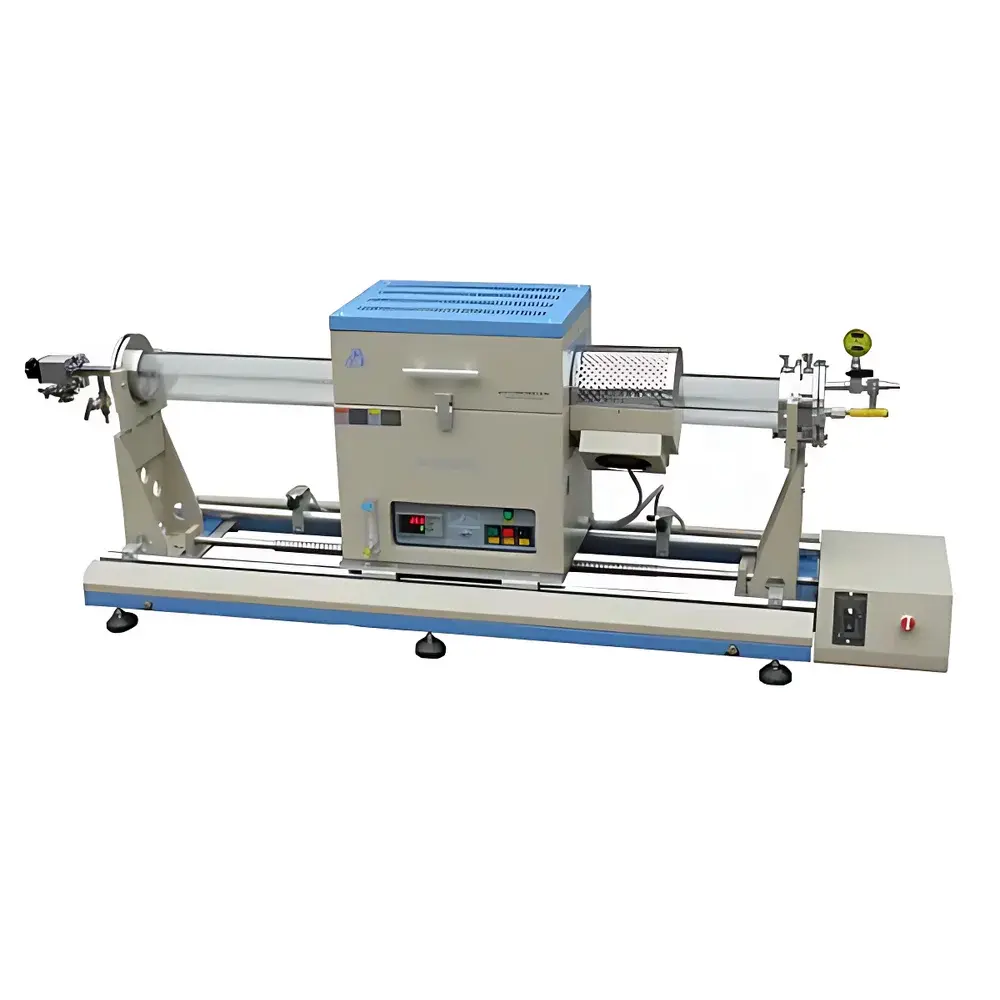
KJ GROUP OTF-1200X-4-RTP-SL Sliding Rapid Thermal Processing Furnace
| Brand | KJ GROUP |
|---|---|
| Origin | Liaoning, China |
| Manufacturer Type | Authorized Distributor |
| Country of Origin | China |
| Model | OTF-1200X-4-RTP-SL |
| Power Supply | 208–240 V AC, 50/60 Hz, 9 kW |
| Maximum Operating Temperature | 1000 °C (≤1 h), Continuous: 950 °C |
| Heating Rate | Up to 100 °C/s |
| Cooling Rate | 8.3 °C/s (900–600 °C) |
| Quartz Tube Dimensions | Ø100 mm × 1400 mm |
| Control Accuracy | ±0.5 °C |
| Sliding Stroke | 340 mm |
| Rail Length | 1200 mm |
| Sliding Speed | 0–70 mm/s |
| Vacuum Capability | 10⁻³ torr (mechanical pump), 10⁻⁵ torr (turbo-molecular pump) |
| Thermocouple | K-type, Ø6.35 mm × 610 mm |
| Vacuum Flange | Water-cooled stainless steel (required >900 °C) |
| Coolant Flow Rate | 4 L/min |
| Mass Flow Controller Range | 16–160 mL/min |
| Chamber Dimensions (heating zone) | Ø100 mm × 1400 mm |
| Overall Footprint (furnace + rail) | 1800 mm × 450 mm × 680 mm |
| Net Weight | 80 kg |
Overview
The KJ GROUP OTF-1200X-4-RTP-SL is a high-performance sliding rapid thermal processing (RTP) furnace engineered for precise, repeatable, and time-resolved thermal treatments in materials science, semiconductor process development, and thin-film research. Unlike conventional box or tube furnaces, this system employs high-intensity infrared (IR) lamp arrays as the primary heating source—enabling ultra-fast transient thermal profiles essential for annealing, dopant activation, oxide growth, and phase transformation studies. Its defining mechanical feature is a motorized, temperature-synchronized sliding rail mechanism that physically displaces the entire heated quartz tube assembly away from the IR zone, initiating controlled convective and radiative cooling without requiring external quench gases or cryogenic intervention. This architecture delivers exceptional thermal ramp fidelity (up to 100 °C/s heating; up to 8.3 °C/s cooling in the 900–600 °C range) while maintaining spatial uniformity across the 1400 mm active zone. The furnace operates under inert or reducing atmospheres (e.g., Ar ≥99.99% purity) and supports vacuum environments down to 10⁻⁵ torr when paired with a turbo-molecular pumping station—making it suitable for processes demanding strict contamination control and oxygen-free conditions.
Key Features
- Sliding rail system with programmable displacement (0–70 mm/s, 340 mm stroke), automatically triggered upon program completion to initiate rapid cooldown
- Dual-layer stainless-steel chamber with integrated high-efficiency cooling fans and imported high-emissivity alumina coating on inner furnace walls for improved thermal reflectivity and longevity
- PID-based 30-segment programmable temperature controller with over-temperature cutoff, real-time data logging, and RS485 communication interface
- Water-cooled stainless-steel vacuum flanges rated for continuous operation above 900 °C (minimum coolant flow: 4 L/min)
- High-purity fused quartz tube (Ø100 mm × 1400 mm) compatible with standard CVD, ALD, and RTP-compatible sample boats and fixtures
- Integrated mass flow controller (16–160 mL/min range) for precise gas dosing during thermal cycles
Sample Compatibility & Compliance
The OTF-1200X-4-RTP-SL accommodates substrates up to 100 mm in diameter—including silicon wafers, sapphire, quartz, glass, metal foils, and ceramic pellets—within standard quartz boats or custom-designed holders. Its open-tube configuration allows direct optical access for in situ monitoring (e.g., pyrometry, ellipsometry, or gas-phase spectroscopy) when equipped with appropriate viewport flanges. The system complies with IEC 61000-6-3 (EMC emission standards) and IEC 61000-6-2 (immunity requirements). For regulated environments, optional audit-trail-capable software modules support 21 CFR Part 11 compliance when integrated with validated PC-based control platforms. All vacuum components meet ASTM F2781 specifications for ultra-high-vacuum elastomer compatibility, and gas delivery pathways are constructed from electropolished 316L stainless steel per SEMI F57 standards.
Software & Data Management
The furnace interfaces via RS485 to KJ GROUP’s proprietary LabControl Suite (Windows-based), enabling full remote operation, multi-parameter trending (temperature, position, gas flow, vacuum pressure), and export of timestamped CSV datasets compliant with ASTM E2916-22 (Standard Guide for Validation of Software Used in Computational Modeling). Optional integration with third-party SCADA systems (e.g., Ignition, WinCC) is supported through Modbus TCP gateways. Data integrity safeguards include cyclic redundancy checking (CRC-16), automatic backup to network drives, and configurable user-level permissions (operator, engineer, administrator). When paired with optional digital vacuum gauges and water-cooling monitors, the system generates automated pass/fail reports aligned with internal quality protocols (e.g., ISO/IEC 17025 Clause 7.8).
Applications
- Silicon wafer rapid thermal annealing (RTA) for dopant activation and defect engineering
- Metal oxide semiconductor (MOS) capacitor formation and interfacial layer stabilization
- Perovskite precursor decomposition and crystallization kinetics studies
- Graphene and transition metal dichalcogenide (TMD) film synthesis via flash thermal processing
- Thermal stability testing of battery electrode materials (e.g., NMC, LFP) under inert atmosphere
- Pre-sintering of ceramic green bodies prior to HIP or SPS densification
FAQ
What inert gas purity is required for stable operation?
Argon with minimum purity of 99.99% (4.0 grade) is required; higher purity (5.0 or 6.0) is recommended for ultra-low carbon/oxygen-sensitive processes.
Is water cooling mandatory for all operating temperatures?
Water cooling of the vacuum flange is mandatory only when sustained operation exceeds 900 °C; below this threshold, air cooling suffices for standard duty cycles.
Can the sliding motion be synchronized with temperature ramping—not just endpoint-triggered?
Yes—via custom script mode in LabControl Suite, users may define position vs. time profiles concurrent with thermal programs, enabling dynamic thermal gradient generation.
What vacuum level is achievable with the base configuration?
Using the included two-stage rotary vane pump, ultimate pressure reaches ≤1×10⁻³ torr; adding an optional turbo-molecular pump extends capability to ≤1×10⁻⁵ torr.
Are calibration certificates available for the K-type thermocouple and flow meter?
NIST-traceable calibration certificates (ISO/IEC 17025 accredited) are available upon request for both the embedded K-type thermocouple and MFC, with annual recalibration intervals recommended.



