
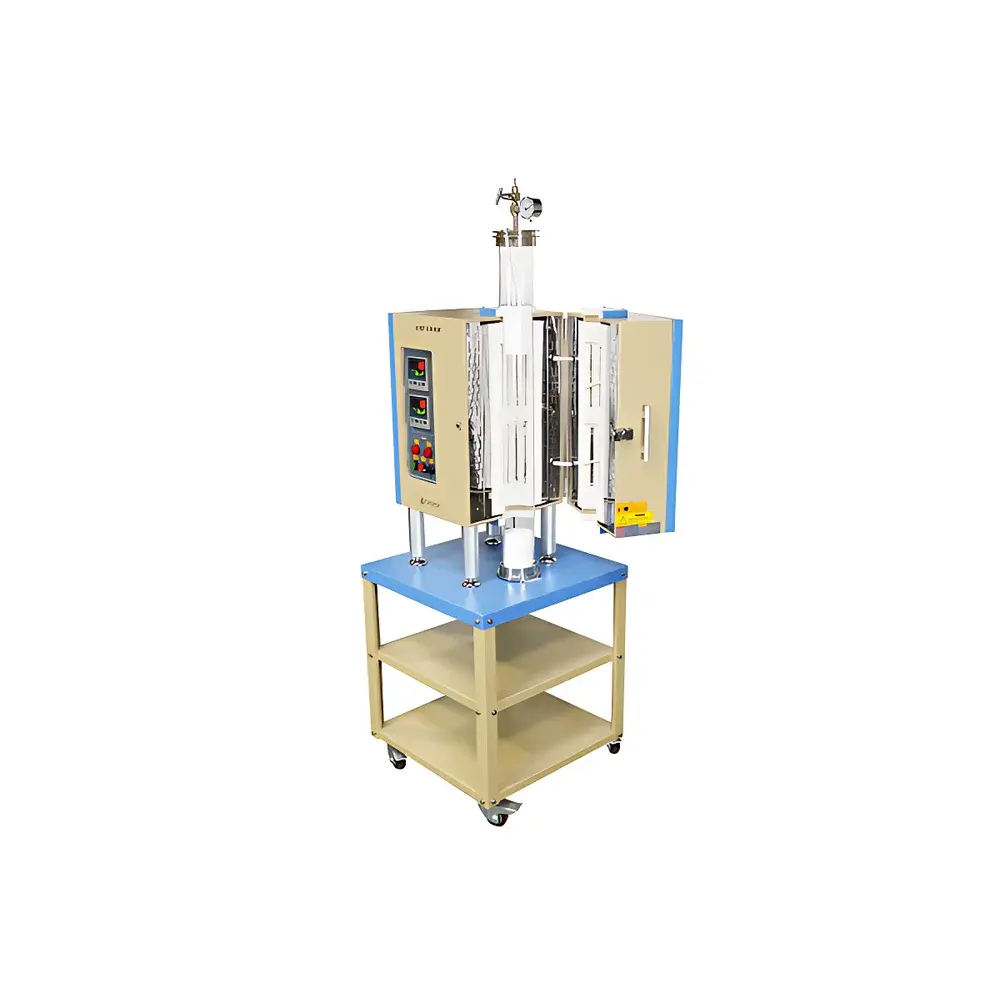
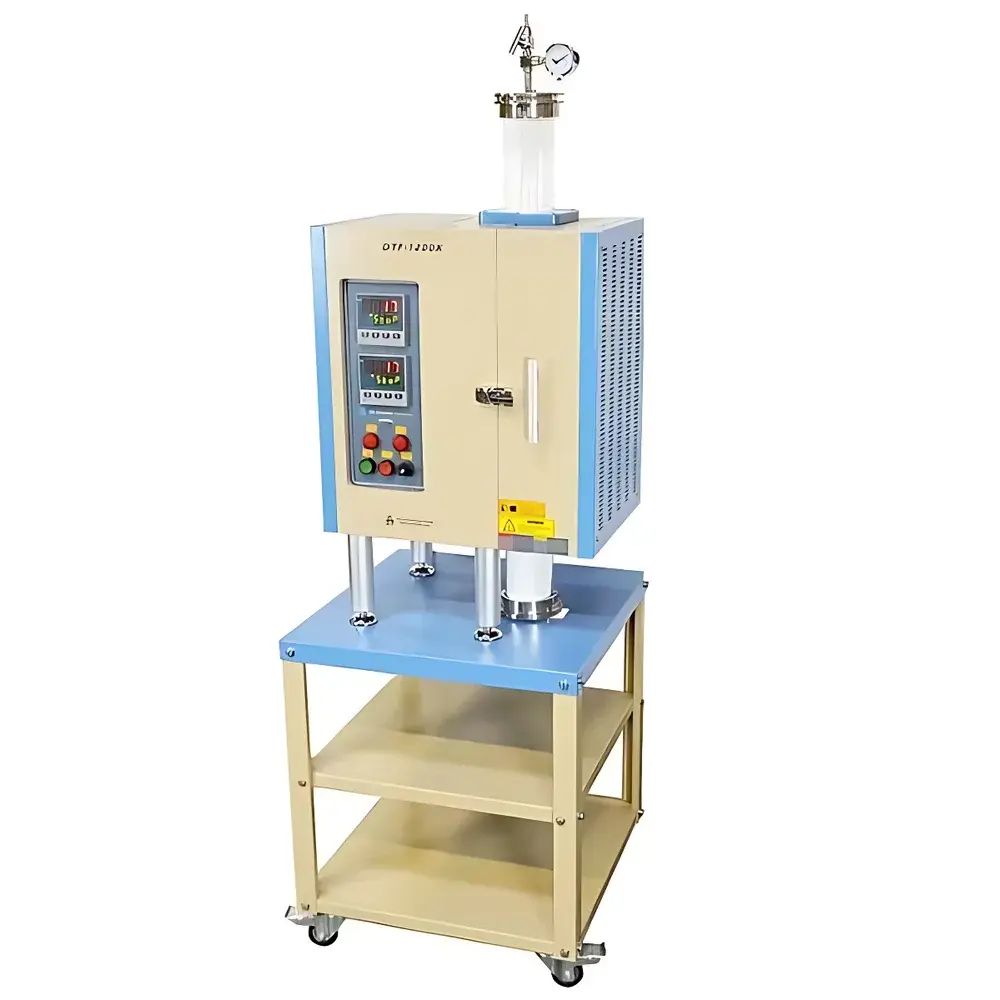
KJ GROUP OTF-1200X-4-VT-II Dual-Zone Vertical Tube Furnace (1200 °C)
| Brand | KJ GROUP |
|---|---|
| Origin | Liaoning, China |
| Manufacturer Type | Authorized Distributor |
| Country of Origin | China |
| Model | OTF-1200X-4-VT-II |
| Power Supply | AC 208–240 V, 50/60 Hz |
| Max. Power | ≤3 kW |
| Tube OD | 100 mm (Quartz) |
| Tube ID | 95 mm |
| Tube Length | 1000 mm |
| Heating Zones | 2 × 200 mm (Total 400 mm) |
| Max. Temp. | 1200 °C (≤1 h), 1100 °C continuous |
| Heating Rate | ≤20 °C/min |
| Temperature Uniformity | ±1 °C |
| Thermocouple | K-type |
| Vacuum Level | 10⁻² Torr (mechanical pump), 10⁻⁵ Torr (turbo-molecular pump) |
| Leak Rate | <5 mTorr/min |
| Cooling Method | Air-cooled double-layer shell |
| Weight | 80 kg (excl. mobile base) |
Overview
The KJ GROUP OTF-1200X-4-VT-II is a dual-zone, vertically oriented, open-top tube furnace engineered for high-temperature thermal processing under controlled vacuum or reactive/inert atmospheres. Designed for vertical sample loading and rapid thermal cycling—including quenching—the system integrates two independently programmable heating zones within a single 100 mm OD quartz tube, enabling precise axial thermal gradients (e.g., for zone melting, crystal growth, or multi-step annealing). Its vertical orientation facilitates gravity-assisted sample suspension via stainless steel hooks integrated into the upper flange, eliminating support-induced thermal distortion and enabling true “hanging” heat treatment—critical for thin-film substrates, fiber precursors, or delicate nanostructures. The furnace operates on fundamental resistive heating principles using Mo-doped FeCrAl alloy elements with ZrO₂ coating, ensuring stable power delivery and extended element life at sustained 1100 °C operation. All thermal control is implemented via PID algorithms with 30-segment ramp-soak programming, meeting essential requirements for reproducible process development in materials synthesis, semiconductor annealing, and ceramic sintering.
Key Features
- Dual independent heating zones (2 × 200 mm), each rated to 1200 °C for short-term and 1100 °C continuously, supporting differential thermal profiles along the tube axis.
- Vertical lift-open design with reinforced hinge mechanism allows unobstructed access to the entire 1000 mm quartz tube—enabling rapid tube replacement, in-situ sample insertion, and post-process quenching without disassembly.
- Double-walled stainless steel housing with forced-air cooling maintains external surface temperature below 60 °C during full-load operation, complying with IEC 61000-3-2 harmonic emission limits and workplace safety standards.
- High-purity alumina fiber insulation lined with US-sourced 1750 °C-rated Al₂O₃ ceramic coating enhances thermal reflectivity, reduces energy consumption by ~18% versus standard linings, and extends refractory service life beyond 5,000 operational hours.
- Integrated K-type thermocouples mounted directly adjacent to each heating zone provide real-time feedback with ±1 °C accuracy over the full operating range (room temperature to 1200 °C).
- Standard stainless steel vacuum flanges (CF or KF configurable) include vacuum gauge ports, manual gate valves, and gas inlet/outlet ports—preconfigured for compatibility with standard mechanical pumps or turbo-molecular pumping stations.
Sample Compatibility & Compliance
The OTF-1200X-4-VT-II accommodates cylindrical samples up to 95 mm diameter and 1000 mm length, with optional hanging fixtures for wire, fiber, or wafer-based specimens. Quartz tube construction ensures chemical inertness toward O₂, N₂, Ar, H₂, NH₃, and diluted CVD precursors—though exposure to halogenated or fluorinated gases above 800 °C is not recommended. The furnace conforms to CE Directive 2014/35/EU (Low Voltage Directive) and 2014/30/EU (EMC Directive); all internal electrical components exceeding 24 V are certified to UL 61010-1, CSA C22.2 No. 61010-1, and MET Laboratories standards. For regulated environments (e.g., ISO 17025-accredited labs or GMP pilot lines), optional audit-ready data logging—traceable to NIST-traceable calibration certificates—is available upon request. Maximum allowable internal pressure is strictly limited to 0.02 MPa (2 bar absolute) to preserve quartz integrity; operation above 1000 °C under vacuum is prohibited per ASTM F2622-20 Section 5.3.2.
Software & Data Management
Temperature profiling is managed via the built-in digital controller with local keypad interface and RS485 Modbus RTU output for integration into LabVIEW, MATLAB, or SCADA systems. While no proprietary software is bundled, the controller supports third-party OPC UA drivers and exports CSV-formatted temperature logs with timestamps, setpoint history, and alarm events. Optional upgrade kits enable 21 CFR Part 11-compliant electronic signatures, audit trails, and user role-based access control when paired with validated PC-based acquisition platforms. All firmware revisions undergo functional safety verification per IEC 61508 SIL 2 criteria, with documented failure modes and diagnostic coverage ratios provided in the technical safety manual.
Applications
- Controlled-atmosphere annealing of metal oxide thin films (e.g., TiO₂, NiO) for photovoltaic and catalytic applications.
- Vertical zone refining of semiconductor-grade silicon or germanium ingots using differential thermal gradients.
- In-situ quenching studies of phase transformation kinetics in shape-memory alloys and high-entropy ceramics.
- Graphitization and carbonization of polymer-derived fibers under N₂ or Ar flow (up to 200 SCCM).
- Pre-sintering of battery cathode precursors (e.g., LiCoO₂, NMC) prior to high-pressure consolidation.
- Thermal stability testing of encapsulation materials per IPC-TM-650 2.6.25 and JEDEC JESD22-A108G protocols.
FAQ
What is the maximum safe operating pressure inside the quartz tube?
The absolute internal pressure must not exceed 0.02 MPa (2 bar). Exceeding this limit risks catastrophic quartz fracture due to thermal stress amplification.
Can the furnace be operated under high vacuum (>10⁻⁴ Torr) at temperatures above 1000 °C?
No. Quartz devitrification accelerates above 1000 °C under high vacuum, compromising structural integrity. Maintain atmospheric or low-backpressure inert gas flow above this threshold.
Is the quartz tube included with the system, and what are its dimensional tolerances?
Yes—a standard 1000 mm × 100 mm OD × 95 mm ID fused quartz tube is supplied, with OD tolerance ±0.5 mm and wall thickness uniformity ±0.3 mm per ASTM F798-21.
What vacuum pumping options are supported, and how is leak rate verified?
Mechanical (10⁻² Torr) and turbo-molecular (10⁻⁵ Torr) configurations are supported. Leak rate is factory-verified using helium mass spectrometry per ISO 10888:2019 Annex B, with documented results provided in the COC.
Are custom thermocouple placements or additional sensor ports available?
Yes. Optional auxiliary K-type or S-type thermocouple feedthroughs (up to 3 total) can be installed at user-specified axial positions during manufacturing.



