
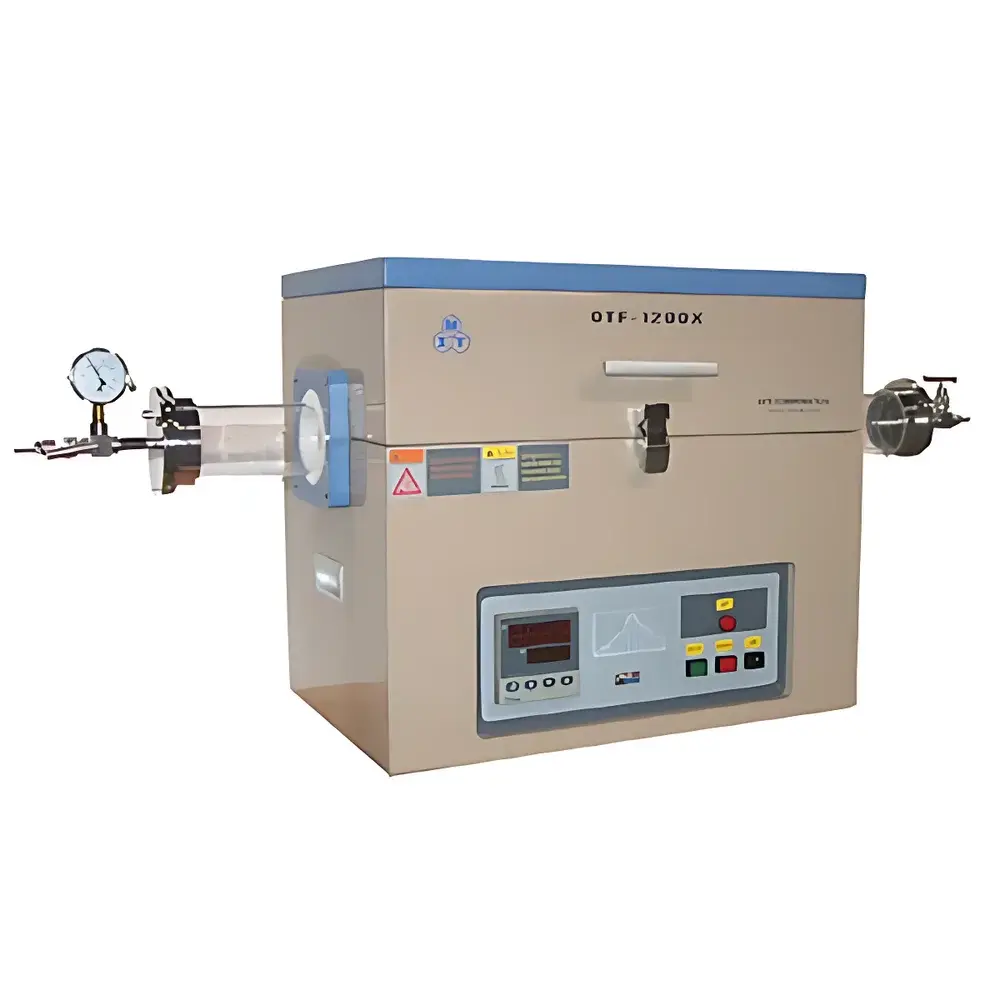
KJ GROUP OTF-1200X Single-Zone Opening-Type Vacuum Tube Furnace
| Brand | KJ GROUP |
|---|---|
| Origin | Liaoning, China |
| Manufacturer Type | Authorized Distributor |
| Country of Origin | China |
| Model | OTF-1200X |
| Price | Upon Request |
| Power Supply | AC 220 V, 50/60 Hz, 2.5 kW |
| Max Operating Temperature | 1200 °C (inert atmosphere required) |
| Continuous Service Temperature | 1100 °C |
| Heating Zone Length | 440 mm |
| Uniform Temperature Zone | 150 mm |
| Max Ramp/Cooling Rate | 20 °C/min |
| Temperature Control Accuracy | ±1 °C |
| Vacuum Level | 1×10⁻² torr (mechanical pump), 1×10⁻⁵ torr (turbo-molecular pump) |
| Leak Rate | <5 mtorr/min |
| Quartz Tube Options | Ø50/44 mm, Ø60/54 mm, Ø80/74 mm, Ø100/94 mm × 1000 mm (OD/ID × L) |
| External Dimensions | 590 × 380 × 520 mm |
| Net Weight | 40 kg |
| Cooling | Forced-air dual-shell circulation |
| Certification | CE |
Overview
The KJ GROUP OTF-1200X is a single-zone, front-opening vacuum tube furnace engineered for precise thermal processing under controlled atmospheres—including inert, reducing, oxidizing, and high-vacuum conditions. Based on resistive heating via doped molybdenum-alloyed FeCrAl wire elements coated with zirconia insulation, the furnace delivers stable, repeatable thermal profiles up to 1200 °C—subject to continuous inert gas purging to prevent quartz tube deformation. Its 440 mm heating zone and 150 mm isothermal region support uniform heat distribution essential for reproducible sintering, annealing, crystal growth, and chemical vapor deposition (CVD) precursor decomposition. Designed for integration into research-grade lab workflows, the OTF-1200X meets fundamental requirements for materials synthesis, phase transformation studies, and thin-film fabrication where thermal stability, atmosphere integrity, and programmable thermal history are critical.
Key Features
- Dual-layer stainless steel housing with integrated forced-air cooling system maintains external shell temperature below 60 °C during operation, enhancing operator safety and long-term structural integrity.
- High-emissivity alumina coating applied to the inner furnace chamber surface improves radiative heat transfer efficiency and extends refractory life under cyclic thermal stress.
- PID-based temperature controller supports up to 30 programmable ramp-hold segments, enabling complex multi-step thermal protocols such as slow nucleation anneals followed by rapid quenching.
- Comprehensive safety architecture includes over-temperature cutoff and thermocouple break detection, automatically halting heating and triggering audible/visual alerts.
- CE-marked design complies with EU Machinery Directive 2006/42/EC and Low Voltage Directive 2014/35/EU, validating electrical safety, mechanical robustness, and EMC performance in laboratory environments.
Sample Compatibility & Compliance
The OTF-1200X accommodates standard quartz tubes (available in four internal diameters: 44, 54, 74, and 94 mm; all 1000 mm long), facilitating compatibility with common crucible formats, substrate holders, and gas-distribution fixtures used in solid-state chemistry and nanomaterial synthesis. When operated under vacuum or purified gas flow, the system supports ASTM E29–23-compliant thermal treatment procedures for ceramic powder densification, metal oxide reduction, and carbon nanotube growth. For GMP-aligned applications—such as catalyst pre-treatment in pharmaceutical intermediate synthesis—the furnace’s traceable temperature logging (via optional PC software) and alarm event recording support adherence to FDA 21 CFR Part 11 data integrity expectations when paired with validated procedural controls.
Software & Data Management
An optional Windows-compatible PC control software package enables remote monitoring and real-time graphing of temperature profiles, setpoint adjustments, and alarm status. Data export is supported in CSV format for post-processing in MATLAB, Python (NumPy/Pandas), or statistical analysis platforms. The software logs timestamps for all parameter changes and system events—including ramp initiation, hold entry, and fault triggers—providing an auditable trail suitable for GLP documentation. While the base unit operates via front-panel PID interface, the software option introduces configurable data sampling intervals (1–60 s), automated report generation, and password-protected user roles—facilitating shared instrument management across multi-user academic or industrial labs.
Applications
- Sintering of advanced ceramics (e.g., Al₂O₃, ZrO₂, SiC) and battery electrode composites (LiCoO₂, NMC cathodes).
- Controlled-atmosphere annealing of transition metal dichalcogenides (MoS₂, WS₂) and perovskite thin films.
- Thermal decomposition of metal-organic precursors in CVD reactor configurations (requires optional dual ferrule fittings and mass flow controllers).
- Heat treatment of shape-memory alloys (NiTi), magnetic soft ferrites, and piezoelectric PZT ceramics.
- Calibration and aging studies of thermocouples and reference materials under ISO/IEC 17025-accredited lab conditions.
FAQ
What vacuum level can the OTF-1200X achieve, and what pumping configuration is required?
The furnace reaches 1×10⁻² torr using a standard two-stage rotary vane mechanical pump; upgrading to a turbo-molecular pump enables operation down to 1×10⁻⁵ torr—essential for ultra-high-purity oxide film growth or low-pressure pyrolysis.
Is inert gas purging mandatory at maximum temperature?
Yes. Sustained operation above 1100 °C requires continuous inert gas flow (Ar or N₂) to suppress quartz tube devitrification and dimensional instability; failure to maintain purge may result in irreversible tube warping.
Can the furnace be integrated into an automated process line?
While not natively equipped with industrial fieldbus interfaces (e.g., Modbus TCP, Profibus), analog 0–5 V or 4–20 mA output signals are available upon request for external PLC synchronization of heating cycles with gas delivery or sample handling subsystems.
What maintenance is recommended for long-term reliability?
Quarterly inspection of vacuum O-rings, annual replacement of furnace door gaskets, and biannual verification of thermocouple calibration against a NIST-traceable reference source are advised to maintain ±1 °C accuracy and leak rate compliance.
Are custom tube dimensions or alternative tube materials (e.g., alumina, silicon carbide) supported?
Standard configurations use fused quartz tubing; custom OD/ID lengths or high-temp alternatives (e.g., recrystallized alumina tubes rated to 1600 °C) are available as special-order items—subject to thermal expansion and sealing interface validation.



