
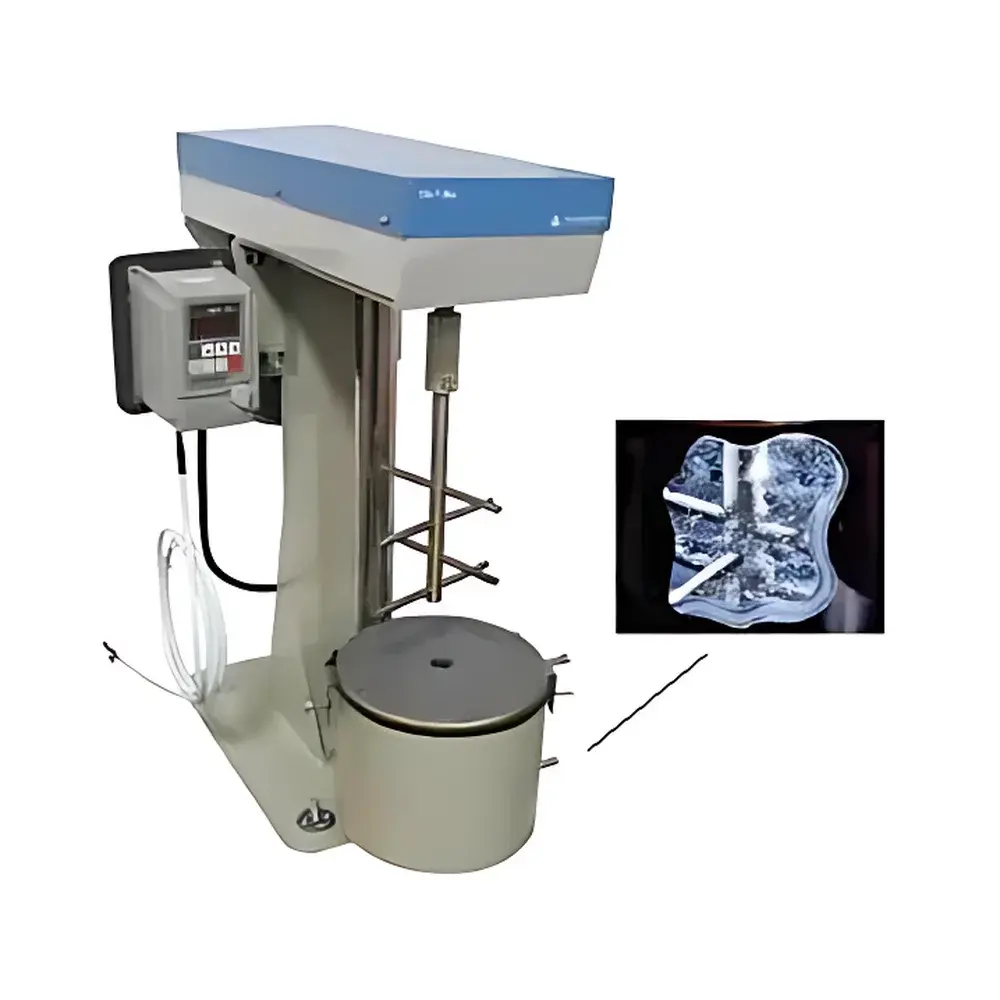
KJ GROUP SFM-5 Vertical Stirred Ball Mill
| Brand | KJ GROUP |
|---|---|
| Origin | Liaoning, China |
| Manufacturer Type | Authorized Distributor |
| Country of Origin | China |
| Model | SFM-5 |
| Pricing | Available Upon Request |
| Power Supply | 220 V AC, 10 A |
| Motor Max Power | 1250 W |
| Speed Range | 0–1200 rpm |
| Programmable Rotation Direction | Yes |
| Vacuum Compatibility | Yes |
| Dimensions (W×D×H) | 700 × 600 × 1100 mm |
| Net Weight | 40 kg |
Overview
The KJ GROUP SFM-5 Vertical Stirred Ball Mill is an engineered laboratory-scale milling system designed for precise, reproducible dry and wet grinding, homogenization, and mechanical alloying of advanced functional materials. It operates on the principle of high-energy attrition milling—where rotational motion of a vertically oriented stirring shaft drives grinding media (typically zirconia or stainless-steel balls) within a sealed, jacketed vessel to generate intense shear, impact, and compressive forces. Unlike planetary ball mills, the SFM-5’s coaxial vertical agitation architecture enables uniform energy distribution across the sample volume and minimizes thermal gradients during extended processing cycles. Its integrated vacuum capability supports oxygen-sensitive synthesis (e.g., cathode precursors for Li-ion batteries), while programmable control over speed, direction, and duration ensures strict protocol adherence in R&D and QC environments.
Key Features
- Vertical stirred mill configuration with precision-machined stainless-steel grinding chamber and removable lid for rapid cleaning and cross-contamination prevention.
- Programmable digital controller enabling multi-step protocols: independent setting of rotation speed (0–1200 rpm), dwell time (1 s–99 h 59 min), forward/reverse direction switching, and automatic shutdown.
- Vacuum-compatible design with standard KF-25 flange interface; compatible with external vacuum pumps (≤10⁻² mbar) and inert gas purging systems (N₂, Ar).
- High-torque AC motor (1250 W nominal power) coupled with a robust gear-reduction drive system for stable low-speed torque delivery and smooth high-speed operation up to 1200 rpm.
- Integrated safety interlocks: lid-position sensor prevents operation when chamber is open; overload and thermal protection circuits safeguard motor and electronics.
- Compact footprint (700 × 600 × 1100 mm) and modular base frame facilitate integration into fume hoods or gloveboxes without requiring floor anchoring.
Sample Compatibility & Compliance
The SFM-5 accommodates batch sizes from 50 mL to 500 mL (volumetric capacity dependent on media fill ratio and material density), supporting diverse material classes including lithium transition metal oxides (LiCoO₂, LiFePO₄), solid-state electrolyte powders (Li₇La₃Zr₂O₁₂, Na₃PS₄), ceramic precursors (Al₂O₃, ZrO₂, BaTiO₃), and polymer composites. Grinding vessels are available in stainless steel, agate, and polyurethane-lined variants to minimize contamination and accommodate chemically aggressive slurries. The system complies with IEC 61000-6-2 (EMC immunity) and IEC 61000-6-4 (EMC emission) standards. While not certified to UL/CSA for North America, its electrical architecture conforms to EN 61010-1 requirements for laboratory equipment safety. Documentation includes CE Declaration of Conformity and RoHS compliance statement.
Software & Data Management
The SFM-5 operates via an embedded microcontroller-based interface with non-volatile memory for storing ≥20 user-defined programs. All operational parameters—including actual speed (monitored via Hall-effect tachometer), elapsed time, direction state, and vacuum status—are logged locally with timestamp resolution of ±1 s. Optional RS-485 serial output enables integration with LabVIEW™, MATLAB®, or custom SCADA platforms for remote monitoring and audit-trail generation. For GLP/GMP-aligned workflows, users may implement external data capture using validated software that satisfies FDA 21 CFR Part 11 requirements for electronic records and signatures—though the device itself does not include built-in Part 11 functionality.
Applications
- Preparation of homogeneous cathode and anode composite slurries for battery electrode development.
- Mechanochemical synthesis of doped phosphors, multiferroics, and high-entropy ceramics.
- Particle size reduction and crystallite refinement of oxide and sulfide solid electrolytes.
- Dispersion stabilization of nanomaterials (e.g., graphene oxide, MXenes) in aqueous or organic media.
- Accelerated aging studies of powder blends under controlled atmosphere to assess storage stability.
- Method development for ASTM E2904-21 (Standard Guide for Mechanical Alloying and Milling) and ISO 13320:2020 (Laser diffraction particle size analysis—sample preparation guidance).
FAQ
What is the maximum recommended media-to-powder mass ratio for optimal grinding efficiency?
For most ceramic and battery-active materials, a 10:1 to 20:1 grinding media-to-sample mass ratio is empirically validated; higher ratios increase collision frequency but may elevate temperature rise beyond 60 °C without active cooling.
Can the SFM-5 be operated under positive pressure (e.g., with O₂ or CO₂)?
Yes—the sealed chamber supports pressure-rated accessories (up to 0.5 MPa gauge); however, pressure regulation requires external regulators and burst-disk safety integration per ASME B31.3 guidelines.
Is the motor rated for continuous duty at 1200 rpm?
The motor is rated for intermittent operation at full speed (≤30 min per cycle); sustained operation above 800 rpm requires ≥15 min cooldown between cycles to maintain thermal stability.
Does KJ GROUP provide validation documentation (IQ/OQ) for GMP environments?
Factory-issued IQ/OQ templates are available upon request; final qualification must be performed by the end-user’s qualified personnel per Annex 15 (EU GMP) or ASTM E2500-22.
Are replacement grinding jars and media supplied with traceable lot documentation?
Yes—zirconia and stainless-steel media are provided with CoA (Certificate of Analysis) listing density, hardness (HV10), and impurity profile (ICP-MS tested); jars include dimensional inspection reports.



