
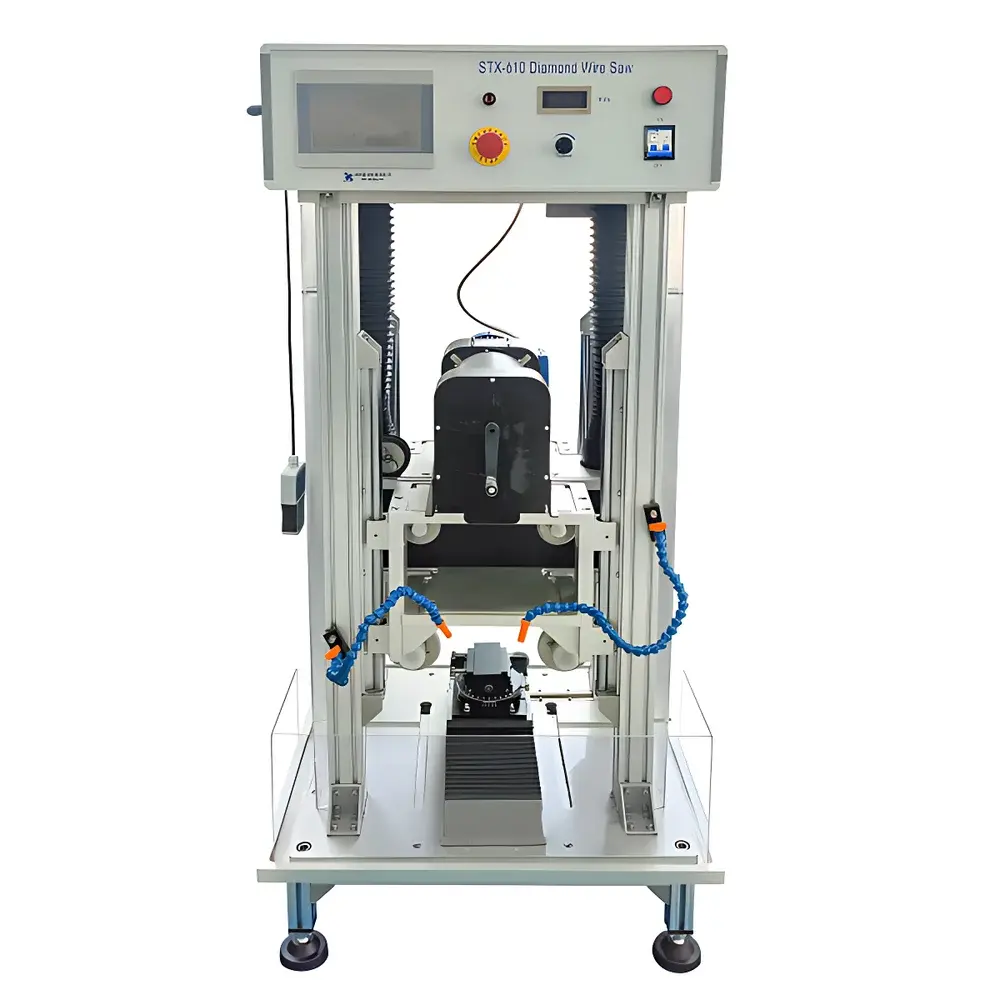
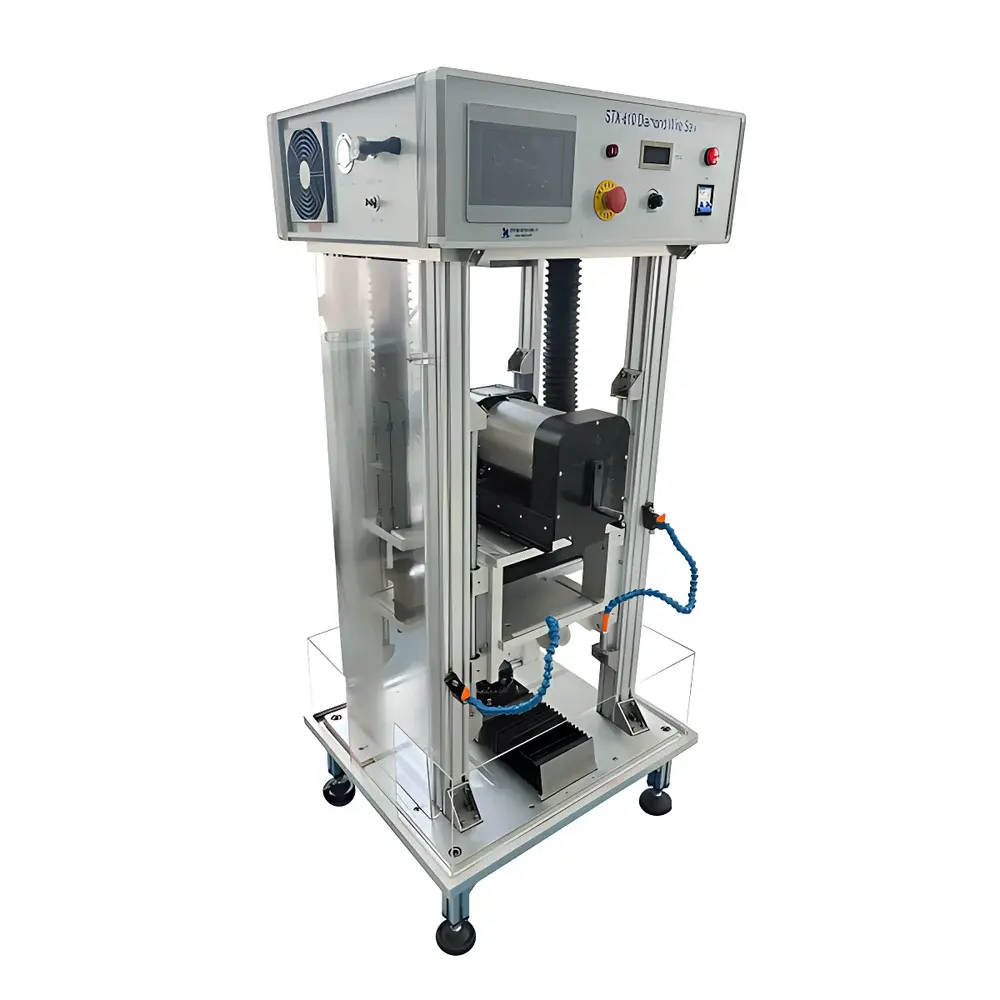
KJ GROUP STX-610 Diamond Wire Saw
| Brand | KJ GROUP |
|---|---|
| Origin | Liaoning, China |
| Manufacturer Type | Direct Manufacturer |
| Country of Origin | China |
| Model | STX-610 |
| Instrument Type | Precision Diamond Wire Cutting System |
| Power Consumption | 500 W |
| Input Voltage | AC 220 V, 50 Hz, 10 A |
| Diamond Wire Length | ≤150 m |
| Wire Diameter | φ0.25–0.45 mm |
| Wire Tensioning | Pneumatic, Adjustable (0.1–0.4 MPa) |
| Wire Speed | 0–8 m/s (variable via AC frequency inverter) |
| Y-Axis Travel | ≤180 mm |
| Z-Axis Travel | ≤160 mm |
| Positioning Resolution (Y/Z) | 0.01 mm |
| Sample Max. Dimensions | Φ150 mm × 150 mm |
| Guiding Pulley Span (inner) | ≤180 mm |
| Worktable Load Capacity | ≤5 kg |
| Rotary Sample Stage | Manual, 360° horizontal rotation ±10° tilt |
| Frame Material | Anodized Aluminum Extrusion |
| Overall Dimensions (L×W×H) | 740 × 800 × 1580 mm |
| Net Weight | ≈190 kg |
| Environmental Requirements | 0–45 °C, 10–85 % RH (non-condensing) |
Overview
The KJ GROUP STX-610 Diamond Wire Saw is an industrial-grade precision cutting system engineered for laboratory-scale sample preparation of hard, brittle, and electrically non-conductive materials. Unlike electrical discharge machining (EDM) or conventional abrasive saws, the STX-610 employs a tensioned diamond-impregnated wire driven in reciprocating motion—enabling high-fidelity sectioning of materials with Mohs hardness up to 9.5, including single crystals, optical ceramics, infrared-transparent substrates (e.g., ZnSe, Ge), thermoelectrics (Bi2Te3, SiGe), geological specimens, and bio-ceramic composites. Its core operating principle relies on controlled mechanical abrasion: diamond particles embedded in nickel or resin bonds engage the sample surface under regulated line speed and pneumatic tension, minimizing thermal damage, microcracking, and subsurface deformation. This makes the STX-610 particularly suited for applications demanding preserved crystallographic integrity, such as X-ray diffraction (XRD) substrate preparation, TEM lamella pre-thinning, and cross-sectional analysis of multilayer functional devices.
Key Features
- Pneumatically regulated wire tensioning: Adjustable pressure range (0.1–0.4 MPa) ensures consistent cutting force across variable wire wear states and material resistances—critical for reproducible kerf width and surface finish.
- AC frequency-inverter-driven main spindle: Enables precise, stepless control of wire linear velocity (0–8 m/s), allowing optimization for soft polymers (low speed) versus sapphire or silicon carbide (higher speed with coolant modulation).
- Dual-axis CNC-guided motion: High-resolution stepper motors drive Y- and Z-axes with 0.01 mm positional repeatability, supporting programmable depth profiling, multi-pass slicing, and angled cuts via manual 360°/±10° sample stage.
- Integrated safety architecture: Hardware-enforced interlocks include wire break detection, Z/Y axis overtravel limit switches, spool end-of-travel cutoff, and emergency stop circuitry compliant with IEC 60204-1 requirements for lab equipment.
- Modular aluminum frame construction: Lightweight yet rigid extruded chassis minimizes vibration transmission, supports stable long-duration cuts (>4 hrs), and facilitates cleanroom-compatible integration via optional exhaust ducting for mist extraction.
Sample Compatibility & Compliance
The STX-610 accommodates a broad spectrum of research-grade materials without requiring electrical conductivity—addressing a key limitation of wire EDM systems. Validated use cases include oxide and nitride ceramics (Al2O3, Si3N4), semiconductor wafers (Si, GaAs, GaN), piezoelectric crystals (LiNbO3, quartz), magnetic alloys (NdFeB, SmCo), porous scaffolds (hydroxyapatite, β-TCP), and layered heterostructures (graphene/h-BN stacks). All cutting protocols align with ASTM E3-22 (Standard Guide for Preparation of Metallographic Specimens) and ISO 14855-1 (Biodegradability testing—specimen geometry control). While not certified for GMP production, its PLC-based parameter logging, tactile HMI interface, and deterministic motion control support GLP-compliant documentation when paired with external audit trails.
Software & Data Management
The STX-610 operates via a dedicated PLC controller interfaced with a 7-inch resistive touchscreen HMI. All operational parameters—including wire speed, tension setpoint, Z-axis feed rate, total cut distance, and runtime—are digitally displayed and stored locally in non-volatile memory for session recall. No proprietary PC software is required; however, process logs can be exported via USB to CSV for traceability in LIMS or ELN environments. The wired jog handle enables safe, sub-millimeter manual positioning during setup—eliminating reliance on visual alignment alone. Firmware updates are performed offline using standard FAT32-formatted USB drives, ensuring data integrity and avoiding network exposure risks common in cloud-connected lab instruments.
Applications
- Preparation of wafer-level cross-sections for SEM/FIB site-specific analysis
- Sectioning of fragile scintillator crystals (LYSO, BGO) for radiation detector R&D
- Thickness-controlled slicing of thermoelectric ingots prior to spark plasma sintering
- Isolation of single-crystal domains from flux-grown boules (e.g., topological insulators)
- Cutting of dental zirconia and titanium alloy prostheses for fatigue testing per ISO 14801
- Microsectioning of fossilized bone or sediment cores for synchrotron micro-CT scanning
FAQ
What types of diamond wire are compatible with the STX-610?
The system accepts standard electroplated or resin-bonded diamond wires with diameters between 0.25 mm and 0.45 mm. KJ GROUP recommends wires with nickel matrix bonding for ceramic and semiconductor applications, and resin-bond variants for organic or low-melting-point materials.
Is compressed air mandatory for operation?
Yes. Pneumatic tensioning requires a clean, dry, oil-free air supply ≥0.6 MPa. A desiccant air dryer and 5 µm particulate filter are strongly advised to prevent solenoid valve clogging.
Can the STX-610 perform angled cuts?
The manually adjustable 2D rotary stage permits horizontal rotation (0–360°) and ±10° tilt, enabling oblique sectioning. For automated angular indexing, external motion controllers must be integrated via the PLC’s digital I/O expansion port.
What cooling medium is required?
A dedicated, low-viscosity cutting oil (e.g., KJ GROUP CTO-100 series) is mandatory to dissipate heat, suspend debris, and extend wire life. Water-based coolants are incompatible and will degrade wire bond integrity.
Does the system meet electromagnetic compatibility (EMC) standards for EU laboratories?
The STX-610 complies with EN 61326-1:2013 (measurement/control lab equipment) for emissions and immunity. CE marking documentation—including DoC and test reports—is available upon request for import compliance verification.



