
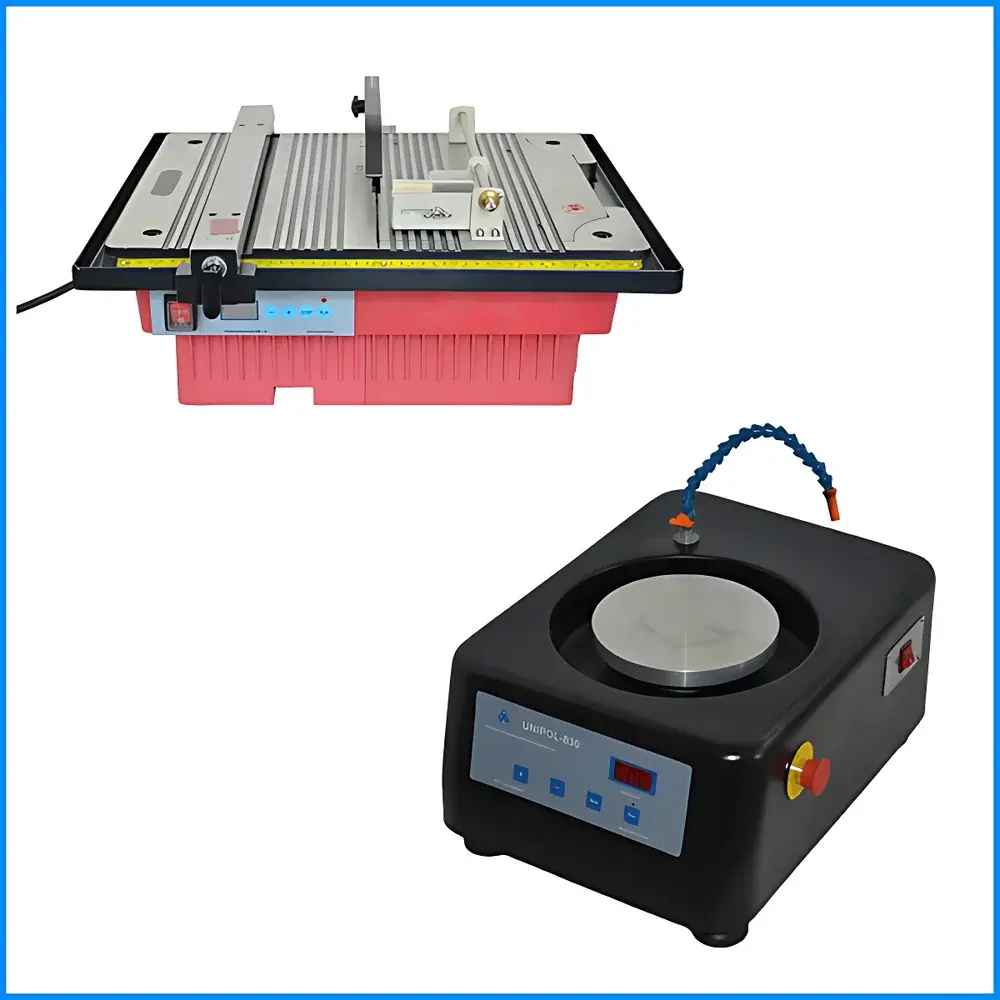
KJ GROUP SYJ-200H & UNIPOL-830 Integrated Metallographic Sample Preparation System
| Brand | KJ GROUP |
|---|---|
| Origin | Liaoning, China |
| Manufacturer Type | Authorized Distributor |
| Country of Origin | China |
| Model | SYJ-200H Manual High-Speed Cutting Machine + UNIPOL-830 Dual-Plate Grinding/Polishing Machine |
| Pricing | Contact for Quotation |
Overview
The KJ GROUP SYJ-200H & UNIPOL-830 Integrated Metallographic Sample Preparation System is a purpose-engineered entry-level solution for laboratories requiring reliable, repeatable metallographic specimen preparation under controlled manual operation. This system combines two core instruments—SYJ-200H manual high-speed precision cutting and UNIPOL-830 dual-plate grinding/polishing—into a coordinated workflow optimized for structural metallurgy, quality control in foundries and heat treatment facilities, and academic materials science labs. The SYJ-200H employs a direct-drive motor and rigid aluminum alloy frame to deliver stable rotational speeds up to 5,000 rpm, enabling rapid sectioning of ferrous and non-ferrous alloys, ceramics, and composites with minimal thermal distortion. The UNIPOL-830 utilizes independent variable-speed motors (0–600 rpm) for each grinding/polishing plate, ensuring precise control over material removal rate and surface finish—critical for achieving artifact-free microstructural observation under optical or electron microscopy.
Key Features
- SYJ-200H: Manual feed mechanism with ergonomic lever-assisted clamping; adjustable cutting depth stop and coolant nozzle positioning for consistent kerf width and thermal management.
- UNIPOL-830: Dual independent drive system with digital speed display and real-time RPM feedback; reversible rotation direction per plate to extend abrasive life and improve planarity.
- Universal sample mounting: Compatible with standard 1″–2″ (25–50 mm) diameter specimens using either mechanical ring clamps or optional electromagnetic chucks (sold separately).
- Modular consumable interface: Standardized 203 mm (8-inch) grinding/polishing plates accept industry-standard abrasive papers (SiC, Al₂O₃), diamond suspensions, and colloidal silica slurries.
- Robust construction: Powder-coated steel chassis with corrosion-resistant stainless-steel work surfaces and sealed bearing assemblies for long-term operational stability.
Sample Compatibility & Compliance
The system accommodates a broad range of conductive and non-conductive solid materials including carbon steels, stainless alloys, aluminum and titanium grades, cast irons, sintered carbides, and ceramic matrix composites. Specimen geometries supported include cylindrical rods, rectangular bars, and irregularly shaped parts up to 200 mm in maximum dimension (SYJ-200H) and 50 mm in diameter (UNIPOL-830). All mechanical adjustments comply with ISO 14971 risk management principles for laboratory equipment. While not certified to UL/CE as a complete integrated unit, each subsystem meets IEC 61000-6-2 (EMC immunity) and IEC 61000-6-4 (EMC emission) standards at the component level. Documentation supports GLP-compliant recordkeeping when paired with external lab information management systems (LIMS).
Software & Data Management
This is a manually operated, analog-digital hybrid system with no embedded firmware or proprietary software. Speed settings on the UNIPOL-830 are controlled via calibrated potentiometers with LED RPM indicators; all operational parameters—including cutting feed rate, coolant flow, and polishing time—are recorded externally per ASTM E3-22 “Standard Guide for Preparation of Metallographic Specimens.” For laboratories requiring audit-ready documentation, the system integrates seamlessly with third-party electronic lab notebooks (ELNs) and LIMS platforms via manual data entry or barcode-scanned protocol templates. Optional accessories include timer modules with relay outputs for automated cycle termination and USB-connected digital tachometers for periodic calibration verification.
Applications
- Routine QC/QA in metal fabrication plants: Cross-sectional verification of weld integrity, case depth measurement in carburized components, and inclusion rating per ASTM E45.
- Failure analysis laboratories: Sectioning of fractured surfaces for SEM-EDS correlation and crack propagation path reconstruction.
- University teaching labs: Hands-on training in ASTM E3-compliant specimen preparation workflows, emphasizing reproducibility, artifact mitigation, and process parameter optimization.
- Research in advanced materials: Preparation of TiAl intermetallics, Ni-based superalloys, and additively manufactured (AM) metal parts where thermal input minimization during sectioning is critical.
FAQ
Is this system suitable for automated, unattended operation?
No. Both the SYJ-200H and UNIPOL-830 require continuous manual supervision and operator intervention during sample loading, feed adjustment, and process monitoring.
Can diamond-impregnated wheels be used on the SYJ-200H?
Yes—provided wheel arbor dimensions match the 22.2 mm spindle and maximum operating speed does not exceed 5,000 rpm. Always verify wheel certification per ANSI B74.17.
Does the UNIPOL-830 support electrochemical polishing?
No. It is designed exclusively for mechanical grinding and cloth-based polishing. Electrochemical units require separate DC power supplies and electrolyte containment systems.
What maintenance intervals are recommended?
Coolant reservoir cleaning every 40 hours of cumulative operation; spindle bearing lubrication every 500 hours; abrasive plate surface truing every 200 cycles or upon visible eccentric wear.
Are replacement parts and consumables available globally?
Yes—KJ GROUP maintains an international distributor network supplying OEM-certified blades, grinding plates, magnetic chucks, and calibration tools with documented traceability to ISO/IEC 17025-accredited reference standards.



