
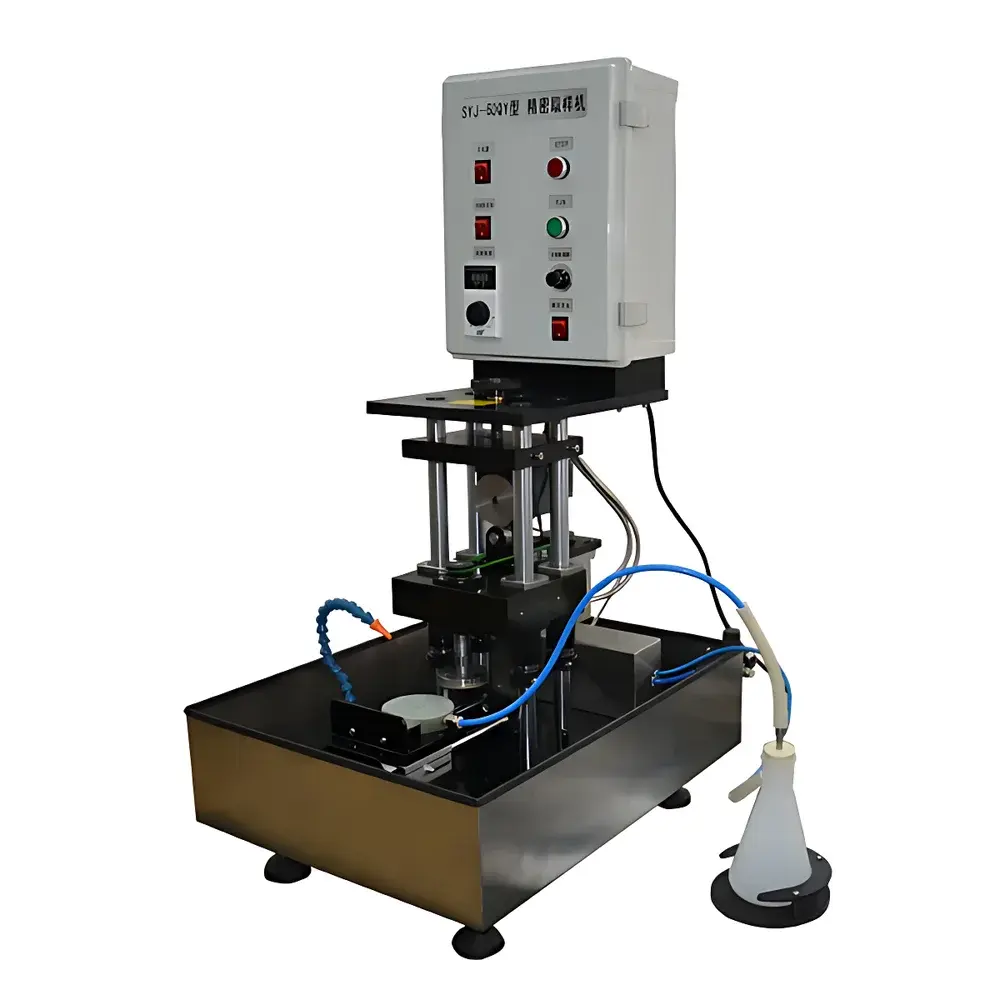
KJ GROUP SYJ-50QY Precision Circular Sampler for Brittle Thin-Film Materials
| Brand | KJ GROUP |
|---|---|
| Origin | Liaoning, China |
| Manufacturer Type | Authorized Distributor |
| Origin Category | Domestic (China) |
| Model | SYJ-50QY |
| Pricing | Upon Request |
| Max Sample Diameter | Ø90 mm × 2 mm |
| Vacuum Source | Clean Compressed Air (0.2–0.6 MPa) |
| Spindle Speed | 300–6500 rpm (recommended: 5000 rpm) |
| Feed Motor Speed | 0.5–7.5 rpm |
| Feed Rate | 0.014–0.23 mm/s |
| Sample Thickness Range | 0.3–1 mm |
| Operating Environment | 25 °C ±15 °C, ≤85% RH (non-condensing), Altitude <1000 m |
| Cooling | Adjustable Water-Based Coolant Flow |
| Dimensions (W×D×H) | 470 mm × 700 mm × 1100 mm |
| Weight | 40 kg |
| Required Utilities | AC 220 V, 50 Hz |
| Water Connection | Inlet & Drain Required |
| Ventilation | Mandatory |
| Workbench Minimum | 600 mm × 850 mm × 700 mm |
Overview
The KJ GROUP SYJ-50QY Precision Circular Sampler is an engineered solution for reproducible, high-tolerance circular specimen preparation from brittle, non-metallic thin-film materials. Designed specifically for laboratory and pilot-scale manufacturing environments, the system operates on a vacuum-assisted clamping principle—using a pneumatically actuated suction cup to immobilize flat, non-porous substrates during precision rotary cutting. Its core mechanism integrates a high-speed, variable-rpm spindle with a digitally controlled feed motor to deliver consistent radial penetration at precisely regulated rates. Unlike general-purpose punch tools or manual die cutters, the SYJ-50QY employs continuous rotational sampling under active coolant flow, minimizing thermal stress and micro-cracking in sensitive ceramics, optical crystals, and soda-lime or borosilicate glass substrates. The device complies with EU Machinery Directive 2006/42/EC and carries full CE marking, confirming conformity with essential health and safety requirements for mechanical equipment used in controlled technical settings.
Key Features
- Vacuum-based sample fixation using a clean-air vacuum generator—enabling instantaneous adhesion and release without mechanical clamps or surface damage
- Adjustable water-coolant delivery system with flow-rate control to suppress localized heating during high-speed cutting of thermally fragile materials
- IP-rated splash-resistant enclosure with integrated drainage channels to maintain operational integrity in wet lab environments
- Dual independent motion control: spindle rotation (300–6500 rpm) and axial feed (0.014–0.23 mm/s) are separately tunable for material-specific optimization
- Modular tooling interface supporting interchangeable sampling cutters—allowing users to select diameter-specific carbide-tipped annular bits (Ø30 mm to Ø90 mm)
- Stable granite-derived base platform and rigid cast-aluminum frame to minimize vibration-induced dimensional deviation across repeated cycles
Sample Compatibility & Compliance
The SYJ-50QY is validated exclusively for planar, non-porous, brittle sheet materials with thicknesses between 0.3 mm and 1.0 mm. Suitable substrates include sintered alumina, silicon nitride, fused quartz, lithium niobate wafers, and annealed float glass. It is not intended for ductile metals, polymer films, laminated composites, or any material exhibiting plastic deformation under shear. Surface flatness must meet ISO 10791-7 (≤5 µm total indicator reading over 100 mm) to ensure uniform vacuum seal formation. All electrical components conform to IEC 61000-6-2 (immunity) and IEC 61000-6-4 (emission) standards. Mechanical safety systems—including emergency stop circuitry, interlocked access guards, and pressure-loss detection—meet EN ISO 13857 requirements for safe distances and EN 60204-1 for electrical equipment of machines.
Software & Data Management
The SYJ-50QY operates via front-panel digital controls with LED status indicators; no embedded software or PC interface is included in the base configuration. However, its analog-compatible I/O ports (0–10 V input for feed rate, discrete TTL signals for vacuum on/off and coolant enable) permit integration into supervised automation workflows compliant with ISA-88 batch control architecture. When deployed within GLP- or GMP-regulated labs, optional external logging systems can capture timestamped parameters—including actual spindle speed, feed duration, vacuum pressure decay profile, and coolant flow confirmation—supporting audit-ready documentation per FDA 21 CFR Part 11 requirements when paired with qualified electronic record systems.
Applications
- Preparation of ASTM C1161-compliant flexural test specimens from advanced technical ceramics
- Generation of circular blanks for optical transmission measurements (per ISO 9050 and EN 410)
- Sampling of thin-glass substrates prior to ion-exchange strengthening or thin-film deposition qualification
- Production of standardized discs for hardness testing (e.g., Vickers microindentation per ISO 6507-1 on polished ceramic cross-sections)
- Controlled geometry extraction from single-crystal wafers for XRD texture analysis or SEM cross-sectional mounting
FAQ
What materials are incompatible with the SYJ-50QY?
Metals, elastomers, fiber-reinforced polymers, laminated glass, and any substrate exhibiting measurable plastic strain under 10 N normal load are excluded due to risk of tool binding, vacuum seal failure, or edge chipping.
Is compressed air supply mandatory?
Yes—the vacuum generator requires clean, oil-free compressed air at 0.2–0.6 MPa. An optional quiet oil-free air compressor (model KJ-AC100) is available as an accessory.
Can the machine operate without coolant?
No—continuous water-based cooling is required during all cutting operations to prevent thermal shock and maintain dimensional stability of both tool and specimen.
What maintenance intervals are recommended?
Vacuum filter replacement every 200 operating hours; spindle bearing lubrication annually; cutter inspection before each use; coolant system descaling quarterly.
Does the SYJ-50QY support automated sample loading?
Not natively—the current design requires manual placement and removal of samples. Robotic integration is feasible via third-party gantry systems using the provided I/O interface.




