
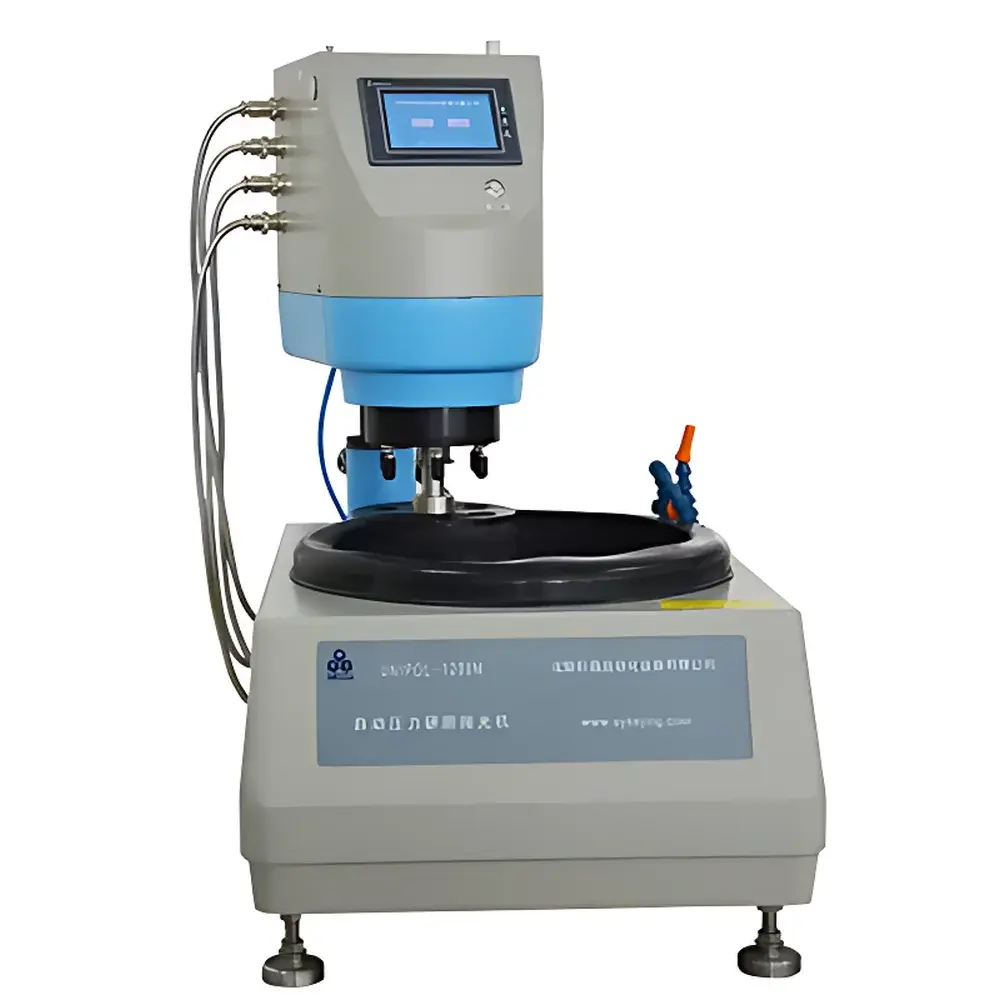
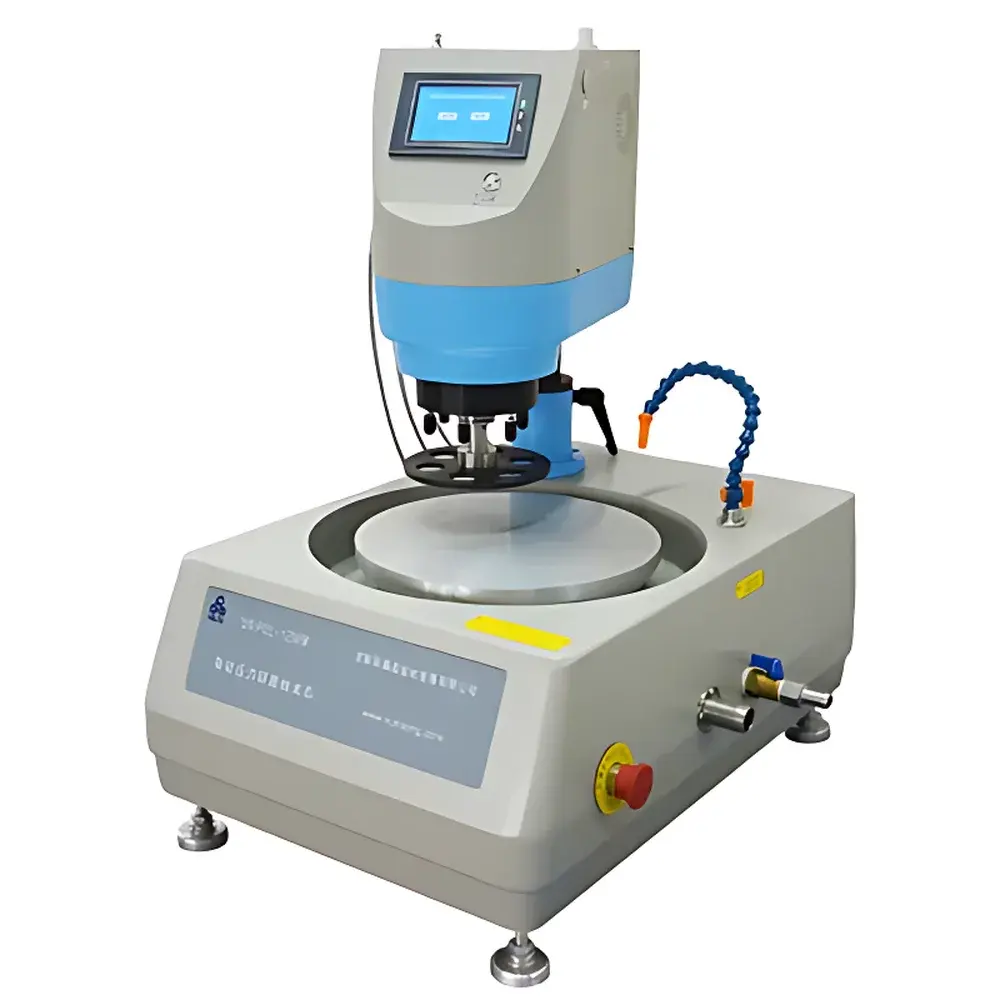
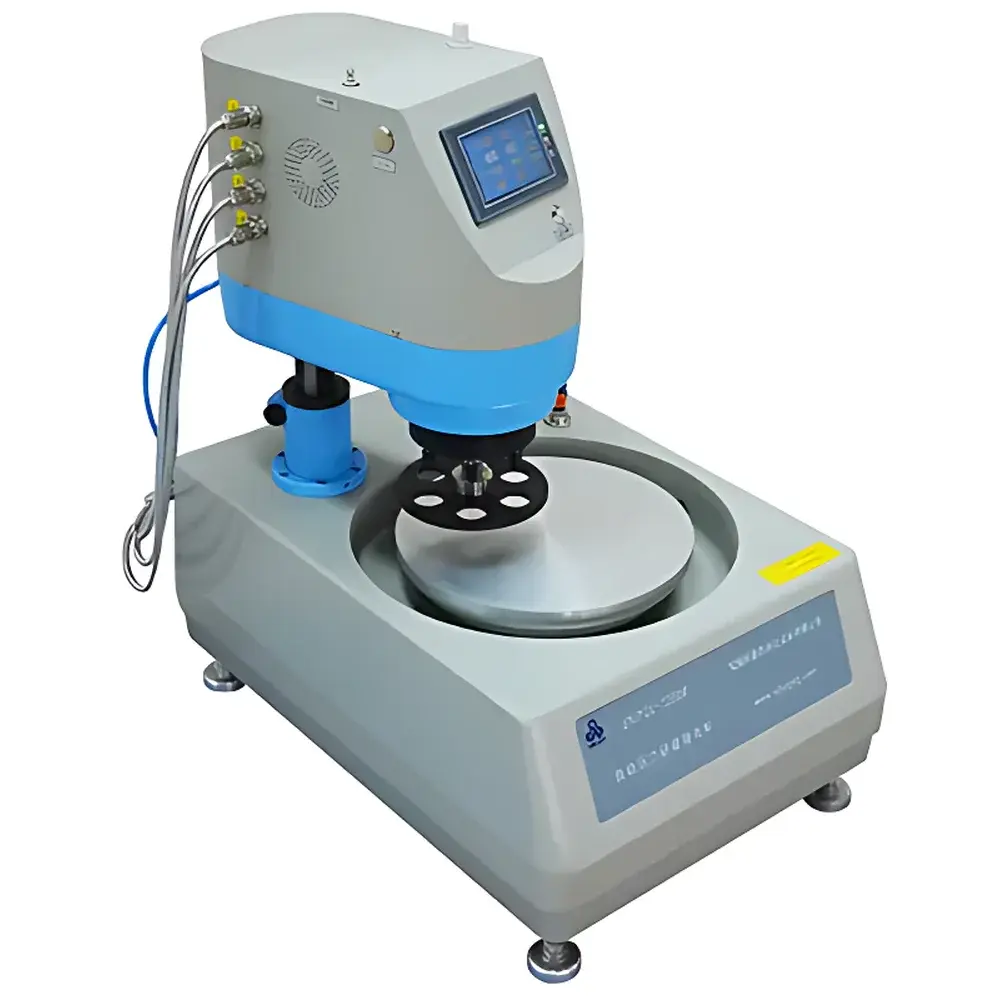
KJ GROUP UNIPOL-1200M Automated Pressure-Controlled Grinding and Polishing System
| Brand | KJ GROUP |
|---|---|
| Origin | Liaoning, China |
| Model | UNIPOL-1200M |
| Dimensions (L×W×D) | 660 mm × 460 mm × 720 mm |
| Number of Grinding/Polishing Plates | 1 |
| Plate Diameter | 300 mm |
| Platen Speed | 50–500 rpm |
| Carrier Head Speed | 1–60 rpm |
| Applied Pressure Range | 0.15–0.4 MPa |
| Power Supply | AC 220 V, 50 Hz, 450 W |
| Weight | 80 kg |
| Standard Carrier Plate Diameter | Ø150 mm |
| Standard Specimen Holders | Ø25 mm (optional: Ø22/Ø30/Ø45 mm) |
Overview
The KJ GROUP UNIPOL-1200M Automated Pressure-Controlled Grinding and Polishing System is an engineered solution for precision sample preparation in materials science laboratories. Designed around a dual-rotating plate architecture—featuring independent speed control of both the grinding/polishing platen (lower plate) and the specimen carrier head (upper plate)—the system enables reproducible, planar surface generation across diverse material classes. Its operational principle relies on controlled mechanical abrasion under regulated pneumatic loading: compressed air actuates a multi-point pressure distribution system that uniformly applies load to the specimen-mounted carrier, ensuring consistent contact pressure across the entire interface with the rotating abrasive surface. This configuration minimizes edge rounding, reduces subsurface damage, and supports sequential coarse-to-fine processing protocols required for metallographic, geological, ceramic, and optical crystal specimen preparation—including ZnS, ZnSe, Si, Ge, and other IR-transmitting substrates.
Key Features
- Dual-axis independent rotation: Lower platen rotates counter-clockwise at 50–500 rpm; upper carrier head rotates clockwise or counter-clockwise at 1–60 rpm, enabling optimized material removal kinetics and surface finish control.
- Pneumatically actuated multi-point pressure application: Delivers uniform load distribution (0.15–0.4 MPa) across the specimen interface, eliminating localized over-grinding and improving flatness repeatability.
- Touchscreen-based HMI: Intuitive interface for setting time-limited cycles, rotational speeds, direction, and pressure parameters—enabling unattended operation with automatic shutdown upon cycle completion.
- Modular carrier system: Standard Ø150 mm carrier plate accommodates interchangeable specimen holders (Ø22 mm, Ø25 mm, Ø30 mm, Ø45 mm), supporting diverse sample geometries including cylindrical mounted specimens and geologic thin-section blanks.
- Robust mechanical architecture: Cast aluminum platen and rigid frame ensure dimensional stability during prolonged operation; integrated water inlet/outlet ports support continuous coolant delivery for thermal management and debris removal.
Sample Compatibility & Compliance
The UNIPOL-1200M is validated for use with metallic alloys, sintered ceramics, optical crystals (e.g., silicon, germanium, zinc sulfide, zinc selenide), geological specimens (rock/mineral thin sections), polymer composites, and embedded organic-inorganic hybrid samples. It conforms to standard laboratory safety and electromagnetic compatibility requirements per IEC 61000-6-3 and IEC 61000-6-4. While not certified to ISO/IEC 17025 as a measurement instrument, its process repeatability supports GLP-aligned documentation when paired with calibrated pressure regulators and timer logs. The system is compatible with ASTM E3, ASTM E407, and ISO 14577 sample preparation workflows for microstructural analysis.
Software & Data Management
The UNIPOL-1200M operates via embedded firmware with no external PC dependency. All process parameters—including elapsed time, platen/carrier speed, direction, and pressure setpoint—are stored in non-volatile memory and accessible via the touchscreen interface. Cycle history is retained for up to 100 runs and can be reviewed for audit purposes. Optional accessories—including SKZD-4 automated dispensing units and YJXZ-25 recirculating filtration tanks—integrate via analog I/O triggers and support traceable slurry delivery and coolant conditioning. For regulated environments, timestamped parameter logs may be exported manually via USB (firmware v2.3+) to meet basic FDA 21 CFR Part 11 record-keeping expectations when used within a documented SOP framework.
Applications
- Preparation of metallographic cross-sections for SEM/EBSD analysis requiring low-damage, flat surfaces.
- Production of geologic thin sections (e.g., zircon U-Pb dating targets) with sub-micron thickness uniformity.
- Surface planarization of infrared optical crystals prior to anti-reflection coating deposition.
- Routine polishing of ceramic and composite specimens for hardness testing (Vickers/Knoop) and porosity evaluation.
- Small-batch prototyping in R&D settings where manual polishing variability must be eliminated without full-scale automation investment.
FAQ
Does the UNIPOL-1200M require an external air compressor?
Yes—operation requires a clean, dry, oil-free compressed air source delivering ≥0.6 MPa supply pressure. A dedicated quiet oil-free compressor (e.g., optional KJ GROUP model) is recommended to maintain stable pressure regulation.
What is the maximum specimen height accommodated by the carrier head?
The standard carrier design accepts specimens up to 25 mm in height when using the Ø25 mm holder; custom spacers are available for taller mounted samples.
Can the system perform both grinding and polishing in a single setup?
Yes—by swapping abrasive media (e.g., SiC papers, diamond-impregnated pads, cloth-backed polishing cloths) on the 300 mm platen and adjusting speed/pressure parameters accordingly, sequential grinding → lapping → polishing protocols are fully supported.
Is the water cooling system closed-loop or open-flow?
The base configuration uses open-flow tap water; however, integration with optional YJXZ-12 recirculating pump and YJXZ-25 filtered reservoir enables closed-loop coolant management for extended operation and reduced water consumption.
Are calibration certificates provided for pressure or rotational speed?
No factory calibration certificates are included; users are advised to verify pressure transducer output and tachometric readings annually using NIST-traceable instrumentation as part of internal quality assurance procedures.



