
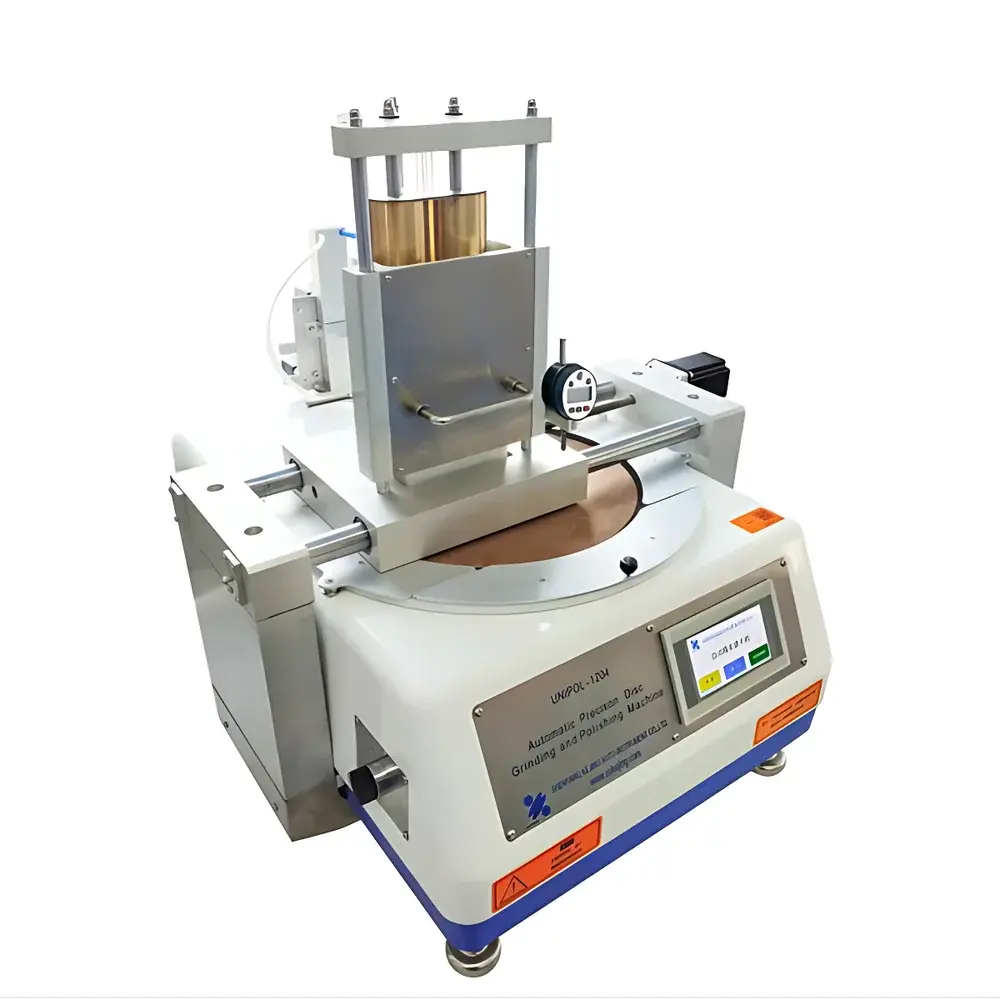
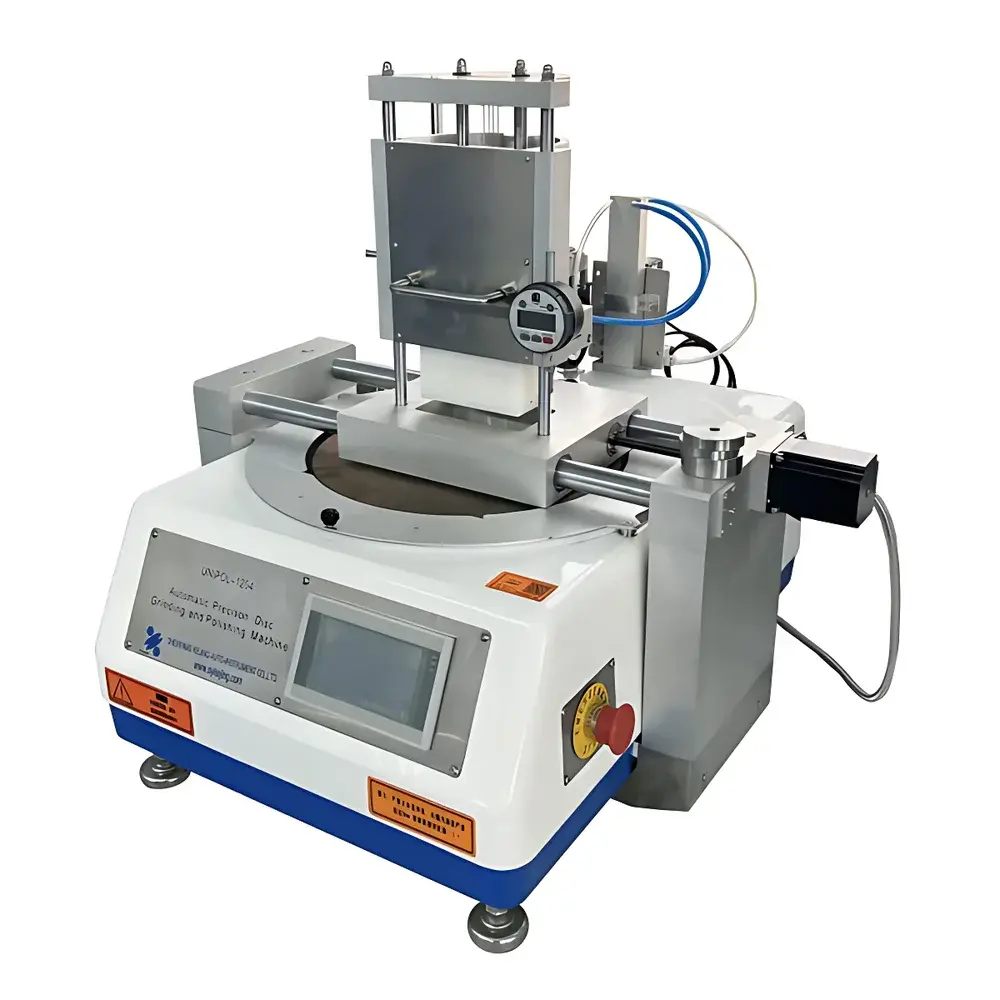
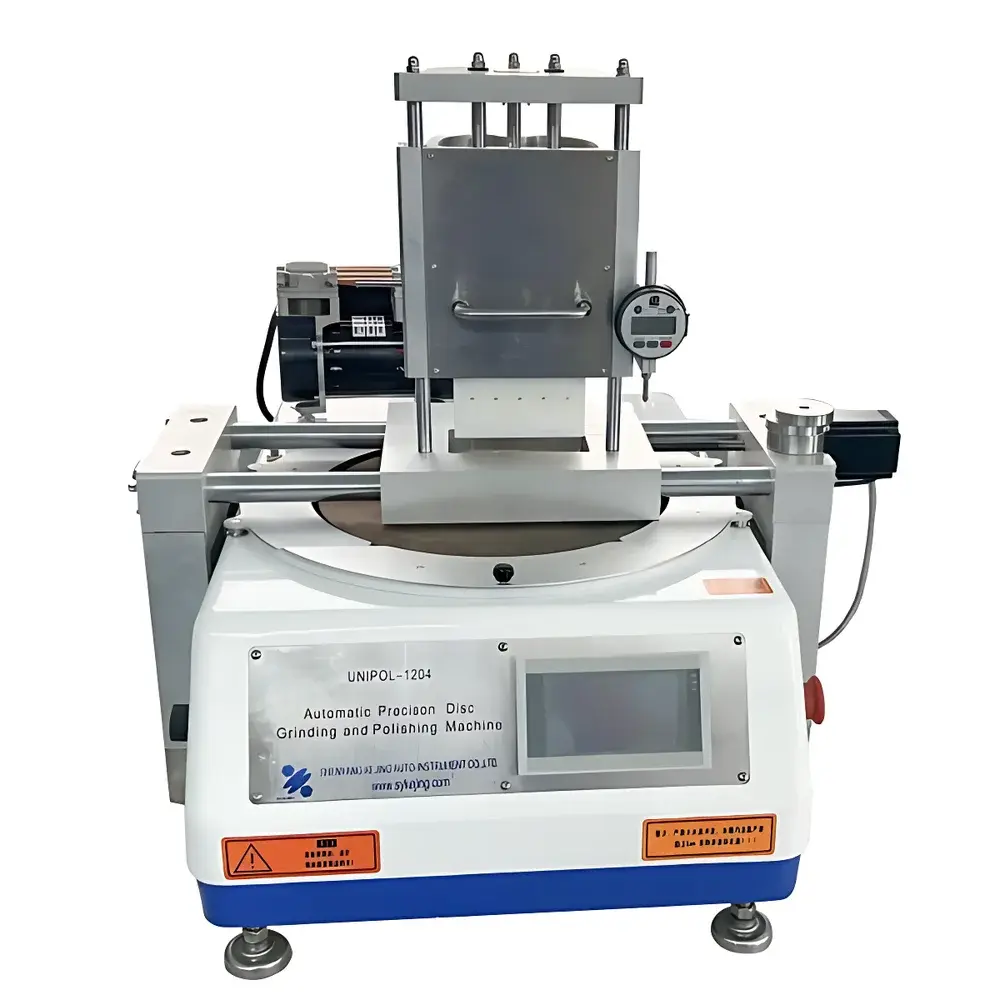
KJ GROUP UNIPOL-1204 Automated Precision Grinding System
| Brand | KJ GROUP |
|---|---|
| Origin | Liaoning, China |
| Manufacturer | KJ GROUP |
| Model | UNIPOL-1204 |
| Power Supply | 220 V AC, 500 W (excl. vacuum pump) |
| Minimum Grinding Thickness | ≤10 µm |
| Maximum Sample Size | 100 × 50 mm |
| Initial Sample Thickness | ≤1 mm |
| Digital Thickness Resolution | 1 µm |
| Feed Mechanism | Gravity-fed (feed increment ≤0.001 mm) |
| Platen Speed | 10–200 rpm |
| Oscillation Stages | 20 adjustable swing speeds |
| Platen Diameter | 300 mm (compatible with diamond discs and abrasive papers: 400#, 600#, 800#, 1000#, 1500#) |
| Counterweight | 450 g |
| Sample Fixation | Vacuum adsorption on glass slide holder |
| Dimensions (W×D×H) | 652 × 700 × 640 mm |
| Net Weight | 70 kg |
Overview
The KJ GROUP UNIPOL-1204 Automated Precision Grinding System is an engineered solution for reproducible, thickness-controlled grinding and polishing of hard-tissue sections—particularly those embedded in resin matrices containing heterogeneous inclusions such as metal alloys, ceramics, polymers, or mineral phases. Designed around a gravity-fed, digitally monitored material removal architecture, the system implements controlled mechanical ablation via rotating abrasive platens while maintaining sub-micrometer positional feedback on sample thickness in real time. Its operational principle integrates precision mechanical translation, vacuum-based sample immobilization, and synchronized oscillatory motion to minimize edge rounding, thermal distortion, and localized pressure gradients—critical parameters in preparing histological and materials science specimens for subsequent microtome sectioning, staining, or high-resolution imaging (e.g., SEM, TEM, light microscopy). Unlike manual or semi-automated grinders, the UNIPOL-1204 eliminates operator-dependent variability through closed-loop thickness monitoring and programmable feed progression, enabling consistent preparation of specimens meeting ISO 13025 (preparation of hard tissue for histomorphometry) and ASTM E3 (standard guide for preparation of metallographic specimens) compliance requirements.
Key Features
- Real-time digital thickness monitoring with 1 µm resolution, enabling endpoint detection and process validation during grinding;
- Gravity-driven feed mechanism with ≤0.001 mm incremental advancement, ensuring predictable and repeatable material removal rates;
- 20-step adjustable oscillation speed for optimized surface uniformity across heterogeneous samples (e.g., bone-metal interfaces);
- 300 mm diameter platen compatible with standardized abrasive media (400#–1500# SiC papers, diamond-impregnated discs), supporting multi-stage grinding-to-polishing workflows;
- Vacuum-assisted fixation on standard microscope slides—eliminating adhesive residues and enabling rapid sample exchange without re-alignment;
- Adjustable counterweight (450 g) and variable platen speed (10–200 rpm) to accommodate differential hardness between matrix and inclusion phases;
- Integrated safety interlocks, low-noise motor drive, and modular consumable design facilitating GMP-aligned maintenance and audit-ready service logs.
Sample Compatibility & Compliance
The UNIPOL-1204 accommodates a broad spectrum of rigid, sectioned specimens up to 100 × 50 mm and initial thickness ≤1 mm—including decalcified or undecalcified bone, calcified cartilage, dental enamel-dentin complexes, composite biomaterials, and metallurgical cross-sections with embedded ceramic or polymer reinforcements. Its vacuum slide holder ensures flatness control within ±0.5 µm over 10 mm²—meeting preparatory specifications for quantitative backscattered electron imaging (BSE), energy-dispersive X-ray spectroscopy (EDS) mapping, and nanoindentation. The system supports GLP-compliant documentation when integrated with external lab information management systems (LIMS), and its mechanical repeatability aligns with ISO/IEC 17025 clause 7.2.2 (method validation) for specimen preparation protocols used in regulatory submissions (e.g., FDA 510(k), CE-IVDR Annex II).
Software & Data Management
While the UNIPOL-1204 operates via embedded hardware controls (no proprietary PC software required), all thickness measurements are logged to non-volatile memory with timestamp and user ID fields. Data export is supported via USB interface in CSV format, enabling traceability integration into electronic lab notebooks (ELN) or LIMS platforms compliant with 21 CFR Part 11 (audit trail, electronic signature readiness). Optional firmware updates maintain alignment with evolving ISO/IEC 17025 documentation standards, and calibration certificates (traceable to NIM, China) are provided with each unit shipment.
Applications
- Precision thinning of hard-tissue sections prior to ultramicrotomy for TEM grid mounting;
- Flatness correction of embedded biopsy blocks for serial sectioning and 3D reconstruction;
- Preparation of metal-ceramic dental prostheses for interfacial bond strength analysis;
- Grinding of orthopedic implant coatings (e.g., hydroxyapatite, TiN) to defined thicknesses for wear testing;
- Standardized polishing of geological thin sections containing quartz-feldspar-mica assemblages;
- QC/QA grinding of reference materials used in proficiency testing programs accredited to ISO/IEC 17043.
FAQ
Does the UNIPOL-1204 support automated endpoint detection based on thickness thresholds?
Yes—the built-in digital micrometer continuously measures sample thickness during grinding and triggers audible/visual alerts when user-defined thresholds (e.g., 25 µm ± 1 µm) are reached.
Can the system accommodate non-standard sample carriers beyond glass slides?
No—the vacuum chuck is dimensionally optimized for standard 76 × 26 mm microscope slides; custom fixtures require third-party mechanical adaptation and void factory calibration.
Is the platen speed independently controllable from oscillation speed?
Yes—platen rotation and sample-stage oscillation are fully decoupled, allowing independent optimization for coarse removal (high rpm, low oscillation) versus fine polishing (low rpm, high oscillation).
What vacuum pump specifications are recommended for optimal adsorption performance?
A minimum -80 kPa vacuum source with ≥15 L/min flow rate is required; KJ GROUP recommends the VP-120 dry diaphragm pump (sold separately) for ISO Class 5 cleanroom compatibility.
How often does the system require recalibration of the digital thickness sensor?
Annual recalibration is advised per ISO/IEC 17025; KJ GROUP provides certified recalibration services with NIM-traceable standards and full uncertainty reporting.



