
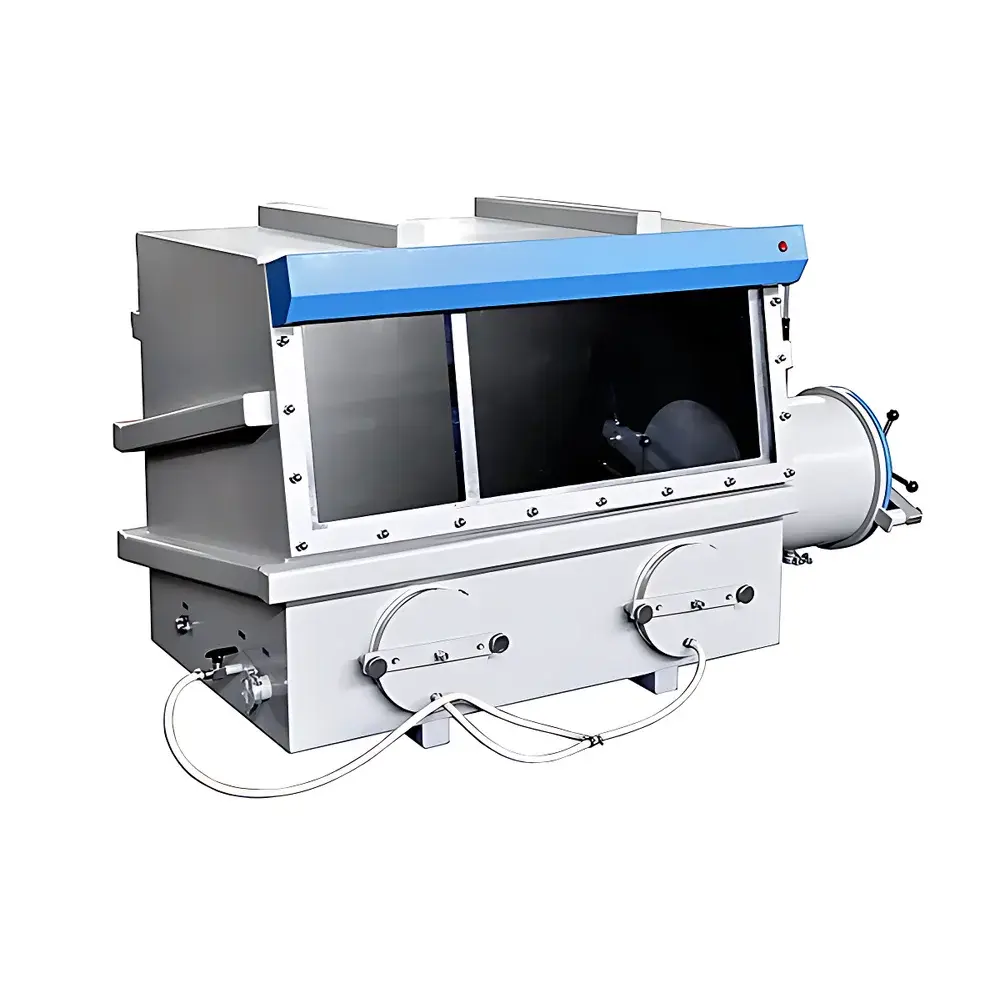
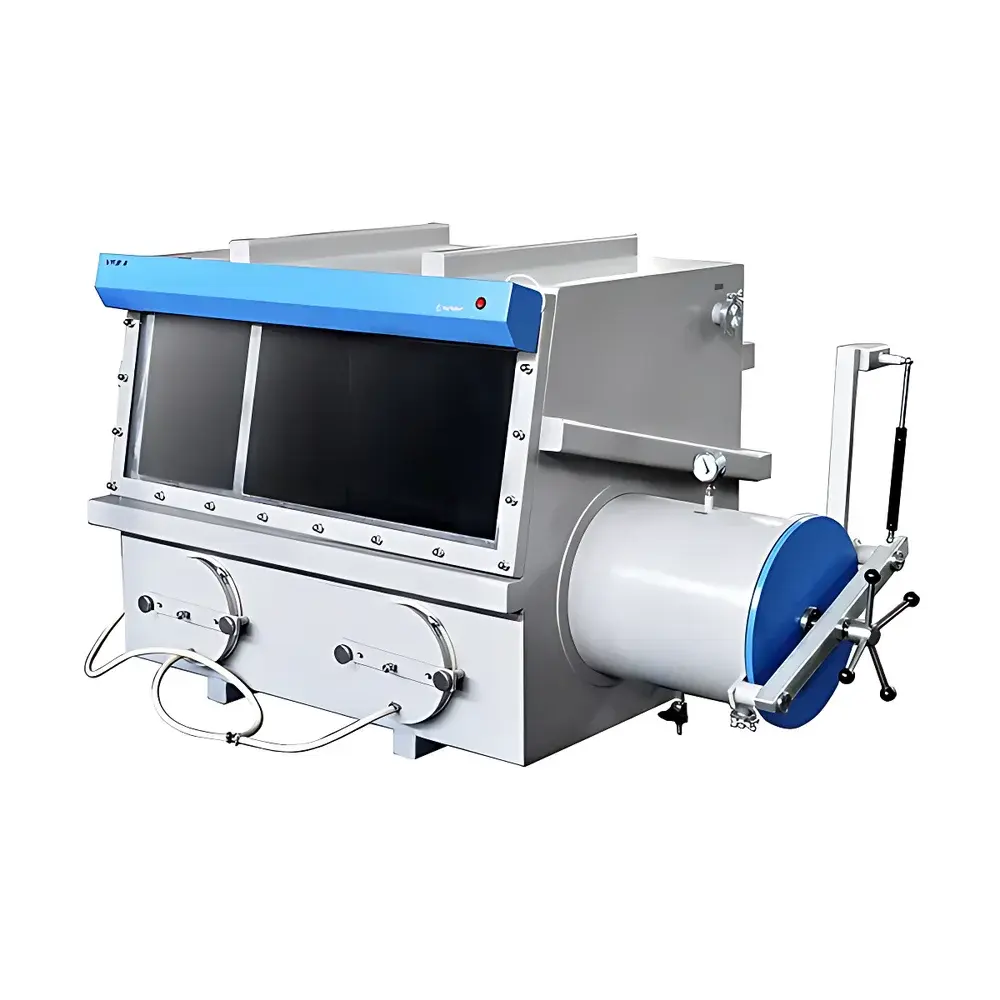
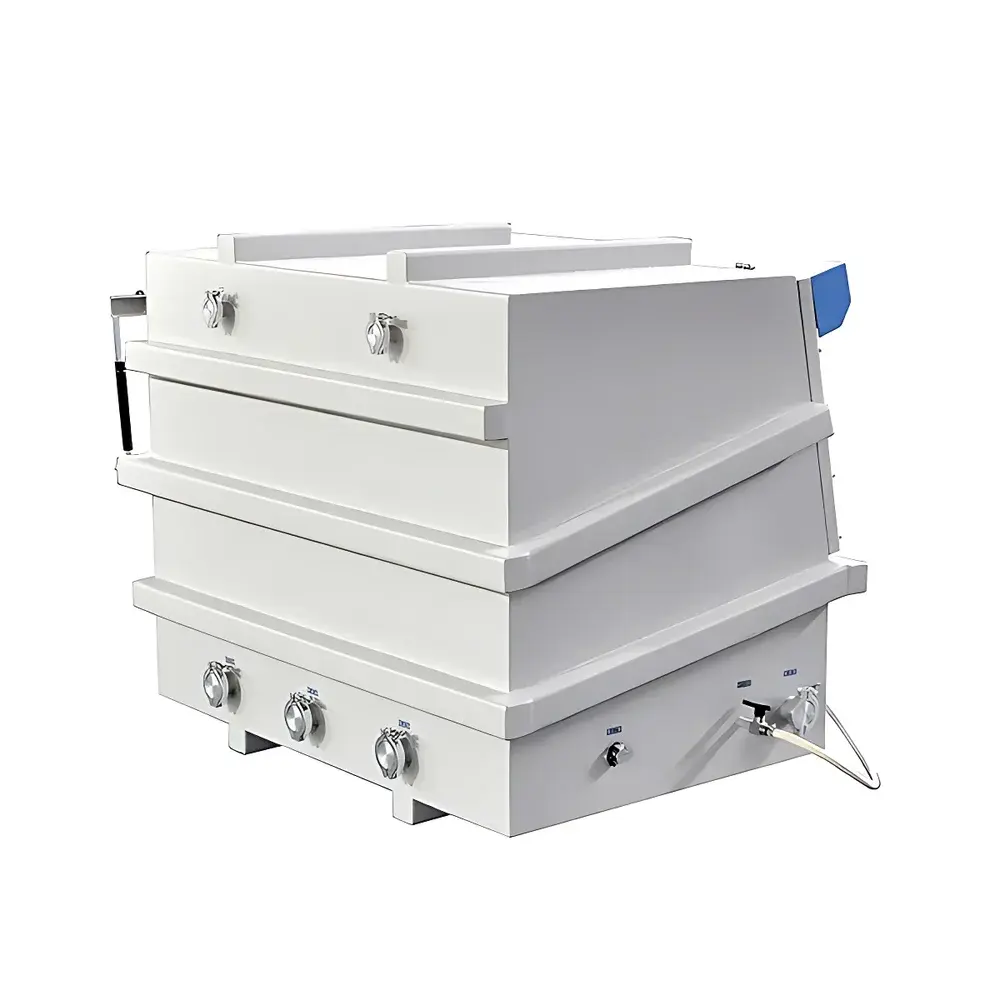
KJ GROUP VGB-4 Stainless Steel Vacuum Glove Box
| Brand | KJ GROUP |
|---|---|
| Origin | Liaoning, China |
| Manufacturer Type | Authorized Distributor |
| Country of Origin | China |
| Model | VGB-4 |
| Pricing | Upon Request |
| Chamber Material | 3 mm 304 stainless steel with welded reinforcement ribs |
| Main Chamber Dimensions | 1120 × 800 × 1000 mm (L×W×H) |
| Antechamber Dimensions | Ø360 × 600 mm |
| Main Chamber Ultimate Vacuum | 0.5 torr |
| Antechamber Ultimate Vacuum | 0.05 torr |
| Maximum Positive Pressure | 1.1 atm |
| Inert Atmosphere Retention Time | >12 h |
| Glove Port Inner Diameter | Ø203 mm |
| Integrated Power Outlet | 1500 W, 3-pin, feedthrough-mounted |
| Vacuum Ports | 2 × KF25 + 3 × KF40 on main chamber rear wall |
| Antechamber Fittings | Vacuum gauge, ball valve, 1 × KF25 port |
| Certification | CE compliant |
| Weight | 360 kg |
Overview
The KJ GROUP VGB-4 Stainless Steel Vacuum Glove Box is an engineered inert-atmosphere workstation designed for controlled handling of air-sensitive materials under ultra-low moisture and oxygen conditions. It operates on a dual-chamber vacuum/inert gas purging principle: samples are introduced via a dedicated antechamber that undergoes sequential evacuation and backfilling with high-purity inert gas (e.g., N₂ or Ar), thereby preventing ambient air ingress into the main working chamber. The main chamber maintains a stable, positive-pressure inert environment—critical for processes such as lithium-ion battery electrode fabrication, organometallic synthesis, and semiconductor thin-film deposition. Constructed from 3 mm thick ASTM A240 304 stainless steel with structural reinforcement ribs welded directly to the chamber walls, the VGB-4 resists deformation under repeated vacuum cycling and ensures long-term dimensional stability. Its design adheres to fundamental vacuum engineering principles—including conductance-limited gas flow, outgassing mitigation through material selection, and pressure differential safety thresholds—making it suitable for routine laboratory-scale inert processing where ultimate vacuum (<10⁻⁶ torr) is not required but robust environmental isolation is essential.
Key Features
- Structurally reinforced 304 stainless steel construction (3 mm thickness) with integral welded ribs to prevent chamber distortion during vacuum operation.
- Dual-stage chamber architecture: a cylindrical antechamber (Ø360 × 600 mm) with integrated vacuum gauge, manual ball valve, and KF25 port; and a rectangular main chamber (1120 × 800 × 1000 mm) optimized for instrument integration and operator ergonomics.
- High-capacity internal power distribution: 1500 W rated 3-pin feedthrough outlet, electrically isolated and sealed per IEC 60529 IP65 standards, enabling safe operation of analytical instruments, hotplates, or vacuum gauges inside the glove box.
- Standardized vacuum interface suite: five total KF ports (2 × KF25 + 3 × KF40) on the rear wall of the main chamber for connection to vacuum pumps, gas purification systems, or process lines.
- CE-marked design compliant with EU Machinery Directive 2006/42/EC and Low Voltage Directive 2014/35/EU, including documented risk assessment and mechanical safety validation.
- Operational pressure envelope: maintains inert atmosphere at up to 1.1 atm(g) positive pressure; vacuum operation is limited to ≤0.5 torr in the main chamber and ≤0.05 torr in the antechamber to preserve structural integrity and glove longevity.
Sample Compatibility & Compliance
The VGB-4 supports handling of moisture- and oxygen-sensitive samples—including alkali metals, metal halide perovskites, lithiated cathode materials, Grignard reagents, and air-stable catalysts—without degradation during transfer or manipulation. Its inert retention time exceeds 12 hours when sealed and purged with ≥99.999% purity argon or nitrogen, meeting minimum requirements for ISO 8573-1 Class 2 compressed air quality equivalency in dry gas delivery. While not certified to ISO/IEC 17025 or GLP for analytical measurement traceability, its mechanical and sealing performance aligns with ASTM E505-22 (Standard Guide for Qualification of Glove Boxes Used in Handling Air-Sensitive Materials). All elastomeric components—including the standard 203 mm inner-diameter butyl rubber gloves—are selected for low permeability to O₂ and H₂O vapor and validated for compatibility with common solvent vapors encountered in synthetic chemistry workflows.
Software & Data Management
The VGB-4 is a manually operated, hardware-integrated platform without embedded microprocessor control or digital data logging. Vacuum status is monitored exclusively via analog Bourdon-tube vacuum gauges calibrated to NIST-traceable standards. For laboratories requiring audit-ready records, external data acquisition systems may be interfaced via the KF25 ports using capacitance manometers (e.g., MKS Baratron series) coupled to PC-based SCADA software supporting 21 CFR Part 11-compliant electronic signatures and audit trails. Optional vacuum pump controllers (e.g., Edwards nXDSi) can be integrated to log cycle times, pump-down curves, and interlock events—enabling retrospective analysis aligned with GMP Annex 11 expectations for critical environmental equipment.
Applications
- Lithium battery R&D: Electrode slurry preparation, coin-cell assembly, and post-cycling disassembly under <1 ppm O₂/H₂O conditions.
- Organometallic synthesis: Handling of pyrophoric reagents (e.g., t-BuLi, DIBAL-H) and air-sensitive catalysts (e.g., Pd(dba)₃, Ni(cod)₂).
- Perovskite photovoltaics: Spin-coating and thermal annealing of MAPbI₃ and related compositions without ambient-induced decomposition.
- Materials science: Controlled exposure testing of corrosion-prone alloys, passivation layer formation studies, and thin-film encapsulation development.
- Radiochemistry: Shielded manipulation of short-lived isotopes where inert atmosphere prevents oxide formation on target substrates.
FAQ
Is the VGB-4 suitable for high-vacuum applications below 10⁻³ torr?
No. The VGB-4 is engineered for medium-vacuum operation only (≤0.5 torr main chamber). Structural design and seal geometry are not rated for ultrahigh vacuum; attempting deeper evacuation risks permanent deformation of the chamber walls.
Can the internal power outlet support motor-driven equipment?
Yes, provided the total connected load remains within 1500 W and the equipment’s starting current does not exceed the 16 A circuit rating. Inductive loads must include local suppression to prevent feedthrough arcing.
What inert gas purity is recommended for optimal atmosphere retention?
≥99.999% (5N) argon or nitrogen, supplied via a dual-stage purifier (e.g., BASF R3-11 + SAES MonoTorr) to achieve sub-ppm O₂/H₂O levels before chamber introduction.
Are custom glove materials available?
Yes—fluoroelastomer (FKM) and laminated multilayer gloves (e.g., Viton®/Butyl composite) can be supplied upon request for enhanced chemical resistance, subject to lead time and compatibility verification.
Does the CE marking cover electromagnetic compatibility (EMC)?
Yes. The CE declaration includes compliance with EN 61326-1:2013 for laboratory electrical equipment, verified via conducted/radiated emissions and immunity testing per EN 61000-4 series standards.



