
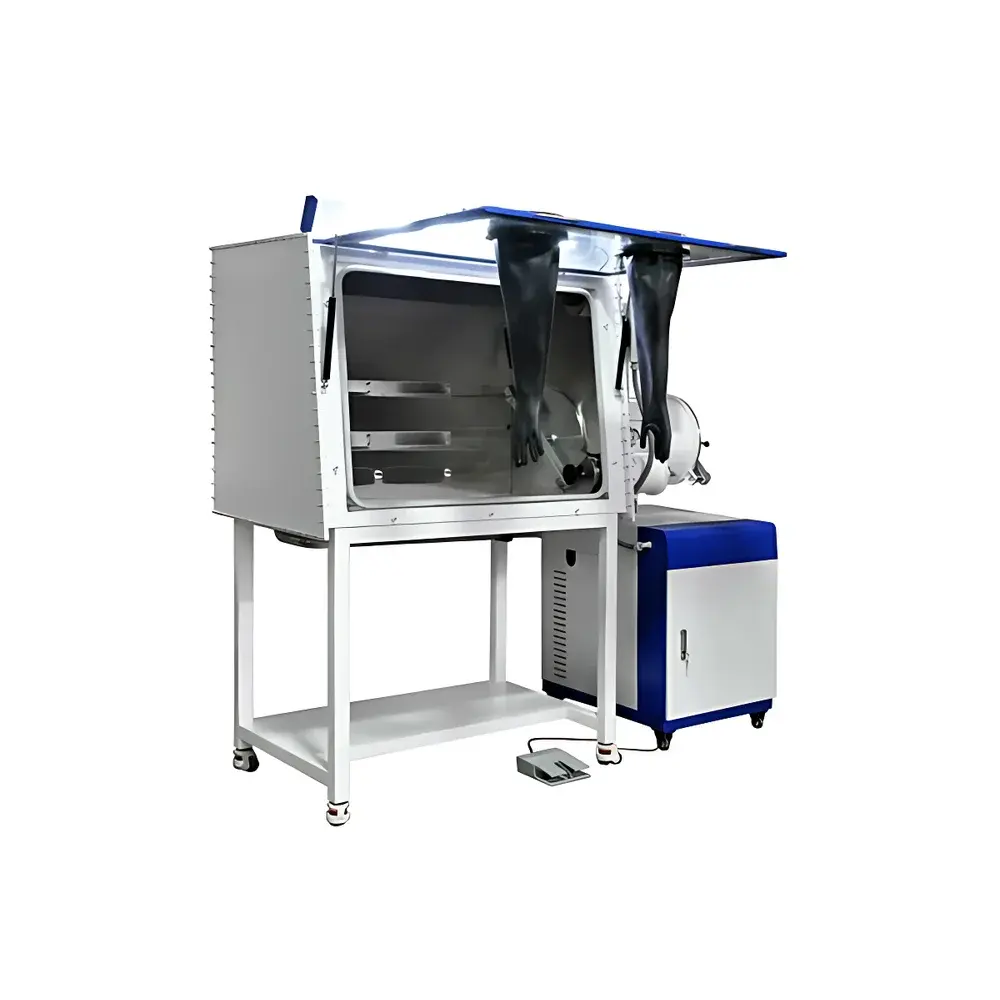
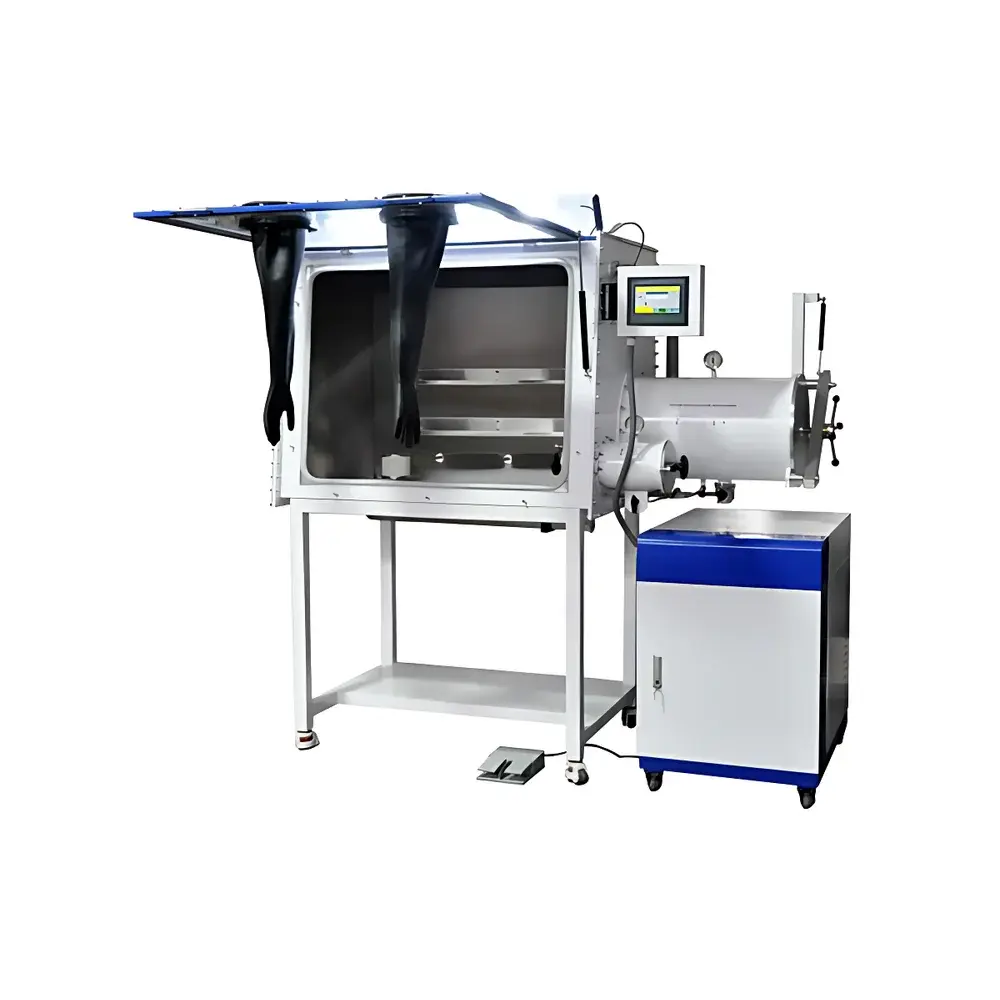
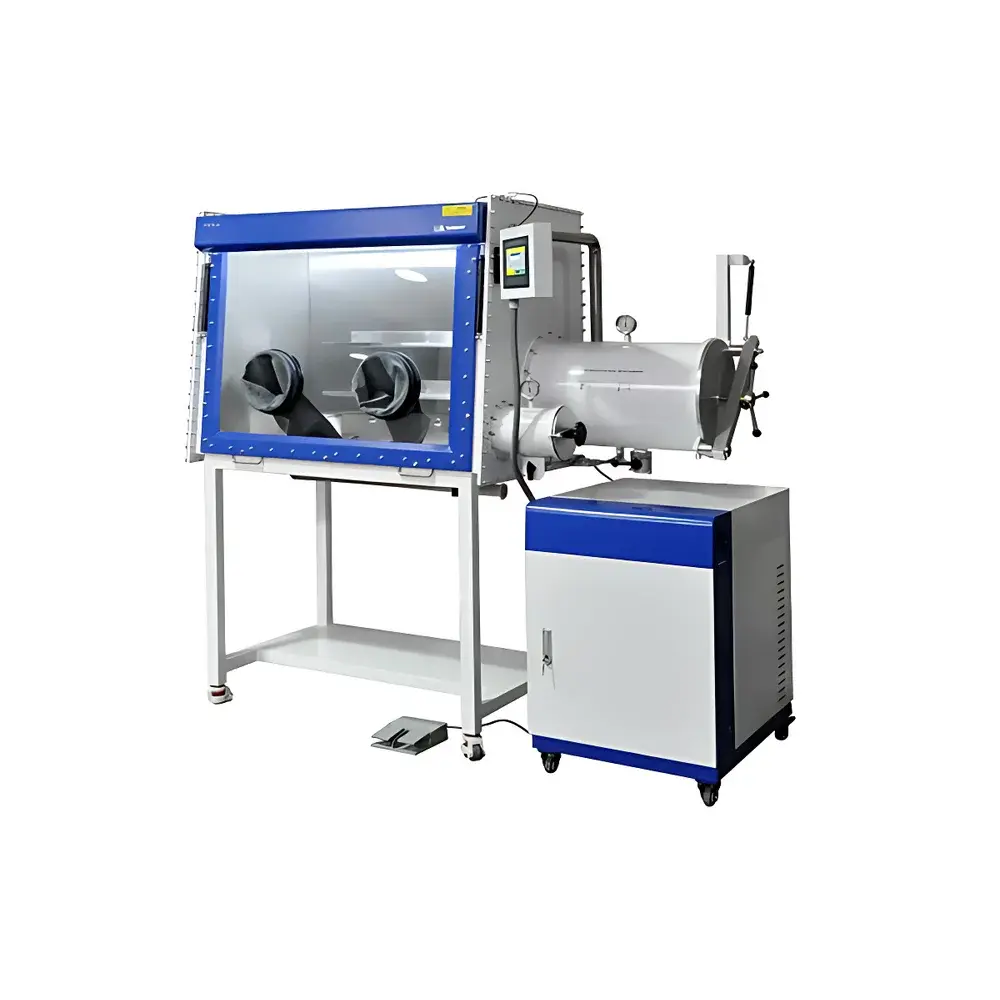
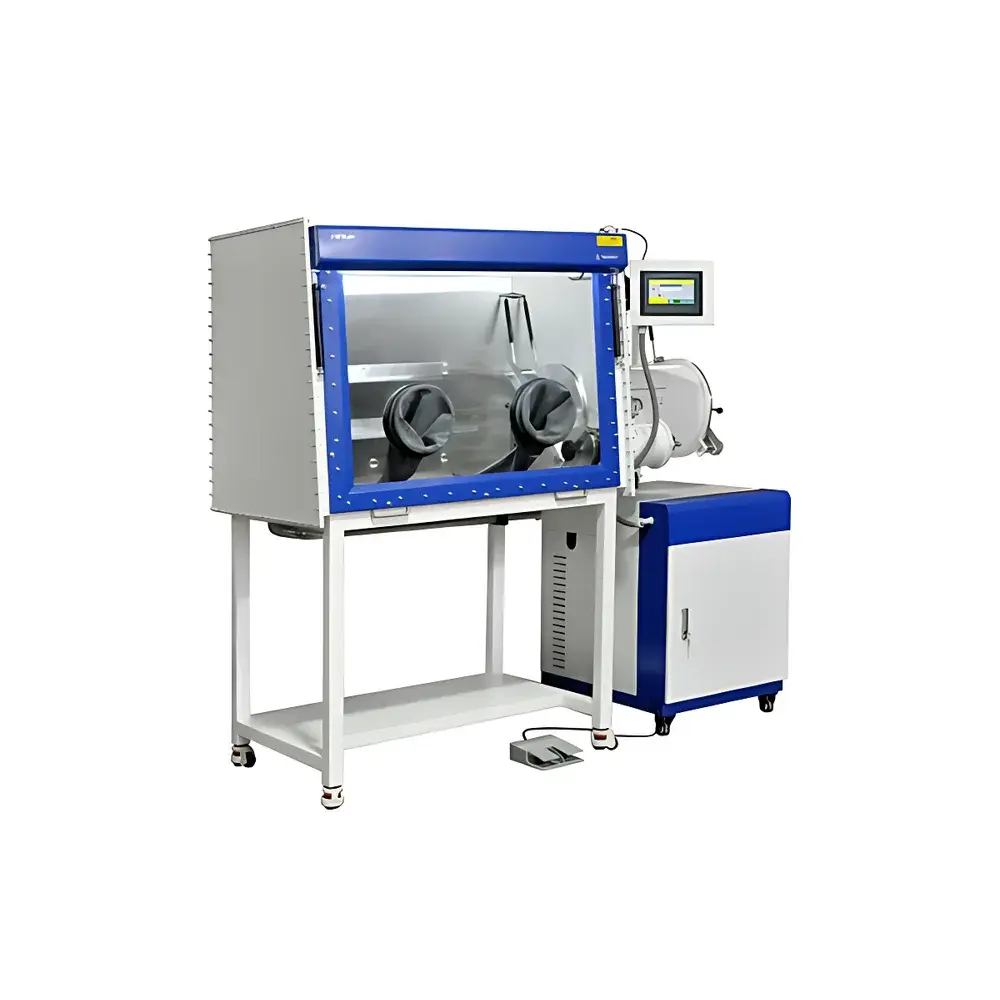
KJ GROUP VGB-6 Front-Access Water & Oxygen Removal Recirculating Glovebox
| Brand | KJ GROUP |
|---|---|
| Origin | Liaoning, China |
| Manufacturer Type | Authorized Distributor |
| Origin Category | Domestic |
| Model | VGB-6 |
| Pricing | Upon Request |
| Power Supply | AC 110–220 V, 50/60 Hz |
| Chamber Material | AISI 304 Stainless Steel |
| Internal Chamber Dimensions | 1220 × 760 × 900 mm (L×W×H) |
| Antechamber Configuration | Dual antechambers — large: Ø360 × 600 mm |
| small | 150 × 300 mm |
| Ambient Conditions | 20 °C, 1 atm |
| H₂O Level | <1 ppm (measured via GE 0–1000 ppm sensor, resolution 0.1 ppm) |
| O₂ Level | <1 ppm (measured via AII 0–1000 ppm sensor, resolution 0.1 ppm) |
| Working Gases | N₂, Ar, He |
| Purge/Control Gas | Compressed air or inert gas |
| Reduction Gas | Inert gas + H₂ mixture (H₂ concentration configurable) |
| Purification Media | BASF oxygen scavenger (Germany), UOP molecular sieve desiccant (USA) |
| Regeneration | Fully automated PLC-controlled cycle |
| Pressure Control | Siemens PLC + 6″ color touchscreen interface |
| Filtration | 0.3 µm particulate filters on both inlet and exhaust lines |
| Vacuum Pump | Edwards dual-stage rotary vane pump (8.4–12 m³/h) |
| Gloves | North Butyl rubber (USA), mounted on stainless steel flanges |
| Lighting | Philips fluorescent tubes |
| Overall Footprint | 2300 × 1500 × 1900 mm (L×W×H) |
Overview
The KJ GROUP VGB-6 Front-Access Water & Oxygen Removal Recirculating Glovebox is an engineered containment system designed for rigorous inert-atmosphere experimentation in materials science, electrochemistry, semiconductor processing, and advanced battery R&D. It operates on a closed-loop recirculation principle, continuously purging the internal chamber with high-purity inert gas while actively removing residual moisture and oxygen via catalytic deoxygenation and adsorptive dehydration. The system integrates dual-stage purification media—BASF’s palladium-based oxygen getter and UOP’s ultra-low-dew-point molecular sieves—to achieve and sustain sub-1 ppm (v/v) H₂O and O₂ concentrations under standard ambient conditions (20 °C, 1 atm). Its front-access hinged viewport enables seamless integration of external instrumentation—including coin-cell crimpers, glovebox-compatible XRD stages, and in-situ spectroelectrochemical cells—without compromising atmospheric integrity.
Key Features
- Front-hinged transparent acrylic viewport with reinforced stainless-steel frame for unobstructed instrument loading and real-time visual monitoring
- Dual antechamber configuration: large (Ø360 × 600 mm) and small (150 × 300 mm) chambers support sequential sample transfer while minimizing inert gas consumption
- Automated regeneration logic embedded in Siemens S7-1200 PLC firmware—executes timed heating, gas flow reversal, and purge cycles without operator intervention
- High-fidelity metrology suite: GE water vapor transmitter (0–1000 ppm, ±0.1 ppm resolution), AII electrochemical oxygen sensor (0–1000 ppm, ±0.1 ppm), Setra differential pressure transducer (±2500 Pa, ±1 Pa repeatability)
- Redundant safety architecture: real-time alarm triggers for pressure deviation (>±50 Pa), sensor drift (>10% calibration shift), filter clogging (ΔP > 150 Pa), and glove integrity loss
- Compliance-ready data logging: timestamped parameter records (H₂O, O₂, pressure, temperature, valve status) stored locally on industrial-grade SD card; exportable as CSV for GLP/GMP audit trails
Sample Compatibility & Compliance
The VGB-6 accommodates air-sensitive samples including lithium metal anodes, sodium-ion cathode precursors, perovskite thin films, organometallic catalysts, and pyrophoric nanomaterials. Its chamber construction (AISI 304 stainless steel, electropolished interior) resists corrosion from LiPF₆-based electrolytes when properly sealed and maintained. The system complies with ISO 14644-1 Class 5 cleanroom particulate requirements (via 0.3 µm filtration) and supports adherence to ASTM D6866 (carbon dating of organic contaminants) and USP <1118> (water activity control in pharmaceutical intermediates). While not certified to IEC 61000-6-4 EMC standards out-of-box, its PLC and sensor interfaces are compatible with third-party validation protocols required for FDA 21 CFR Part 11-compliant environments.
Software & Data Management
The 6-inch Siemens SIMATIC HMI touchscreen provides bilingual (English/Chinese) navigation, real-time trend graphs for all critical parameters, and password-protected access levels (Operator, Technician, Administrator). All system events—including valve actuations, sensor calibrations, and regeneration logs—are time-stamped and archived with SHA-256 checksum integrity verification. Data export supports USB mass storage and optional RS-485 Modbus TCP gateway for integration into centralized LIMS or MES platforms. Audit trail functionality meets ALCOA+ principles: attributable, legible, contemporaneous, original, accurate, complete, consistent, enduring, and available.
Applications
- Electrode fabrication for Li-, Na-, and solid-state batteries under controlled dew point conditions
- Handling of alkali-metal precursors (e.g., n-BuLi, LiAlH₄) and Grignard reagents requiring O₂/H₂O levels below detection limits
- In-situ characterization workflows: coupling with glovebox-integrated Raman spectrometers, SEM-EDS systems, or thermal gravimetric analyzers
- Thin-film deposition of metal halide perovskites where trace O₂ induces non-radiative recombination
- Encapsulation and packaging of OLED test substrates prior to hermetic sealing
- Long-term stability testing of catalysts under simulated operating atmospheres (e.g., N₂/H₂ mixtures at 5% H₂)
FAQ
What inert gases are compatible with the VGB-6 purification system?
N₂, Ar, and He are fully supported. Deoxygenation efficiency varies by carrier gas: N₂ yields fastest O₂ removal kinetics due to favorable diffusion and surface interaction with BASF catalyst; Ar requires longer stabilization time but offers superior thermal stability for high-temperature processes.
Can the glovebox be integrated with external vacuum or gas supply infrastructure?
Yes—the system includes standardized VCR fittings for inlet/outlet gas manifolds and a dedicated vacuum port compatible with Edwards pump interlocks. Optional analog/digital I/O modules enable hardwired handshake with central plant SCADA systems.
How frequently must the purification media be regenerated?
Regeneration intervals depend on usage intensity and initial contamination load. Under typical lab operation (8 hrs/day, 5 days/week, minimal sample transfers), full regeneration is required every 6–12 months. The PLC monitors breakthrough indicators (rising O₂/H₂O slope, reduced pressure recovery rate) and alerts users proactively.
Is remote monitoring supported?
Standard configuration includes local HMI only. Remote access requires optional Ethernet-enabled PLC firmware upgrade and secure VPN tunneling—implemented per ISO/IEC 27001-aligned network segmentation policies.
What maintenance documentation is provided?
Each unit ships with a validated IQ/OQ protocol template, preventive maintenance checklist (quarterly glove inspection, biannual filter replacement, annual sensor calibration), and material certificates for all wetted parts (304 SS, butyl gloves, BASF/UOP media).



