
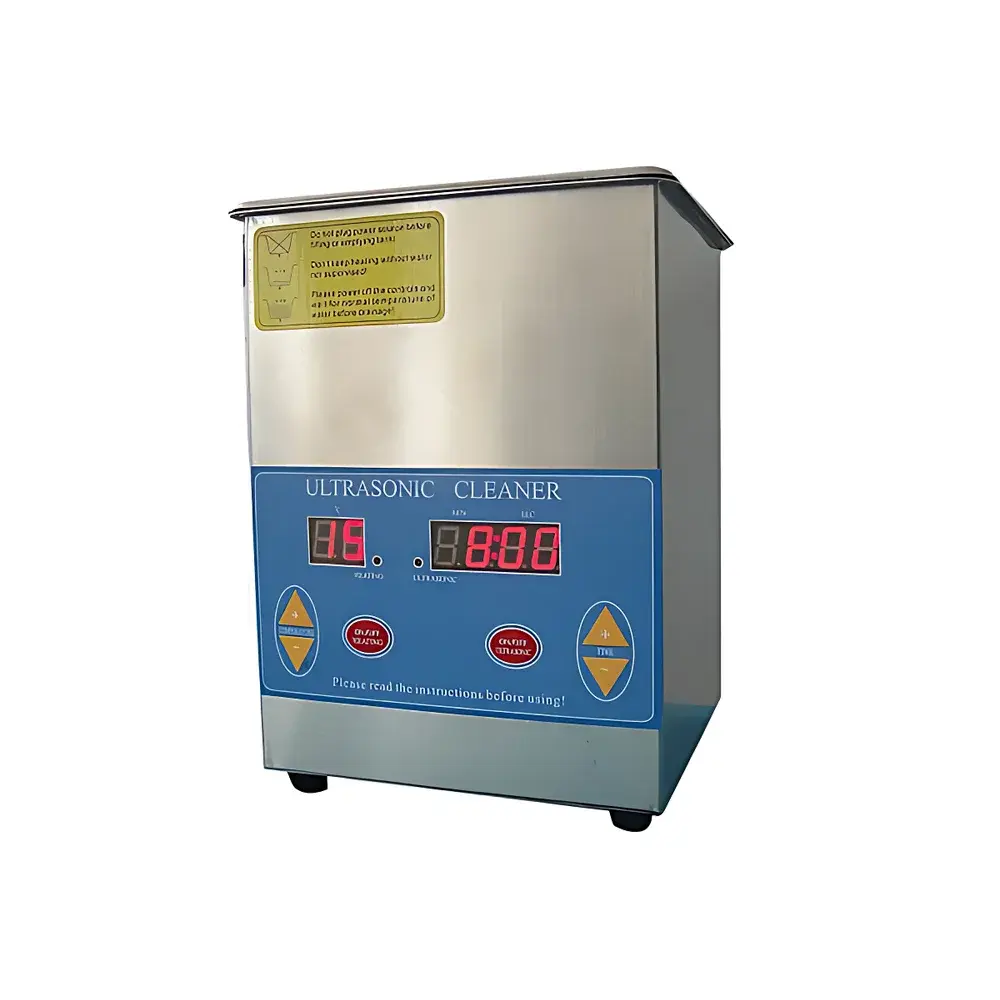
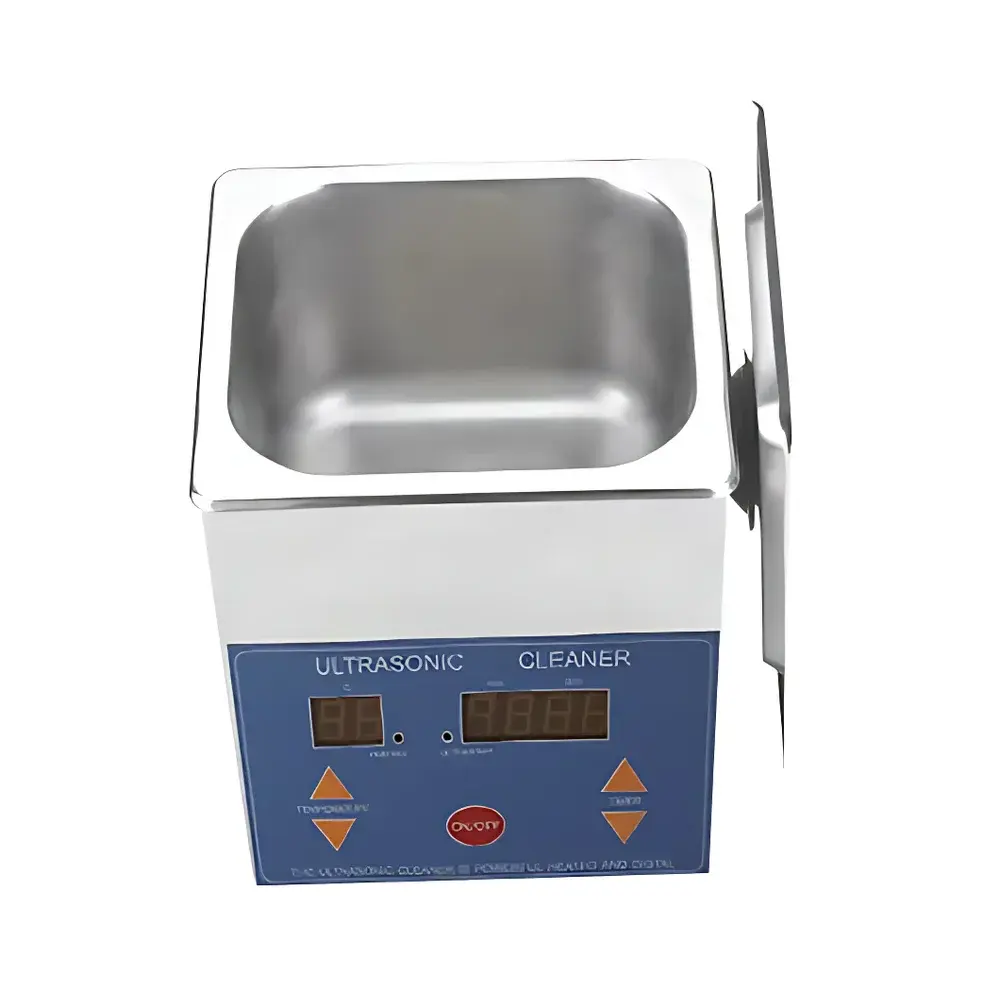
KJ GROUP VGT-1620TD Benchtop Ultrasonic Cleaner
| Brand | KJ GROUP |
|---|---|
| Origin | Liaoning, China |
| Manufacturer Type | Authorized Distributor |
| Origin Classification | Domestic (China) |
| Model | VGT-1620TD |
| Instrument Type | General-Purpose Ultrasonic Cleaner |
| Tank Capacity | 2000 mL |
| Ultrasonic Frequency | 40 kHz or 25 kHz (selectable) |
| Ultrasonic Power Output | 60 W |
| Power Adjustment | Not Available |
| Temperature Control | Not Available |
| Timer Adjustment | Yes (digital preset, auto-shutoff) |
| Sound-Dampening Lid | Included |
| Drain/Refill Method | Manual (hand-controlled valve) |
| Input Voltage | 220 V AC, 50 Hz |
| Internal Tank Dimensions | 150 mm × 140 mm × 100 mm |
| Overall Dimensions | 190 mm × 170 mm × 220 mm |
| Net Weight | < 1 kg |
Overview
The KJ GROUP VGT-1620TD is a compact, benchtop ultrasonic cleaner engineered for precision cleaning of delicate and complex-surface components in laboratory, academic, and light industrial environments. It operates on the principle of acoustic cavitation: high-frequency sound waves (25 kHz or 40 kHz) generate microscopic vacuum bubbles in the cleaning solution; upon collapse, these bubbles release localized energy sufficient to dislodge particulate contaminants, organic residues, and thin films without mechanical abrasion or surface damage. This non-contact, isotropic cleaning mechanism ensures consistent removal from blind holes, crevices, threads, and microstructures—areas inaccessible to brushes, swabs, or solvent rinsing alone. Designed for routine use in QC labs, electronics assembly support, optical component maintenance, and teaching laboratories, the VGT-1620TD delivers reproducible cleaning performance with minimal operator intervention.
Key Features
- Benchtop footprint (190 × 170 × 220 mm) optimized for space-constrained lab benches and cleanroom carts.
- Seamless, one-piece stainless steel tank (304 grade) formed via deep-drawn stamping—eliminates weld seams that could harbor residue or compromise corrosion resistance.
- Integrated stainless steel mesh basket with argon-welded frame for uniform suspension and enhanced acoustic coupling during immersion.
- Digital timer with adjustable range (1–30 minutes); automatic power cutoff upon completion ensures process repeatability and prevents overexposure.
- Sound-dampening hinged lid reduces ambient noise by ≥15 dB(A) and minimizes solvent evaporation during operation.
- High-efficiency piezoelectric transducer array delivering stable 60 W nominal acoustic output at either 25 kHz (higher cavitation intensity, suited for heavy particulates) or 40 kHz (finer bubble distribution, ideal for fragile substrates).
- Front-panel controls with LED indicators for timer status and power activation—no software or PC interface required.
Sample Compatibility & Compliance
The VGT-1620TD accommodates a broad range of sample types including optical lenses, watch movements, semiconductor wafers (pre-bonding), surgical instruments (non-critical reprocessing), printed circuit boards (PCBs), jewelry, dental prostheses, and botanical specimens. Its 2000 mL tank volume supports immersion of multiple small parts simultaneously while maintaining adequate solution depth for effective cavitation field development. The unit complies with IEC 61000-6-3 (EMC emission limits) and IEC 61000-6-2 (immunity to electrostatic discharge and RF fields). While not certified for sterile reprocessing per ISO 17664 or AAMI ST79, it meets general laboratory equipment safety requirements under GB 4793.1–2007 (equivalent to IEC 61010-1). For GLP/GMP-aligned workflows, users may document timer settings, solution composition, and batch records manually or integrate with external audit-trail systems.
Software & Data Management
The VGT-1620TD is a standalone hardware device with no embedded firmware, network connectivity, or data logging capability. All operational parameters—including frequency selection, timer duration, and power activation—are set via physical push-button controls. No software installation, driver dependencies, or calibration certificates are required. This architecture ensures long-term reliability, immunity to cybersecurity vulnerabilities, and full compatibility with air-gapped laboratory networks. For regulated environments requiring traceability, operators may pair the unit with external time-stamped video recording or manual logbooks referencing SOPs (e.g., SOP-CLEAN-02) and batch identifiers.
Applications
- Removal of polishing compounds, flux residues, and oxide layers from precision metal and ceramic components prior to metrology or coating.
- Decontamination of reusable glassware (vials, cuvettes, capillaries) and quartz substrates before spectroscopic analysis.
- Preparation of MEMS devices and microfluidic chips for bonding or packaging by eliminating hydrophobic contaminants.
- Supporting ASTM D2621 (cleanliness of automotive fuel system components) and ISO 8502-3 (surface cleanliness assessment) via standardized rinse-and-weigh protocols.
- Extraction assistance in analytical chemistry workflows—for example, accelerating leaching of analytes from plant matrices into aqueous or ethanol-based solvents.
- Deaeration of degassed water or low-viscosity solvents prior to HPLC mobile phase preparation.
FAQ
Is the VGT-1620TD suitable for cleaning medical devices intended for human use?
No—it is not validated or certified for sterilization, high-level disinfection, or reprocessing of critical or semi-critical medical devices per FDA 21 CFR Part 820 or EN ISO 13485. It may be used for preliminary cleaning of non-invasive tools in research settings only.
Can I use flammable solvents such as acetone or ethanol in this unit?
No. The VGT-1620TD lacks explosion-proof construction, intrinsically safe electronics, or vapor monitoring. Only aqueous or mild detergent-based solutions with flash points > 60 °C are permitted.
Does the unit include heating functionality?
No. The VGT-1620TD does not incorporate a heater or temperature sensor. External warm-water baths (≤ 50 °C) may be used cautiously, but elevated temperatures reduce cavitation efficiency and accelerate transducer aging.
What maintenance is required to ensure long-term performance?
Rinse the tank with deionized water after each use; inspect the transducer mounting surface quarterly for delamination; replace the cleaning solution daily or per contamination load; avoid ultrasonic operation when the tank is empty or below minimum fill level (1500 mL).



