
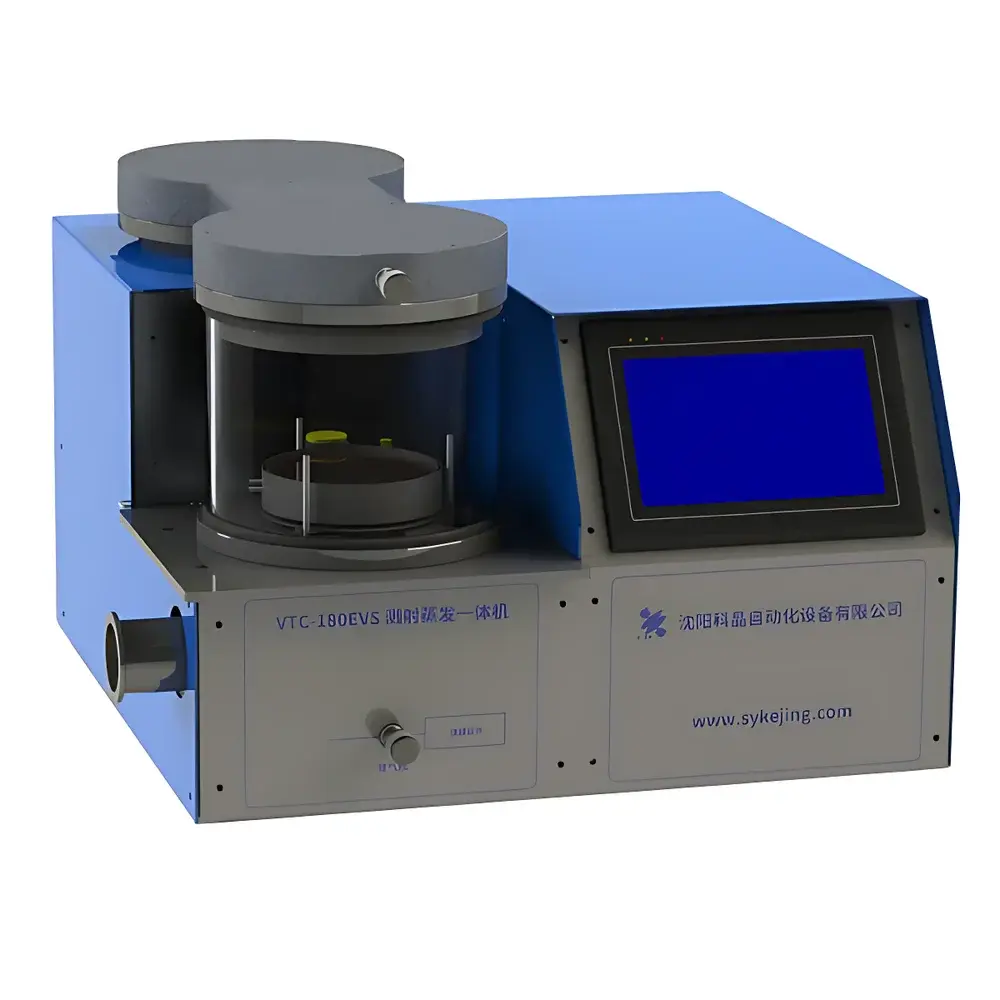
KJ GROUP VTC-180EVS Integrated Sputtering and Thermal Evaporation Coater
| Brand | KJ GROUP |
|---|---|
| Origin | Liaoning, China |
| Manufacturer Type | Authorized Distributor |
| Region Classification | Domestic (China) |
| Model | VTC-180EVS |
| Pricing | Upon Request |
| Sputtering Target Configuration | 3×2-inch magnetron targets (with shutters) or 1×3-inch magnetron target |
| Evaporation Power Supply | 1000 W / 5 V / 200 A |
| Evaporation Electrode Spacing | 55 mm |
| Substrate Holder Diameter | 150 mm (optional rotation, shutter, and bias functionality) |
| Input Voltage | AC 220 V / 2000 W |
| DC Sputtering Power Supply | 500 W / 600 V |
| Thickness Measurement Accuracy | ±0.1 nm (standard) or ±0.01 nm (high-precision quartz crystal monitor, optional) |
| Mass Flow Control | Dual-channel MFCs (50 SCCM and 100 SCCM, optional) |
| Gas Inlet Pressure | < 0.15 kPa |
| Vacuum Interface | KF40 |
| Base Pressure | ≤ 2.0 × 10⁻³ Pa (standard) |
| Operating Pressure Range (Sputtering) | 0.5–3 Pa |
| Cooling Water Pressure | 0.2–0.4 MPa |
| Ambient Temperature Limit | < 35 °C |
| Relative Humidity Limit | < 75 % RH (non-condensing) |
| Altitude Limit | < 1500 m |
| Footprint (W×H×D, ex. pump) | 480 × 320 × 460 mm |
| Net Weight (ex. pump) | ~47 kg |
Overview
The KJ GROUP VTC-180EVS Integrated Sputtering and Thermal Evaporation Coater is a compact, benchtop-scale vacuum thin-film deposition system engineered for research-grade process development, prototype fabrication, and hands-on training in academic, governmental, and industrial laboratories. It combines two fundamental physical vapor deposition (PVD) techniques—DC magnetron sputtering and resistive thermal evaporation—within a single, modular vacuum chamber architecture. This dual-mode capability enables users to deposit a broad spectrum of materials including metals (e.g., Al, Cr, Ti, Au), oxides (e.g., ITO, SiO₂, TiO₂), nitrides (e.g., TiN), and organic small molecules, without requiring chamber venting or hardware reconfiguration. The system operates under medium vacuum conditions (0.5–3 Pa during sputtering; 10⁻³–10⁻⁴ Pa base pressure), leveraging standard KF40 vacuum flanges and compatibility with common roughing + high-vacuum pumping configurations—including diffusion pumps, turbomolecular pumps, or hybrid systems.
Key Features
- Dual-Mode PVD Architecture: Seamless, tool-free switching between DC magnetron sputtering and resistive thermal evaporation via an integrated source carriage mechanism—eliminating downtime associated with manual source replacement or chamber opening.
- Modular Magnetron Configuration: Supports either three 2-inch magnetron cathodes (each equipped with individual mechanical shutters and semi-automatic target selection) or one 3-inch magnetron cathode—enabling co-sputtering, sequential layering, or multi-material deposition strategies.
- High-Stability Evaporation System: Dual independent evaporation electrodes (55 mm spacing) accommodate crucibles, boats, or filaments; powered by a digitally regulated 1000 W / 200 A DC supply with 0.1% current stability and programmable ramp/hold profiles.
- Advanced Sputtering Power Management: Proprietary 500 W / 600 V switch-mode DC power supply featuring real-time arc suppression, selectable constant-current or constant-power operation modes, and built-in overvoltage/overcurrent protection.
- Intuitive Human-Machine Interface: 7-inch capacitive TFT touchscreen with fully graphical, icon-driven control software—supporting recipe storage, parameter logging, and real-time monitoring of voltage, current, pressure, and thickness.
- Standardized Modular Design: All functional units—including vacuum chamber, power supplies, gas delivery, and substrate stage—are implemented as ISO-standardized modules, facilitating field service, component-level replacement, and future upgrades (e.g., RF matching networks, substrate heating).
Sample Compatibility & Compliance
The VTC-180EVS accommodates substrates up to Ø150 mm on a manually adjustable or optionally motorized rotating stage. Optional features include a mechanical shutter for sharp film edge definition, substrate biasing (±200 V DC) for ion-assisted growth, and thermocouple-based temperature monitoring. The system meets general laboratory safety standards per IEC 61000-6-3 (EMC emission) and IEC 61000-6-2 (immunity), and its vacuum interface design conforms to ISO-KF dimensional specifications (DIN 28403). While not certified for GMP production environments, the system supports GLP-aligned documentation practices through optional USB data export (process logs, thickness curves, power traces) and is compatible with third-party audit-ready software extensions for 21 CFR Part 11 compliance when deployed with validated firmware and access controls.
Software & Data Management
Embedded firmware provides local control of all deposition parameters—including sputtering power setpoints, evaporation current ramps, gas flow rates (via optional dual MFCs), and shutter timing sequences. Real-time thickness and deposition rate are calculated from user-selected quartz crystal microbalance (QCM) sensors (e.g., Inficon XTM/2 or equivalent), with resolution down to 0.01 nm in high-precision mode. All operational data—including timestamps, sensor readings, and alarm events—are timestamped and exportable to FAT32-formatted USB drives in CSV format. No cloud connectivity or remote access is implemented by default, ensuring data sovereignty and alignment with institutional IT security policies. Firmware updates are performed offline via USB, with version history and checksum verification included.
Applications
- Development of transparent conductive oxide (TCO) films for optoelectronic device prototyping (e.g., OLED test pixels, perovskite solar cell electrodes)
- Deposition of adhesion layers (Cr, Ti) and reflective stacks (Al, Ag) in MEMS packaging and optical coating R&D
- Preparation of calibration standards for surface analysis tools (XPS, AES, SIMS) requiring atomically controlled multilayer structures
- Thin-film sensor fabrication—including resistive gas sensors (WO₃, SnO₂), piezoresistive strain gauges (NiCr), and thermoelectric materials (Bi₂Te₃)
- Undergraduate and graduate teaching labs: demonstration of PVD fundamentals, plasma–surface interactions, stoichiometry control, and vacuum metrology
FAQ
Is the VTC-180EVS suitable for reactive sputtering (e.g., using O₂ or N₂)?
Yes—dual mass flow controllers (50 SCCM and 100 SCCM) support precise reactive gas dosing; chamber design includes dedicated gas inlets and pressure stabilization ports optimized for compound film synthesis.
Can the system be upgraded to include RF sputtering capability?
Yes—RF matching network modules (13.56 MHz) are available as factory-installed options and integrate mechanically and electrically with the existing magnetron feedthroughs.
What vacuum pumping configurations are supported?
The system is designed for KF40-compatible pumping trains: standard configuration uses a 2 L/s rotary vane pump; optional high-vacuum performance requires addition of a turbomolecular pump (≥ 100 L/s) or oil diffusion pump with cold trap.
Does the quartz crystal thickness monitor support multiple sensor crystals simultaneously?
No—the system interfaces with a single QCM sensor head; however, the controller supports hot-swap calibration and user-defined density/sensitivity factors for different materials.
Is remote operation or network integration possible?
Not natively—the control system is isolated and USB-local only; Ethernet or RS-485 interfaces are not provided, preserving electromagnetic compatibility and simplifying regulatory validation pathways.



