
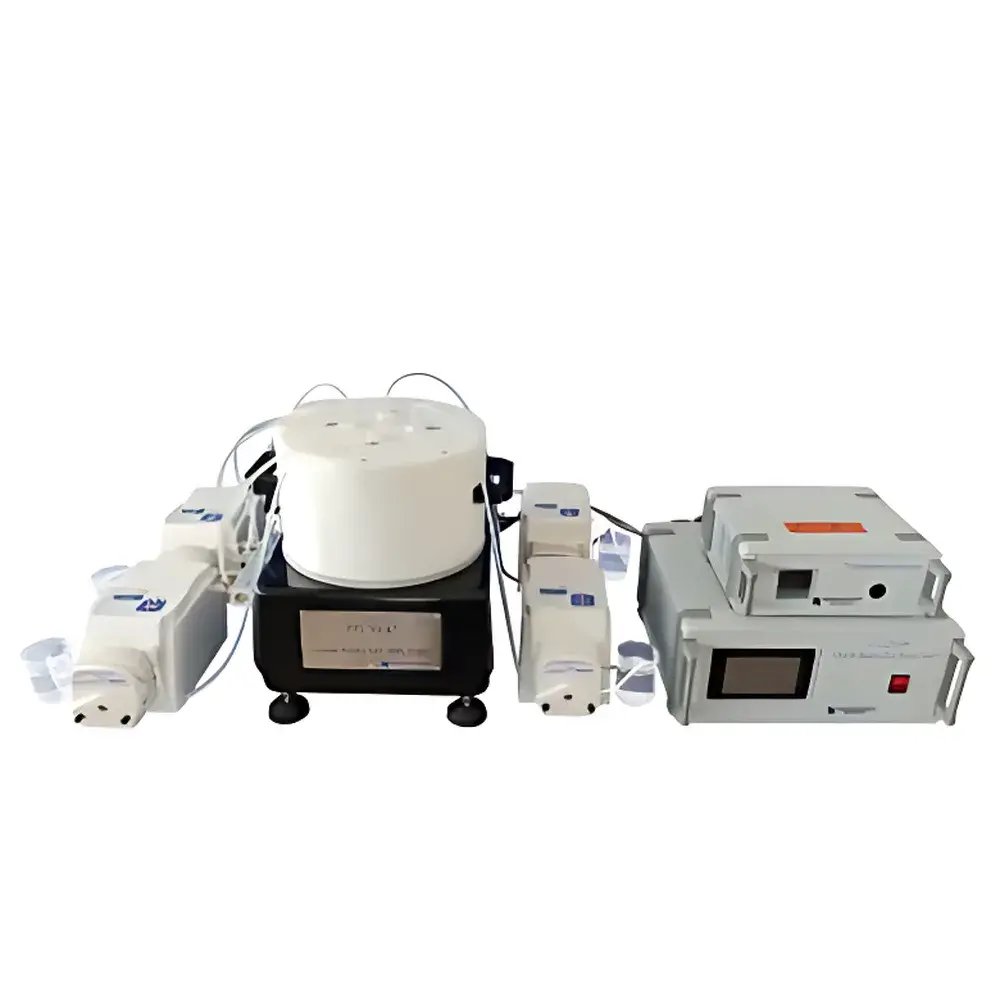
KJ GROUP VTC-200-4P Infrared-Heated Spray Spin Coater
| Brand | KJ GROUP |
|---|---|
| Origin | Liaoning, China |
| Manufacturer Type | Authorized Distributor |
| Country of Origin | China |
| Model | VTC-200-4P |
| Pricing | Upon Request |
| Motor Power | 200 W (AC 220 V, 50 Hz) |
| Heating Power | 1200 W (Carbon Fiber IR Heater) |
| Speed Range | 100–2000 RPM (±1% stability) |
| Dual-Stage Program | Time1/Speed1 & Time2/Speed2 (1–200 s / 100–2000 RPM each) |
| Heating Range | RT to 100 °C |
| Chamber Material | Polypropylene (PP) |
| Mainframe Structure | Cast Aluminum |
| Dimensions (L×W×H) | 500 × 410 × 330 mm |
| Weight | 24 kg |
| Operating Environment | 5–40 °C, ≤85% RH, altitude <1000 m |
| Required Power Supply | AC 220 V, 50 Hz, grounded |
| Water Interface | Inlet/Outlet ports provided |
| Ventilation | Required |
| Workbench Spec | ≥600 × 600 × 700 mm, ≥50 kg load capacity |
Overview
The KJ GROUP VTC-200-4P Infrared-Heated Spray Spin Coater is a precision-engineered thin-film deposition system designed for semiconductor fabrication, photomask manufacturing, microelectronics R&D, and advanced materials processing. It integrates three core unit operations—spray dispensing, rotational spin coating, and post-deposition infrared thermal treatment—into a single, synchronized platform. Unlike conventional spin coaters that rely solely on centrifugal force for film uniformity, the VTC-200-4P employs a controlled雾化 (atomized spray) delivery mechanism combined with programmable dual-stage rotation and top-mounted IR heating to achieve superior solvent evaporation control and interfacial homogeneity. The system operates on the principle of dynamic fluid shear under controlled angular acceleration, where viscous precursor solutions are atomized via four independently adjustable nozzles onto a rotating substrate, enabling rapid lateral spreading before solvent removal initiates. This sequence minimizes Marangoni instabilities and edge bead formation—critical for sub-micron film reproducibility in lithographic and functional coating applications.
Key Features
- Dual-stage programmable spin protocol: Independent configuration of Speed1/Time1 (dispersion phase) and Speed2/Time2 (uniformity refinement phase), both adjustable from 100–2000 RPM and 1–200 seconds respectively, with ±1% speed stability ensured by servo motor and PLC-based closed-loop control.
- Infrared heating module integrated into the upper chamber lid: Carbon fiber heating elements provide rapid, uniform thermal input (RT to 100 °C), minimizing thermal gradients across substrates and enabling in-situ solvent volatilization without requiring post-process bake steps.
- Four-nozzle spray manifold: Precision-engineered stainless-steel nozzles deliver consistent atomized mist distribution over substrates up to Ø160 mm, reducing solution waste and enhancing surface coverage compared to static pipette or syringe-based dispensing.
- Modular substrate fixation system: Combines vacuum-assisted rubber suction cups (Ø153 mm standard) with ferromagnetic steel templates (Ø160 mm standard, customizable), ensuring secure hold-down during high-RPM operation while enabling rapid wafer exchange.
- Chemically resistant polypropylene (PP) process chamber: Offers exceptional resistance to organic solvents (e.g., acetone, PGMEA, IPA), acids, and bases—validated per ASTM D543—and eliminates stress cracking risks common in acrylic or polycarbonate enclosures.
- Vibration-damped cast aluminum chassis: Structural rigidity combined with elastomeric isolation mounts reduces operational noise to <62 dB(A) at 1 m distance and maintains mechanical alignment stability over extended duty cycles.
Sample Compatibility & Compliance
The VTC-200-4P accommodates rigid planar substrates including silicon wafers (up to 6″/150 mm), glass slides, quartz masks, ceramic carriers, and metal foils. Substrate thickness range: 0.1–5 mm. Customizable magnetic templates and suction cup configurations support non-standard geometries and multi-piece fixtures. All electrical subsystems comply with IEC 61000-6-3 (EMC emission limits) and IEC 61000-6-2 (immunity requirements). Temperature control accuracy meets ISO/IEC 17025 traceability guidelines when calibrated using NIST-traceable PT100 sensors. The system supports GLP/GMP documentation workflows through optional audit trail logging (via external PC interface), and its discrete power domains (motor, heater, pump) facilitate independent validation per FDA 21 CFR Part 11 Annex 11 principles.
Software & Data Management
While the VTC-200-4P operates via an embedded front-panel HMI with real-time RPM, temperature, and timer display, it features RS-485 and USB-B interfaces for integration with laboratory automation systems. Optional KJ LabControl™ software (Windows-compatible) enables remote parameter upload/download, recipe versioning, event logging (start/stop timestamps, fault codes), and export of CSV-formatted run reports—including speed ramp profiles, thermal soak durations, and pump actuation cycles. All digital records include operator ID fields and configurable electronic signatures compliant with ALCOA+ data integrity criteria. Firmware updates are delivered via signed .bin files with SHA-256 checksum verification.
Applications
- Photolithography: Uniform photoresist coating (e.g., AZ® series, SU-8) on Si, GaAs, and compound semiconductor wafers prior to mask alignment.
- Perovskite solar cell fabrication: Controlled deposition of precursor inks (e.g., PbI₂/MAI in DMF/DMSO) with minimized coffee-ring effects.
- MEMS packaging: Conformal polymer passivation layers (e.g., BCB, polyimide) on released structures.
- Lab-on-chip development: Hydrophobic/hydrophilic surface patterning using fluorinated silanes or PEG-based coatings.
- Quantum dot thin films: Colloidal QD dispersion (e.g., CdSe/ZnS in octane) with tunable thickness via spin speed modulation.
- Microfluidic channel priming: Rapid, low-waste hydrogel (e.g., PVA, gelatin methacryloyl) coating for anti-fouling surface functionalization.
FAQ
What substrate sizes does the VTC-200-4P support?
Standard configuration accommodates substrates up to Ø160 mm; custom magnetic templates and suction cups are available for Ø100 mm, Ø125 mm, and rectangular formats (max 150 × 150 mm).
Is the infrared heating system compatible with temperature-sensitive substrates?
Yes—the carbon fiber IR emitters deliver directional radiant heat with minimal convective transfer, allowing precise surface temperature control without bulk heating of thermally fragile carriers (e.g., PET, PI, or thin-glass substrates).
Can the spray nozzles be cleaned in situ?
Each nozzle connects to a dedicated peristaltic pump (4 total); solvent flush cycles can be programmed via manual override or automated sequences using compatible cleaning agents (e.g., IPA, acetone). Nozzle disassembly is tool-free.
Does the system meet cleanroom compatibility requirements?
The PP chamber and sealed cast-aluminum frame generate no particulates under ISO Class 5 conditions; optional HEPA-filtered exhaust ducting is available for integration into Class 100–1000 cleanroom ventilation networks.
How is process repeatability verified?
KJ GROUP provides a factory calibration certificate documenting speed linearity (NIST-traceable tachometer), thermal uniformity mapping (±1.5 °C across Ø150 mm zone), and spray pattern consistency (measured via high-speed imaging and gravimetric droplet analysis).



