
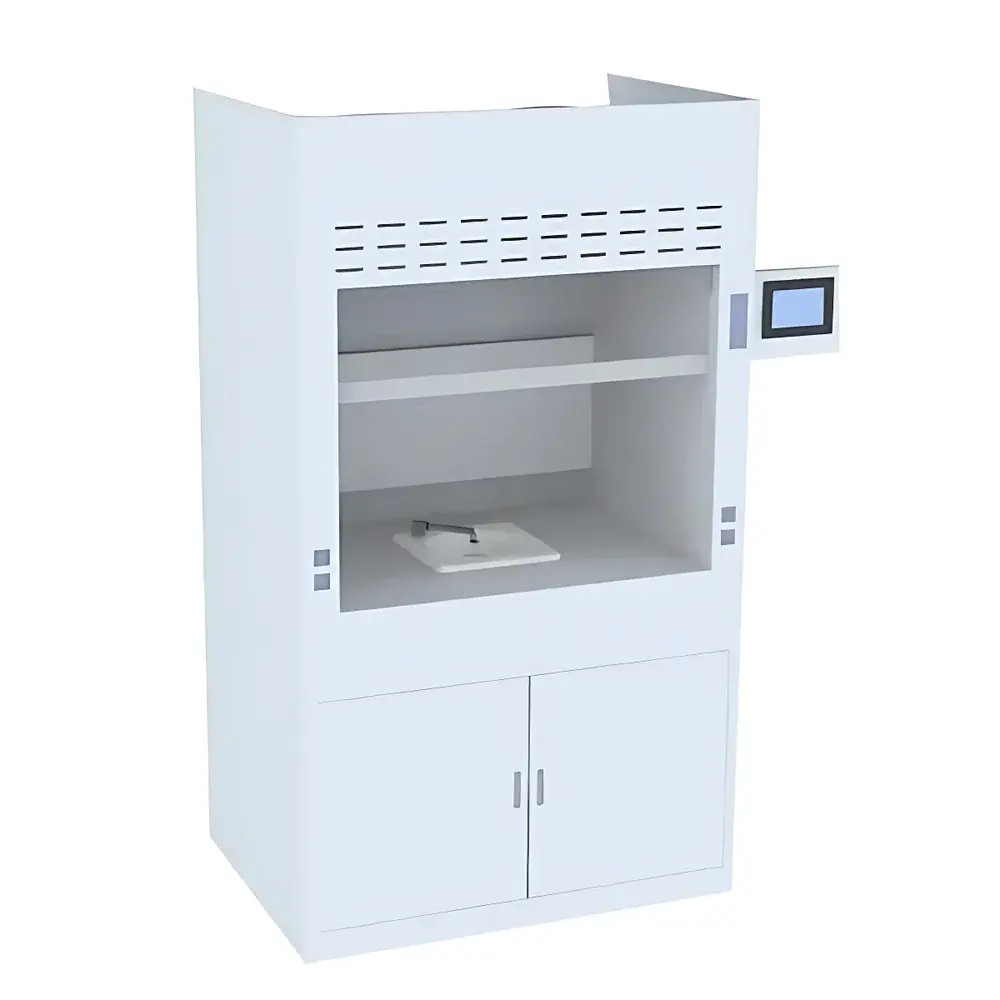
KJ GROUP VTC-200-CSC Cabinet-Style Spin Coater
| Brand | KJ GROUP |
|---|---|
| Origin | Liaoning, China |
| Manufacturer Type | Authorized Distributor |
| Country of Origin | China |
| Model | VTC-200-CSC |
| Quotation | Upon Request |
| Cabinet Material | Full PP (Polypropylene) Construction |
| Maximum Substrate Size | ≤8-inch wafers |
| Speed Range | 20–10,000 rpm |
| Acceleration/Deceleration Range | 0–50,000 rpm/s |
| Speed Accuracy | ±1 rpm (high-precision option available) |
| Auto-Dispense Channels | Up to 4 configurable |
| Program Storage | 100 recipes × 100 steps each |
| Dimensions (W×D×H) | 1200 × 800 × 2100 mm |
| Drain Configuration | Bottom-mounted liquid drainage |
| Exhaust System | Top-mounted independent PP exhaust duct |
| Optional Modules | Edge-bead removal, backside rinse, temperature-controlled recirculating chiller interface |
Overview
The KJ GROUP VTC-200-CSC Cabinet-Style Spin Coater is an industrial-grade, manually operated spin coating system engineered for high-reproducibility thin-film deposition on semiconductor wafers and planar substrates up to 200 mm (8-inch) diameter. Utilizing the principle of centrifugal force-driven fluid thinning, the system uniformly disperses photoresist, polymer solutions, sol-gel precursors, or functional nanomaterial dispersions across the substrate surface during controlled rotational acceleration and steady-state spinning. Its fully enclosed polypropylene (PP) cabinet architecture provides inherent chemical resistance to common organic solvents (e.g., acetone, PGMEA, IPA, chlorobenzene) and acidic/basic etchants, making it suitable for cleanroom-adjacent environments where corrosion mitigation and operator safety are critical. Unlike open-bench spin coaters, the VTC-200-CSC integrates mechanical stability, process containment, and modular expandability—meeting foundational requirements for pilot-line fabrication, R&D validation, and quality-controlled small-batch production in microelectronics, MEMS, and optoelectronic device development.
Key Features
- Full polypropylene (PP) monolithic cabinet construction with seamless welds and chemical-resistant gasketing—certified for long-term exposure to Class A/B solvents per ASTM D543.
- High-torque industrial servo motor with closed-loop feedback control, enabling precise speed regulation from 20 to 10,000 rpm and programmable acceleration/deceleration profiles up to 50,000 rpm/s.
- Integrated human-machine interface (HMI) with touch-enabled 7-inch TFT display, supporting real-time parameter monitoring, recipe navigation, and error logging with timestamped event history.
- Four-channel programmable auto-dispense system with syringe-pump-driven precision metering (±0.5% volumetric repeatability), compatible with standard Luer-lock dispensing needles and solvent-resistant tubing.
- Modular expansion capability: factory-configurable interfaces for edge-bead removal (EBR), backside rinse (BSR), and external chiller loop integration (±0.5 °C temperature stability with optional recirculating coolant system).
- Engineered ergonomics: front-access loading bay with adjustable wafer chuck height, bottom-mounted gravity-fed waste collection sump, and top-mounted dedicated PP exhaust duct with passive venting or active connection to facility scrubber systems.
Sample Compatibility & Compliance
The VTC-200-CSC accommodates rigid planar substrates including silicon, glass, quartz, sapphire, and metal-coated wafers (≤200 mm), as well as ceramic and polymer films mounted on carriers. Chuck compatibility supports both vacuum-suction and mechanical clamping configurations. The system complies with IEC 61000-6-2 (EMC immunity) and IEC 61000-6-4 (EMC emissions) standards. Its PP enclosure meets UL 94 HB flammability rating and conforms to ISO 14644-1 Class 8 (ISO Class 100,000) cleanroom-compatible material specifications. While not certified for GMP manufacturing, its audit-ready parameter logging, recipe version control, and non-volatile memory support GLP-aligned documentation practices required for academic publication, patent filing, and technology transfer workflows.
Software & Data Management
The embedded firmware supports local storage of up to 100 multi-step recipes (100 steps per recipe), each defining discrete spin stages (acceleration ramp, dwell time at target speed, deceleration profile, dispense timing, and pause intervals). All operational data—including actual vs. setpoint rpm traces, dispense volume logs, error codes, and user login timestamps—are recorded internally and exportable via USB 2.0 to CSV format. No cloud connectivity or remote access is implemented, ensuring data sovereignty and alignment with institutional IT security policies. Audit trail functionality satisfies basic 21 CFR Part 11 readiness when paired with institutional electronic signature protocols.
Applications
- Photoresist coating for mask aligner and stepper lithography processes in university cleanrooms and prototyping facilities.
- Deposition of perovskite precursor layers, PEDOT:PSS hole-transport films, and metal oxide electron-transport layers in solution-processed photovoltaic R&D.
- Uniform spin-casting of graphene oxide, MXene, or quantum dot suspensions for flexible sensor and transparent conductor development.
- Preparation of calibration standards for ellipsometry, profilometry, and UV-Vis spectroscopy through controlled film thickness gradation (via speed/solution concentration correlation).
- Backside passivation and edge isolation processing using integrated BSR and EBR modules under inert gas purge (optional N₂ line interface).
FAQ
What substrate sizes does the VTC-200-CSC support?
The system is optimized for substrates up to 200 mm (8-inch) diameter; chucks for 100 mm, 150 mm, and 200 mm wafers are available as accessories.
Is the auto-dispense system compatible with viscous resists above 50 cP?
Yes—when configured with positive-displacement syringe pumps and heated dispensing lines (optional), it handles viscosities up to 200 cP at controlled ambient temperatures.
Can the unit be integrated into a Class 100 cleanroom?
While the cabinet itself meets particulate-shedding requirements for ISO Class 8 environments, full Class 100 integration requires supplemental laminar flow hoods and facility-grade HEPA filtration upstream of the exhaust interface.
Does the system support automated recipe transfer between multiple units?
Recipe files are stored in proprietary binary format but can be exported/imported via USB drive in human-readable CSV metadata wrappers for cross-platform verification and backup.
What maintenance intervals are recommended for the servo drive and chuck vacuum system?
Servo motor bearings require inspection every 12 months or 2,000 operating hours; vacuum filter elements should be replaced quarterly under continuous use, per ISO 8573-1 compressed air quality guidelines.



