
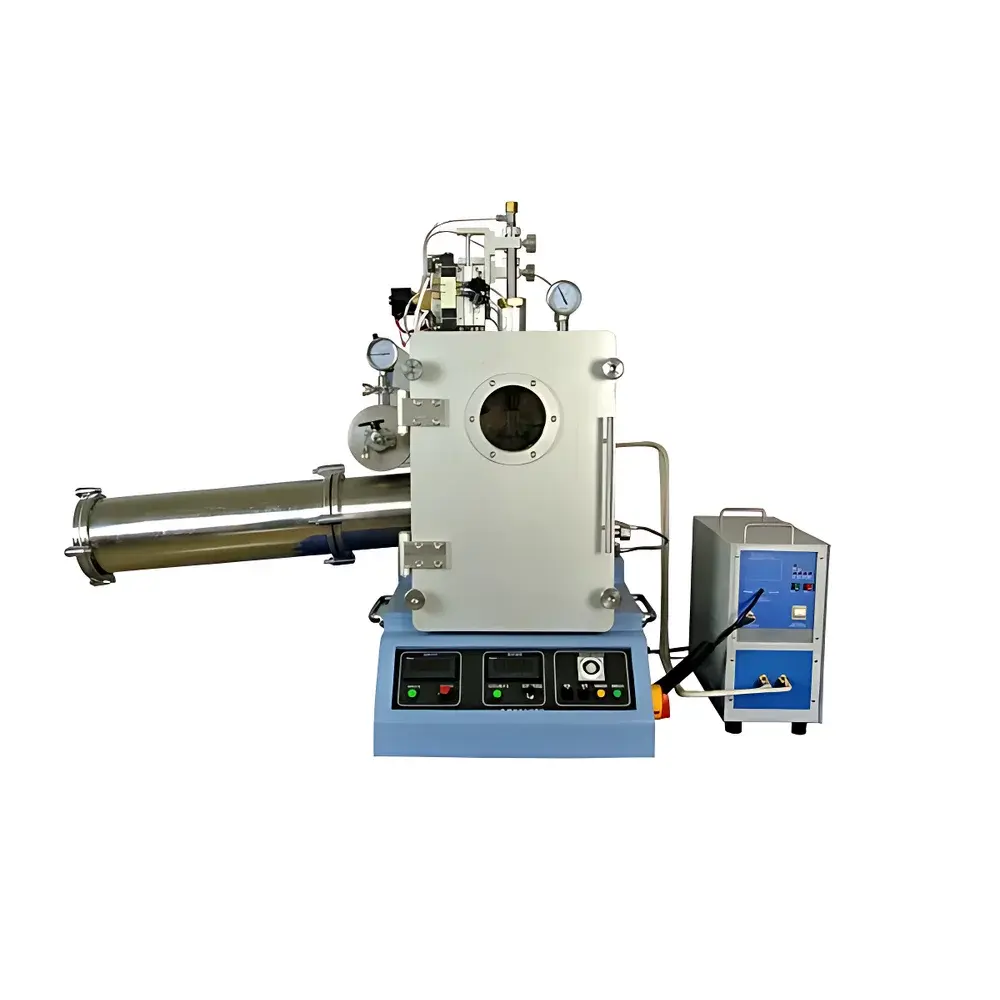
KJ GROUP VTC-200S Desktop Vacuum Melt-Spinning Furnace
| Brand | KJ GROUP |
|---|---|
| Origin | Liaoning, China |
| Manufacturer Type | Authorized Distributor |
| Origin Category | Domestic (China) |
| Model | VTC-200S |
| Pricing | Upon Request |
| Induction Power Options | 7 kW / 15 kW / 20 kW |
| Max. Melting Capacity | 20 g |
| Copper Roller Diameter | 200 mm |
| Max. Roller Speed | 3000 rpm (31 m/s linear velocity) |
| Vacuum Chamber Dimensions | 300 × 300 × 480 mm (W×D×H) |
| Base Vacuum (Mechanical Pump) | 5 × 10⁻² Torr |
| High Vacuum (Turbo-Molecular Pump) | 5 × 10⁻⁵ Torr |
| Observation Window | Ø120 mm quartz viewport with LED illumination |
| Nozzle Options | Ø1 mm round or 10 mm × 1 mm slit |
| Max. Ribbon Width | ≤10 mm |
| Max. Operating Temperature | 1800 °C |
| Pressure Control | PID-regulated pneumatic valve |
| Cooling Requirement | External water chiller (e.g., KJ-6200 recommended) |
Overview
The KJ GROUP VTC-200S Desktop Vacuum Melt-Spinning Furnace is an engineered solution for rapid solidification of metallic alloys via the melt-spinning technique. This process leverages electromagnetic induction heating to achieve precise, localized melting of small-volume metal charges (≤20 g), followed by controlled ejection of molten metal through a precision nozzle onto a high-speed rotating copper wheel. The resulting thermal gradient—exceeding 10⁶ K/s at the wheel interface—enables suppression of crystalline nucleation, yielding amorphous or nanocrystalline ribbons up to 10 mm wide. Designed for laboratory-scale development of metallic glasses, soft magnetic alloys (e.g., Fe-, Co-, Ni-based systems), and metastable intermetallics, the VTC-200S operates within a fully sealed stainless-steel vacuum chamber capable of base pressures down to 5 × 10⁻² Torr (mechanical pumping) and ultra-high vacuum conditions of 5 × 10⁻⁵ Torr (with optional turbo-molecular pump). The system supports inert gas backfilling (Ar, He) to eliminate oxidation and moisture contamination during casting and quenching—critical for reproducible ribbon morphology and phase stability.
Key Features
- Modular induction power architecture: Selectable 7 kW (single-phase, 30–80 kHz), 15 kW (three-phase, 30–80 kHz), or 20 kW (three-phase, 80–200 kHz) RF sources—optimized for materials with melting points ranging from 600 °C (e.g., Zn-Al alloys) to >1800 °C (e.g., Mo-Si-B systems).
- Precision-controlled copper roller: Ø200 mm × 40 mm solid copper drum with 0–3000 rpm variable speed (0–31 m/s surface velocity), enabling fine-tuning of cooling rate and ribbon thickness (typically 20–50 µm).
- Integrated vacuum & gas handling: Dual-stage pumping system with mechanical rotary vane pump and optional turbo-molecular pump; PID-regulated pneumatic pressure valve for repeatable melt ejection control (0.01–0.5 MPa range); solenoid valves for automated vacuum isolation and gas purging.
- Real-time process monitoring: Ø120 mm quartz viewport with integrated LED lighting permits direct optical observation of melt ejection, jet stability, and ribbon formation without breaking vacuum.
- Compact footprint: Total system dimensions of 1240 L × 680 W × 1050 H mm allow installation on standard lab benches—ideal for university research labs, R&D centers, and pilot-scale metallurgy facilities.
Sample Compatibility & Compliance
The VTC-200S accommodates a broad spectrum of conductive metallic feedstocks—including pure elements (Fe, Ni, Co, Cu, Al, Mg), binary and ternary alloys (e.g., Fe80B20, Co66Fe4Si15B15, Zr55Cu30Al10Ni5), and refractory compositions—provided mass remains ≤20 g and crucible compatibility is maintained. Standard quartz crucibles include both Ø1 mm round and 10 mm × 1 mm rectangular nozzles; boron nitride (BN) crucibles are available as an option for highly reactive melts (e.g., Ti-, Zr-, or rare-earth-containing systems). The system conforms to general laboratory safety standards for vacuum equipment (ISO 27467-1:2020) and electromagnetic compatibility (IEC 61000-6-3). While not certified for GMP production, its programmable parameter logging and manual intervention safeguards support GLP-compliant experimental documentation.
Software & Data Management
Operation is managed via an intuitive front-panel touchscreen HMI with dedicated controls for roller RPM, induction power (% of max), vacuum status, gas inlet pressure, and ejection timing. All setpoints and real-time sensor feedback—including thermocouple-measured crucible temperature (optional Type C or B thermocouple integration), chamber pressure (capacitance manometer), and roller encoder output—are logged internally with timestamping. Export is supported via USB to CSV format for post-processing in MATLAB, Python (pandas), or Excel. Though no proprietary software suite is bundled, the system’s analog/digital I/O ports (0–10 V, RS485 Modbus RTU) permit integration into centralized lab automation platforms compliant with IEEE 1851-2019 instrumentation protocols.
Applications
- Development of amorphous soft magnetic ribbons for high-frequency transformers and inductors (ASTM A932/A932M).
- Rapid screening of glass-forming ability (GFA) in bulk metallic glass precursors.
- Preparation of nanocrystalline templates for subsequent annealing studies (e.g., α-Fe(Si) precipitation in FINEMET-type alloys).
- Investigation of solidification kinetics under extreme cooling rates (>10⁶ K/s), relevant to additive manufacturing melt pool modeling.
- Small-batch synthesis of metastable phases inaccessible via conventional casting—e.g., Fe-based quasicrystals or Laves-phase supersaturated solid solutions.
FAQ
What is the maximum recommended sample mass for consistent ribbon formation?
20 g is the upper practical limit. Exceeding this may cause inconsistent melt ejection, nozzle clogging, or thermal overload of the induction coil—especially with high-thermal-conductivity metals like Cu or Al.
Can the system be used for reactive metals such as titanium or zirconium?
Yes—with BN crucibles (optional) and high-purity argon or helium backfilling (<1 ppm O₂/H₂O), provided vacuum integrity is verified prior to heating and the chamber is pre-baked if residual moisture is suspected.
Is water cooling mandatory for the induction power supply?
Yes. All three power options require closed-loop deionized water cooling (recommended flow ≥12 L/min, ΔT ≤5 °C). The KJ-6200 chiller is specified for thermal stability and corrosion resistance.
How is temperature measured during operation?
A Type C (W5%Re–W26%Re) or Type B (Pt30%Rh–Pt6%Rh) thermocouple can be inserted directly into the crucible base or sidewall—calibrated against known fixed points (e.g., Ag, Au melting points) per ASTM E230/E230M.
Does the system support automated sequence programming (e.g., ramp-hold-cool cycles)?
No native scripting capability exists; however, external PLC or LabVIEW control via RS485/Modbus enables full sequence automation—including synchronized ramping of power, roller speed, and gas pressure—meeting ISO/IEC 17025 traceability requirements when configured with audit-trail logging.



