
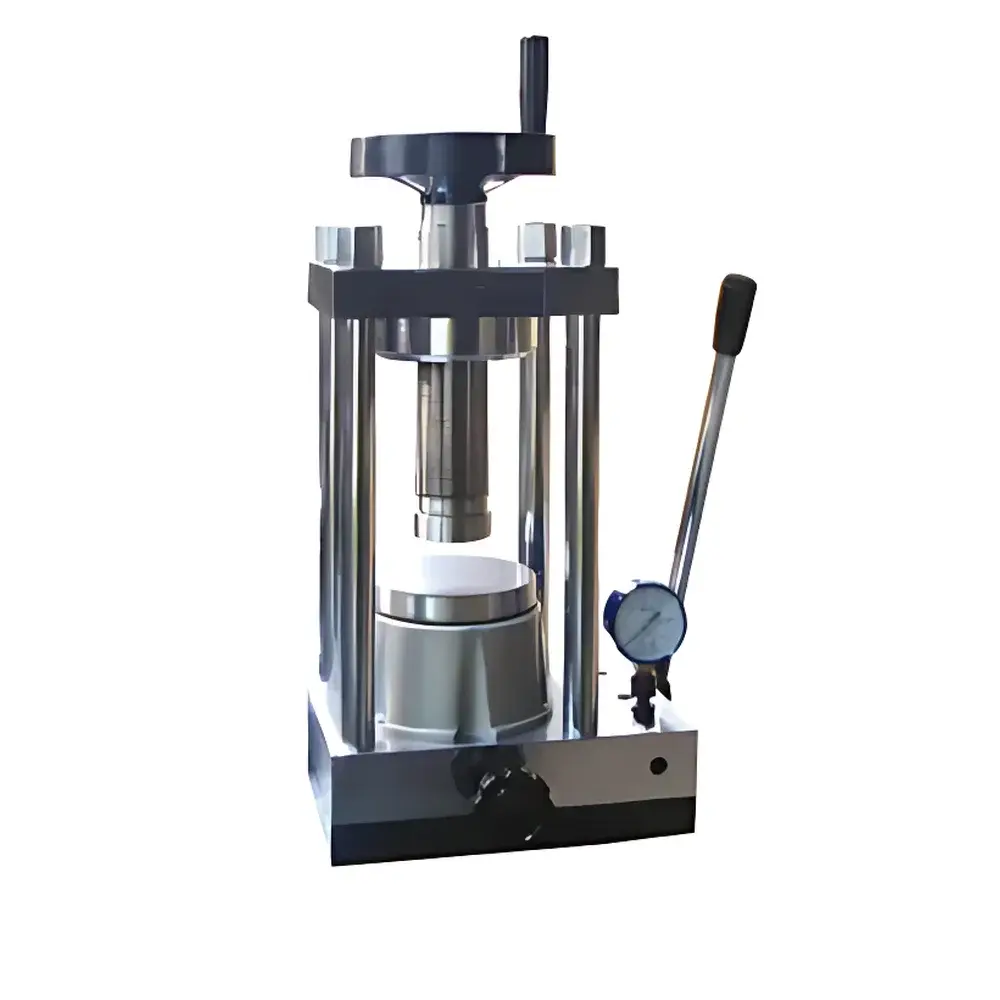
KJ GROUP YLJ-30T Manual Hydraulic Pellet Press
| Brand | KJ GROUP |
|---|---|
| Origin | Liaoning, China |
| Manufacturer Type | Authorized Distributor |
| Country of Origin | China |
| Model | YLJ-30T |
| Instrument Type | Manual Hydraulic Pellet Press |
| Maximum Working Pressure | 30 tons (300 kN) |
| Maximum System Pressure | 30 MPa (300 kgf/cm²) |
| Piston Diameter | Ø105 mm |
| Maximum Piston Stroke | 20 mm |
| Pressure Stability | ≤1 MPa / 10 min |
| Preloading Mode | Rapid manual pre-compression |
| Working Chamber Dimensions | 140 × 120 × 150 mm |
| Overall Dimensions | 325 × 230 × 550 mm |
| Net Weight | 50 kg |
Overview
The KJ GROUP YLJ-30T Manual Hydraulic Pellet Press is a precision-engineered laboratory press designed for reproducible sample consolidation under controlled uniaxial compressive force. It operates on a manually actuated hydraulic principle: user-applied force via a lever-driven plunger activates a dual-stage hydraulic system—first rapid pre-compression, then fine-pressure buildup—to deliver stable, calibrated pressure to the sample within a rigid die cavity. With a rated maximum capacity of 30 tons (300 kN) and a system pressure limit of 30 MPa, the press enables high-density pellet formation for analytical and materials research applications where consistency, traceability, and mechanical integrity are critical. Its compact footprint (325 × 230 × 550 mm), robust cast-iron frame, and sealed hydraulic circuit ensure long-term dimensional stability and minimal maintenance in regulated lab environments.
Key Features
- Manual hydraulic operation with rapid pre-compression lever mechanism for efficient initial sample densification and precise final pressure control
- High-strength steel frame and hardened piston assembly (Ø105 mm diameter) engineered for uniform load distribution and minimal elastic deformation
- Pressure stability ≤1 MPa over 10 minutes—validated per ISO 7500-1 Class 1 requirements for static force measurement systems
- Adjustable working chamber (140 × 120 × 150 mm) accommodating standard and custom dies for discs, cylinders, annuli, and multi-layer compacts
- Integrated analog pressure gauge with dual-range calibration (0–10 MPa and 0–30 MPa) compliant with EN 837-1 for industrial pressure instrumentation
- Self-contained hydraulic circuit using ISO VG 46 mineral oil—compatible with GLP/GMP solvent-handling protocols and non-reactive with common ceramic, oxide, and battery electrode powders
Sample Compatibility & Compliance
The YLJ-30T supports broad material classes including but not limited to lithium-ion cathode/anode powders (LiCoO₂, NMC, graphite), ceramic precursors (Al₂O₃, ZrO₂, SiC), catalyst supports (γ-Al₂O₃, zeolites), geological standards (USGS rock powders), and pharmaceutical excipients. Die sets (sold separately) conform to ASTM E1779 and ISO 13320 specifications for pressed pellet geometry used in XRF, FTIR, and XRD analysis. The press itself meets CE machinery directive 2006/42/EC essential health and safety requirements and is documented for traceable use in ISO/IEC 17025-accredited laboratories performing method validation per ASTM D6988 (for powder compaction density) and USP (for pharmaceutical tabletting simulation).
Software & Data Management
As a fully manual instrument, the YLJ-30T does not incorporate embedded electronics or digital control interfaces. However, it is explicitly designed for integration into auditable workflows: pressure application time, peak pressure reading, and die ID are recorded manually in laboratory notebooks or LIMS-compatible electronic logbooks. The analog pressure gauge includes a locking needle feature for post-compression verification—supporting 21 CFR Part 11-compliant audit trails when paired with validated paper-based or hybrid documentation systems. Calibration certificates (traceable to NIM China or NIST SRM equivalents) are provided with each unit and recommended annually per ISO/IEC 17025 clause 6.5.2.
Applications
- Preparation of homogeneous, binder-free pellets for quantitative X-ray fluorescence (XRF) analysis—ensuring matrix-matched calibration and minimizing particle-size bias
- Compaction of infrared-transparent KBr or polyethylene pellets for FTIR transmission spectroscopy of catalysts and polymers
- Forming high-density sintering preforms for solid-state battery electrolyte testing (e.g., LLZO, LATP) under inert atmosphere glovebox integration
- Controlled cold-pressing of metal oxide powders prior to sintering studies (dilatometry, TGA-MS coupling)
- Reproducible tablet fabrication for dissolution rate screening in early-phase pharmaceutical development
- Standard reference material (SRM) pelletization per ASTM D7348 for coal ash analysis and cement clinker characterization
FAQ
What is the recommended hydraulic fluid for the YLJ-30T?
ISO VG 46 anti-wear mineral oil is specified; brake fluid, water-glycol, or phosphate ester fluids must not be used due to seal incompatibility and risk of hydraulic failure.
Can the press be used inside a nitrogen-filled glovebox?
Yes—the unit contains no electronics or outgassing elastomers; all external surfaces are stainless steel or powder-coated carbon steel compatible with inert atmospheres.
Is pressure calibration required before first use?
Yes—a break-in procedure (3 cycles at 20–25 MPa followed by full-system bleed) is mandatory to eliminate air entrapment and stabilize hydraulic response per manufacturer’s technical bulletin TB-YLJ-30T-01.
How often should the hydraulic oil be replaced?
Every 12 months or after 500 operating cycles, whichever occurs first; oil analysis (ASTM D92, D97, D2440) is advised if used with hygroscopic samples.
Does the YLJ-30T support automated data logging?
No—it is a purely mechanical-hydraulic device; however, its analog gauge output can be interfaced with third-party digital pressure transducers (e.g., Honeywell PX3AN) for optional PC-based acquisition under validated configurations.
Related Products



