
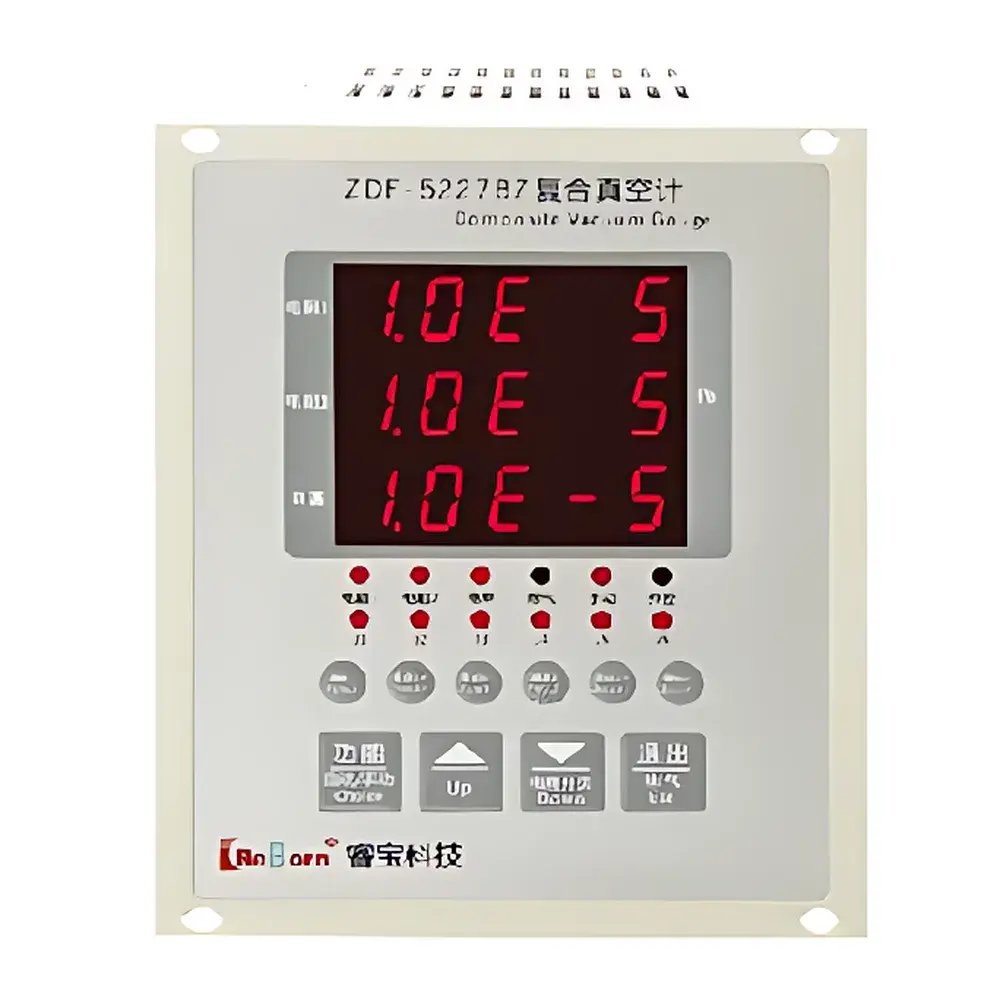
KJ GROUP ZDF-5227BZ Combined Vacuum Gauge
| Brand | KJ GROUP |
|---|---|
| Origin | Liaoning, China |
| Manufacturer Type | Authorized Distributor |
| Country of Origin | China |
| Model | ZDF-5227BZ |
| Pricing | Upon Request |
| Measurement Principle | Dual Pirani (ZJ-52T) + Hot Cathode Ionization (ZJ-27) |
| Range | 1.0×10⁵ to 1×10⁻⁵ Pa (effective: 3×10³ to 1×10⁻⁵ Pa) |
| Display | Triple 5-digit LED (scientific notation) |
| Control Outputs | 4 relay channels (expandable to 6) |
| Analog Output | 0–5 V (optional) |
| Communication | RS-232 / RS-485 (optional) |
| Power Supply | AC 85–265 V, 50/60 Hz, 15 W |
| Dimensions (H×W) | 129 mm × 107 mm |
| Cutout | 110 mm × 104 mm |
| Weight | ~1.5 kg |
| 规管 Compatibility | ZJ-52T (glass/metal/DN16–35 CF/DN10–40 KF) & ZJ-27 (glass/metal/DN16–35 CF/DN10–40 KF) |
| Gas Dependency | Pirani channels calibrated for N₂/air |
Overview
The KJ GROUP ZDF-5227BZ Combined Vacuum Gauge is an integrated, microprocessor-controlled vacuum measurement instrument engineered for broad-range, high-reliability pressure monitoring in vacuum systems spanning rough to high vacuum regimes. It implements a hybrid sensing architecture comprising two independent Pirani thermal conductivity sensors (ZJ-52T series) and one hot cathode ionization gauge (ZJ-27 series), enabling continuous, gap-free coverage from atmospheric pressure (1.0×10⁵ Pa) down to 1×10⁻⁵ Pa. The dual-Pirani configuration allows differential or redundant measurement strategies—Pirani Channel 1 operates independently for primary rough-vacuum monitoring, while Pirani Channel 2 is electronically coupled with the ionization sensor to enable seamless range handover and cross-validated readings in the transition zone (~10⁻¹ to 10⁻³ Pa). This architecture mitigates inherent limitations of single-sensor gauges, including thermal drift in Pirani elements and filament burnout risk in ionization gauges during accidental atmospheric exposure. The instrument’s firmware employs real-time temperature compensation, automatic zeroing routines, and adaptive gain switching to maintain measurement integrity across ambient fluctuations and long-term operation.
Key Features
- Triple-channel digital display with three independent 5-digit LED windows—each showing real-time pressure in scientific notation (e.g., 2.4E−3 = 2.4×10⁻³ Pa)
- Intelligent range-switching logic that automatically selects active sensor based on measured pressure, eliminating manual mode selection
- Four programmable relay outputs (expandable to six) supporting point-control and band-control modes with configurable hysteresis and delay timers
- Non-volatile memory retains user-defined setpoints, calibration offsets, and system parameters after power loss
- Modular front-panel menu navigation with intuitive icon-assisted prompts—no technical manual required for routine setup
- Compact 1U-form-factor chassis (129 mm H × 107 mm W) designed for panel-mount integration in vacuum chambers, gloveboxes, sputtering systems, and thin-film deposition equipment
- Comprehensive electrical isolation between sensor inputs, control relays, and communication interfaces to suppress ground-loop interference in industrial environments
Sample Compatibility & Compliance
The ZDF-5227BZ is compatible with standard vacuum flange interfaces including glass-sealed ZJ-52T and ZJ-27 gauge tubes, metal direct-insert variants, and industry-standard CF (DN10, DN16, DN25, DN35) and KF (DN10, DN16, DN25, DN40) configurations. Pirani channels are factory-calibrated for nitrogen and dry air; deviations occur with hydrogen, helium, or reactive gases—users requiring process gas-specific accuracy must apply certified correction factors per ISO 27893 or consult application-specific calibration data. The ionization channel exhibits minimal gas species dependence below 1×10⁻² Pa and remains stable under typical UHV-compatible bake-out conditions (≤150 °C). While not certified to IEC 61000-6-2/6-4 for EMC or UL 61010-1 for safety, the unit meets functional safety expectations for laboratory and pilot-scale vacuum systems operating within GLP-compliant environments. All relay outputs comply with IEC 60947-5-1 for industrial control applications.
Software & Data Management
The gauge supports optional RS-232 and RS-485 serial interfaces (Modbus RTU protocol) for integration into SCADA, PLC, or custom LabVIEW-based monitoring platforms. ASCII command sets allow remote readout of all three pressure values, status flags (e.g., filament on/off, overpressure alarm), and relay states. Analog output (0–5 V, scalable via software) provides continuous pressure tracking for analog chart recorders or legacy DCS systems. Firmware updates are performed via UART using vendor-provided utilities; no proprietary drivers are required. Audit trails—including timestamped control event logs and calibration history—are retained in non-volatile memory and exportable via serial query. While not FDA 21 CFR Part 11 compliant out-of-the-box, the device supports traceable operation when deployed with external electronic log systems meeting ALCOA+ principles.
Applications
- Process monitoring in physical vapor deposition (PVD), magnetron sputtering, and electron-beam evaporation systems
- Roughing and high-vacuum stage verification in semiconductor packaging and MEMS fabrication tools
- Leak detection support via pressure-rise rate analysis in sealed chamber qualification
- Quality assurance in vacuum heat treatment furnaces and freeze-dryer validation protocols
- Educational use in university physics labs for vacuum science demonstrations and student instrumentation projects
- Integration into custom-built vacuum test stands for aerospace component qualification per MIL-STD-810
FAQ
Can the ZDF-5227BZ measure hydrogen or argon accurately?
Pirani channels require gas-specific correction factors for non-N₂/air gases per ISO 27893 Annex B; the ionization channel remains reliable for H₂, Ar, and other permanent gases below 1×10⁻² Pa.
What happens if the ionization filament is exposed to atmosphere during venting?
The gauge includes automatic filament protection: ionization emission is disabled above 1×10⁻¹ Pa, and a soft-start ramp prevents thermal shock during reactivation.
Is analog output linear across the full pressure range?
No—the 0–5 V output maps logarithmically to pressure decade bands; users must configure scaling in host software per selected measurement range.
How often does the instrument require recalibration?
Annual verification against a NIST-traceable reference standard is recommended for GLP-critical applications; factory calibration stability exceeds ±5% of reading over 12 months under normal lab conditions.
Can I replace the ZJ-52T or ZJ-27 gauge tubes in the field?
Yes—both sensor types use standardized electrical connectors and mechanical mounting; replacement requires only basic torque tools and adherence to vacuum sealing protocols (e.g., proper O-ring lubrication and bolt sequence).



