
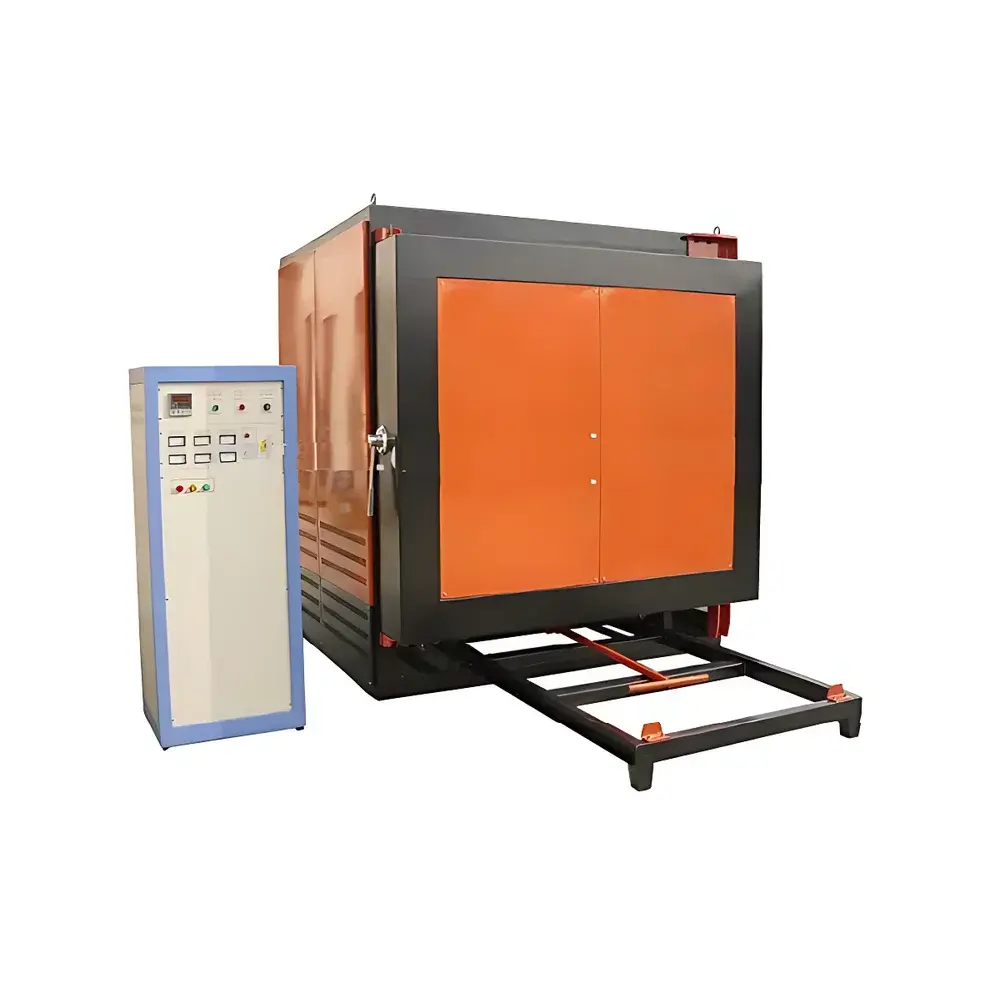
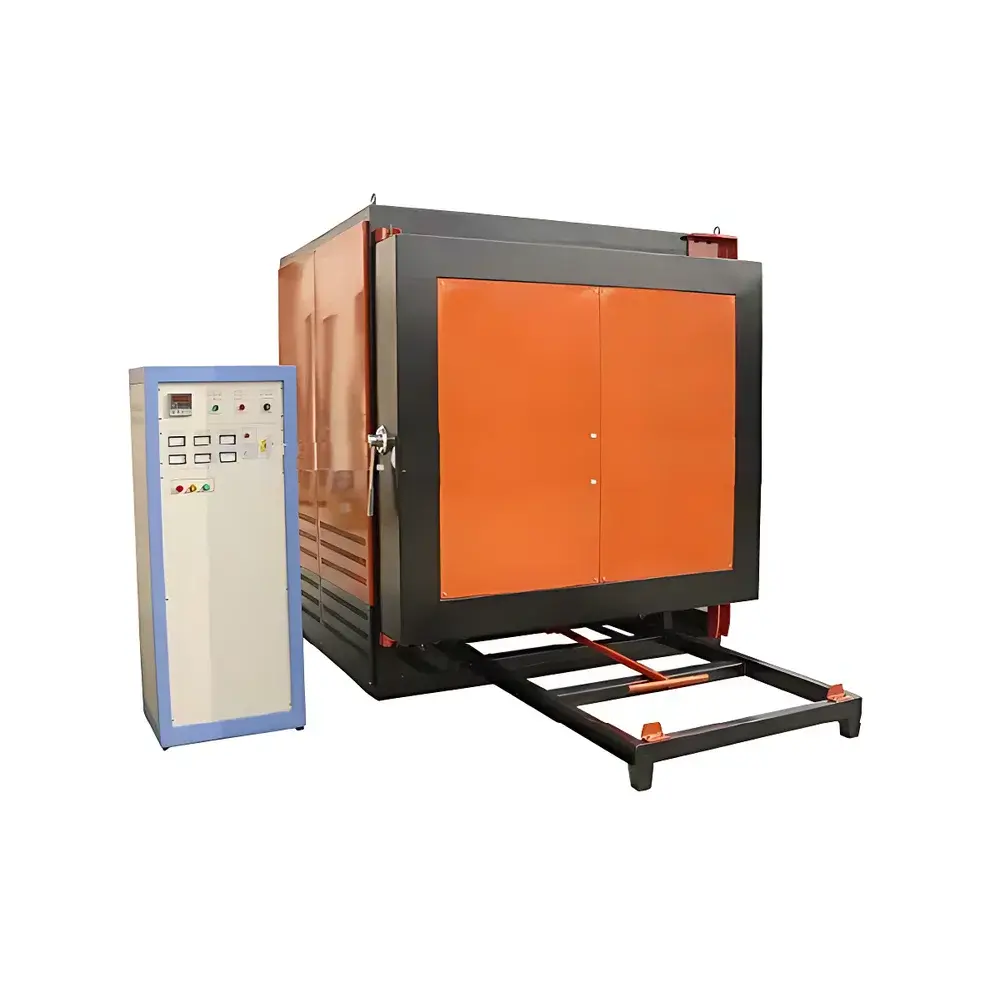
KJ GROUP ZWDL-900X Car Bottom High-Temperature Sintering Furnace
| Brand | KJ GROUP |
|---|---|
| Origin | Anhui, China |
| Manufacturer Type | Authorized Distributor |
| Country of Origin | China |
| Model | ZWDL-900X |
| Rated Voltage | AC 380 V, 50/60 Hz |
| Rated Power | 50 kW |
| Maximum Operating Temperature | 1350 °C |
| Recommended Heating Rate | ≤5 °C/min |
| Temperature Uniformity | ±1 °C (at 1280 °C, steady state) |
| Heating Element | Silicon Carbide Rods (Φ30 mm × 1200 mm + 350 mm, delta-connected) |
| Chamber Dimensions | 1300 mm × 1200 mm × 1200 mm (W×D×H) |
| External Dimensions (Furnace Body) | 2100 mm × 2100 mm × 2300 mm |
| Control Cabinet Dimensions | 640 mm × 550 mm × 1600 mm |
| Net Weight | ~350 kg |
| Cooling System | Integrated Closed-Loop Chiller (deionized water or purified water) |
| Atmosphere Requirement | Argon (≥99.99% purity), supplied via external cylinder with 6 mm double-ferrule compression fitting |
| Ambient Requirements | Altitude ≤1000 m |
| Electrical Supply | 3-phase AC 380 V, 63 A circuit breaker with dedicated grounding |
| Minimum Circuit Breaker Rating | 250 A |
| Workbench Requirement | ≥1500 mm × 600 mm × 700 mm, load capacity ≥200 kg |
| Ventilation | Local exhaust ventilation required for inert gas purge management |
Overview
The KJ GROUP ZWDL-900X Car Bottom High-Temperature Sintering Furnace is a robust, industrial-grade batch furnace engineered for precise thermal processing of advanced ceramics, refractory metals, and functional composites under controlled inert atmospheres. Designed as a split-type box furnace, it features a heavy-duty car-bottom loading mechanism that enables rapid, safe, and repeatable handling of large-volume or high-mass workpieces—ideal for R&D laboratories and pilot-scale production environments where throughput and thermal consistency are critical. The furnace operates on the principle of resistive heating via silicon carbide (SiC) elements mounted symmetrically on opposing side walls, generating a highly uniform thermal field within the insulated chamber. Its vacuum-formed, high-purity alumina fiber lining (Al2O3 ≥99.5%) ensures low thermal mass, excellent insulation performance, and long-term structural stability at sustained temperatures up to 1350 °C. Temperature measurement and regulation rely on a calibrated Type S (Platinum–Rhodium 10%–Platinum) thermocouple, selected for its exceptional stability, low drift, and traceable calibration over extended service life—meeting fundamental requirements for ISO/IEC 17025-compliant thermal validation protocols.
Key Features
- Car-bottom configuration with reinforced steel rail system for seamless insertion and extraction of heavy loads (up to 200 kg).
- Dual-wall construction with multi-layered high-purity alumina fiber insulation (density: 220–240 kg/m³), minimizing heat loss and enabling rapid cooldown cycles.
- Symmetrically arranged SiC heating elements (Φ30 mm, L = 1200 mm + 350 mm) wired in delta configuration for balanced power distribution and minimized thermal gradient across the 1.3 m × 1.2 m × 1.2 m hot zone.
- Integrated closed-loop chiller unit (pre-filled with deionized water) for active cooling of furnace shell, electrical connections, and thermocouple feedthroughs—ensuring operational safety and component longevity.
- Dedicated inert gas manifold with pressure-regulated argon inlet (99.99% purity minimum), compatible with standard 6 mm double-ferrule compression fittings and equipped with flow meter and purge cycle timer.
- Industrial-grade control panel featuring programmable PID temperature controller, main power switch, heater ON/OFF toggle, emergency stop button (EN 418 compliant), and real-time status indicators (power, heater, alarm).
Sample Compatibility & Compliance
The ZWDL-900X accommodates diverse sample geometries—including green ceramic compacts, sintered metal preforms, graphite crucibles, and composite substrates—within its spacious, rectangular chamber. Its inert-atmosphere capability supports oxygen-sensitive processes such as solid-state reaction synthesis, densification of TiC/TiN-based cermets, and annealing of oxide superconductors. The furnace meets foundational mechanical and electrical safety standards per IEC 61000-6-2 (immunity) and IEC 61000-6-4 (emissions). While not certified to UL or CE as a complete system, its subsystems—including the chiller, thermocouple wiring, and contactor assembly—are built to UL 508A and RoHS 2011/65/EU specifications. For GLP/GMP environments, optional data logging (via RS485 Modbus RTU) supports audit-ready temperature profiles aligned with FDA 21 CFR Part 11 requirements when paired with validated software.
Software & Data Management
The furnace’s intelligent temperature controller supports up to 30 programmable ramp-hold segments with user-defined rate limits (0.1–20 °C/min), soak times (0–9999 min), and over-temperature cut-off thresholds. Real-time process data—including setpoint, measured temperature, heater voltage/current, and alarm status—is accessible via front-panel LCD or exported via RS485 serial interface using standard Modbus RTU protocol. Integration with LabVIEW™, MATLAB®, or SCADA platforms enables automated recipe execution, remote monitoring, and synchronized acquisition with external instrumentation (e.g., dilatometers or mass spectrometers). Optional USB data logger firmware provides time-stamped CSV export for traceability in quality documentation systems.
Applications
- Sintering of silicon carbide (SiC), aluminum nitride (AlN), and zirconia (ZrO₂) ceramics under argon atmosphere.
- Heat treatment of tungsten, molybdenum, and niobium alloys requiring oxygen-free conditions.
- Graphitization and high-temperature annealing of carbon-based composites and C/C materials.
- Thermal stabilization of battery cathode precursors (e.g., NMC, LFP) prior to cell assembly.
- Calibration reference furnace applications where spatial temperature uniformity (±1 °C) and temporal stability (<0.5 °C/h drift) are verified per ASTM E220.
FAQ
What is the recommended maintenance interval for the silicon carbide heating elements?
Silicon carbide rods should be inspected visually every 200 operating hours for cracking or surface degradation; typical service life exceeds 1500 h at 1280 °C with proper atmosphere control and gradual thermal cycling.
Can the furnace be operated under vacuum instead of argon?
No—the ZWDL-900X is not vacuum-rated; its sealing design and insulation structure are optimized for positive-pressure inert gas purging only.
Is third-party temperature uniformity mapping available?
Yes—KJ GROUP partners with ISO/IEC 17025-accredited calibration labs to perform 9- or 16-point uniformity surveys per AMS 2750E Zone Certification requirements.
Does the control system support recipe import/export via USB?
The standard controller does not include USB port; however, optional upgrade kits with USB-C interface and proprietary PC software enable full recipe backup and version-controlled deployment.
What grounding requirements apply to ensure electromagnetic compatibility?
A dedicated copper grounding rod (≤5 Ω resistance to earth) connected directly to the furnace chassis and control cabinet is mandatory—shared building grounds may induce noise in thermocouple signals and compromise PID stability.



